
The Hidden Lever: How Algorithmic Tuning Shapes Public Opinion
Opinion Dynamics in Social Networks: The Effect of Centralized Interaction Tuning on Emerging Behaviors
This paper introduces a stochastic multiagent model based on interacting Markov chains to study opinion dynamics in social networks. It specifically analyzes how centralized interaction tuning—modeled as an "interaction intensity" parameter—influences collective emerging behaviors like consensus, polarization, and community cleavage.
TL;DR
Is the "neutrality" of social media algorithms a myth? This paper by Bolzern et al. demonstrates that simply by turning a "volume knob" on how much users interact—without ever filtering for specific political content—platforms can trigger community fragmentation, flip social power balances, and force consensus or polarization.
Background Positioning: This work bridges the gap between Control Theory and Social Sociology, evolving classical deterministic models (like the Taylor or Friedkin-Johnsen models) into a robust Stochastic Markovian framework.
The Problem: The Invisible Hand of the "Interaction Knob"
Most people worry about "shadow banning" or "biased fact-checking." However, the authors argue that a much more subtle form of manipulation exists: Centralized Interaction Tuning. By adjusting the parameter (interaction intensity), a platform manager decides the "diet" of social influence each user receives.
The core challenge is understanding how these seemingly neutral adjustments interact with individual influenceability and network topology to create emergent collective behaviors that no single user intended.
Methodology: The Markovian Architecture of Opinion
The paper departs from deterministic "real-valued" opinions. Instead, each agent is a Markov Chain where states represent discrete opinions (e.g., Left, Center, Right).
The Core Mechanism
The probability of an agent switching opinions is governed by:
- Intrinsic Rate (): Their personal tendency to change mind.
- Social Correction: A factor proportional to the weighted opinions of their neighbors, scaled by the platform's Interaction Intensity () and the user's Influenceability ().

The authors mathematically prove that this stochastic model "contains" the classical Taylor model as a special case, making it a more generalized tool for analyzing social networks.
Emerging Behaviors: From Chaos to Cleavage
One of the most striking findings is how the same network can exhibit wildly different behaviors just by sliding the scale:
- Consensus: High interaction intensity () eventually forces the entire network into a probabilistic consensus, effectively "averaging" everyone's influence.
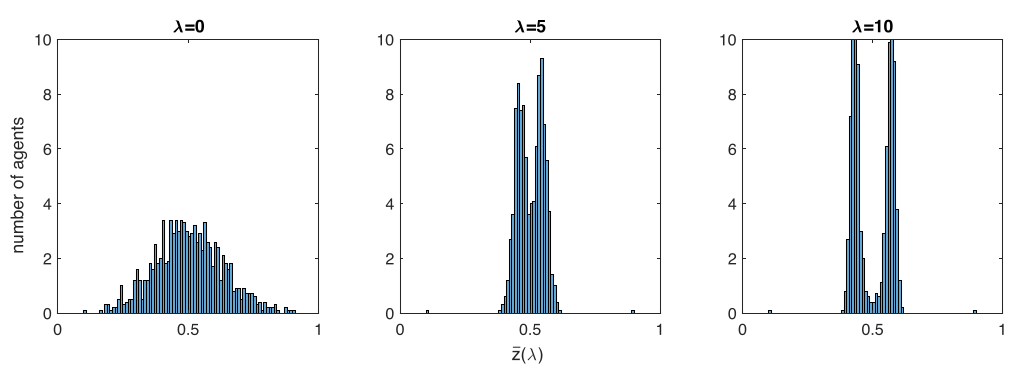
- Community Cleavage: If a platform identifies "stubborn-center" users (those whose influenceability drops when they hold moderate views), increasing global interaction actually splits the community into two warring poles.
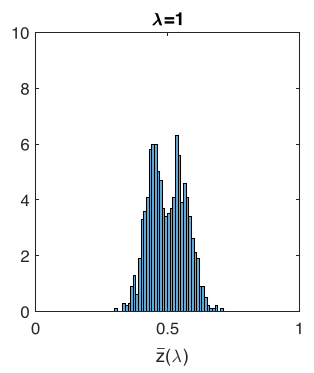 In the figure above, increasing transforms a peaceful Gaussian distribution (top left) into a fractured, bimodal society (bottom right).
Social Power: Why Topology Matters
The authors introduce Stochastic Social Power, a metric that calculates how much an individual's (or faction's) initial bias contributes to the final average opinion of the entire network.
Sectarianism vs. Integration
In a "Conflict of Factions" scenario, the paper asks: Should a group isolate itself (Sectarianism) or merge with the community (Integration) to gain power?
- The Result: If a majority faction isolates itself but maintains a "hub" to influence others, its social power grows quadratically relative to its size as interaction intensity increases.
- The "Neutral" Trap: An unbiased platform manager could inadvertently help a smaller, more stubborn faction gain dominance over a larger, more influenceable one simply by increasing the "loudness" of the network.
Deep Insight & Conclusion
This paper serves as a warning for the algorithmic age. It proves that Neutrality is Not Enough. A platform does not need to be "biased" toward a specific ideology to disrupt the democratic balance; it only needs to tune the rate and structure of interaction.
Takeaway for Researchers: The transition from deterministic to Markovian agents allows for a much more nuanced view of "volatility" and "stubbornness" in social groups. Future work in AI safety and social policy must account for these non-monotonic effects of interaction filtering.
Limitations: While the model is mathematically elegant, it assumes static network topologies. In the real world, "homophily" (the tendency to unfollow people we disagree with) means the graph G itself is often a function of the opinion , a dynamic that would add another layer of complexity to this already rich framework.