
Markovian Agents: Decoding the Mathematics of Social Influence and Sectarianism
Opinion Dynamics in Social Networks with Heterogeneous Markovian Agents
This paper introduces a stochastic framework for opinion dynamics in social networks using heterogeneous Markovian agents. The core method utilizes continuous-time Markov chains where transition rates are linearly modulated by a neighborhood influence parameter λ, achieving a tractable lower-dimensional representation of agent probability distributions.
TL;DR
Researchers have developed a new mathematical framework to model how opinions shift in social networks using Heterogeneous Markovian Agents. By "marginalizing" high-dimensional stochastic processes, they've created a way to predict collective behavior—showing exactly how platform algorithms (the influence parameter λ) and network structures (brokers vs. silos) determine which opinions win.
The "Curse of Dimensionality" in Social Modeling
Most classic models treat opinions as simple numbers that average out over time. But humans are non-deterministic; we jump between discrete states. While Markov Chains are perfect for modeling these jumps, a network of agents with opinions creates a state space of . For a small group of 100 people with 2 opinions, that's states—more than the number of atoms in the universe.
The authors' core insight is that we don't need to track the entire network state. By focusing on the marginal probability of each individual, they collapsed an untractable problem into a manageable system of linear differential equations.
Methodology: The Linear Emulative Model
The model assumes each agent has an internal "opinion matrix" . However, this matrix isn't static. It is modified by the agent's neighbors:
Where the transition rate to a new opinion increases proportionally to the fraction of neighbors already holding that opinion, scaled by an influence factor .
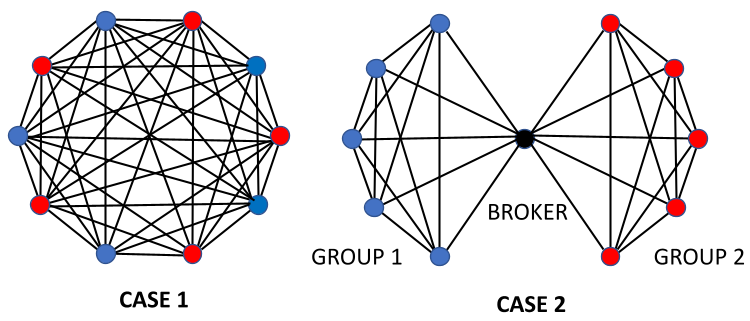 Fig 2: Comparison of fully mixed subgroups (Left) vs. groups connected via a broker/hub (Right).
Key Insight: The Power of the Stubborn Minority
One of the most striking results involves a "Majority" group (80 people, preferring Opinion 1) and a "Stubborn Minority" (20 people, strongly preferring Opinion 2).
- In a Complete Graph: As the influence increases, the majority's dominance actually decreases because they are constantly exposed to the stubborn minority.
- In a Broker Scenario: When the groups only talk through a neutral "hub," the majority retains much more power.
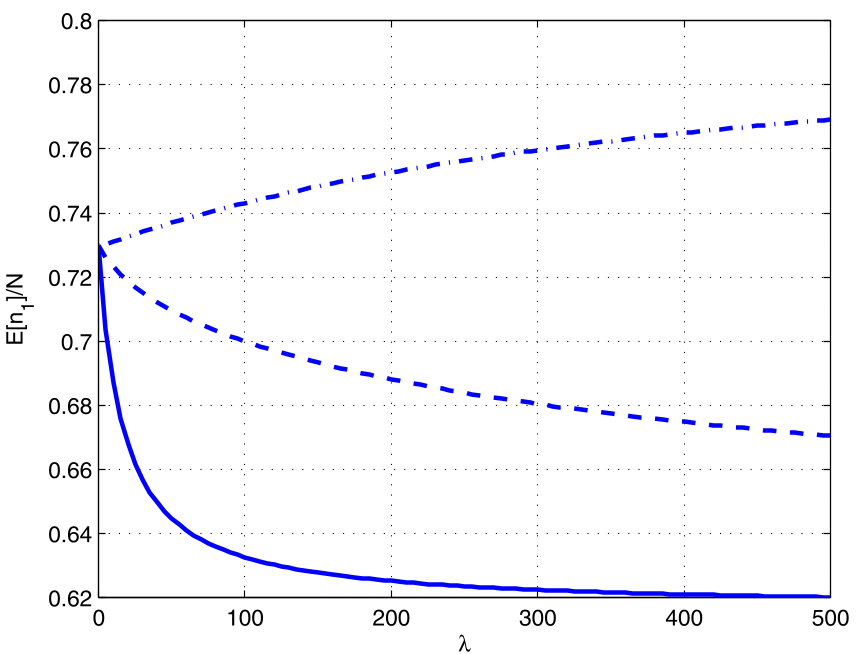 Fig 1: The expected fraction of the majority opinion drops significantly in fully mixed networks (solid line) compared to broker-mediated networks (dash-dot line).
Sectarianism vs. Integration
The paper concludes with a provocative analysis of Social Power. It defines which groups "bend" the consensus toward their own internal bias.
The math suggests a "Premium to Sectarianism." In certain topologies, a group increases its social power by remaining insular and only interacting through specific channels (like a hub) rather than fully integrating. This effectively mathematicalizes the logic behind "echo chambers": if you are a majority, integration might actually dilute your influence if the minority is more "stubborn" (has a more rigid matrix).
Critical Analysis & Future Outlook
This work is a significant step toward making stochastic social models practical for large-scale simulations. However, it currently assumes unbiased influence (where is the same for all opinions). In the real world, "fake news" or highly emotional content might have a higher intrinsic .
Future Research Directions:
- Dynamic Topologies: How does the model change if agents can choose to "unfollow" those they disagree with?
- Strategic Brokers: If the hub agent has its own agenda (an asymmetric ), how effectively can it pivot the entire network?
This Markovian approach provides a rigorous foundation for platform designers to understand how their "filtering algorithms" (manipulating ) might be inadvertently promoting sectarianism over consensus.