
Beyond Convergence: How Leaders Drive Opinion Separation in Competitive Networks
Opinion separation in leader–follower coopetitive social networks
This paper investigates opinion separation in continuous-time leader-follower coopetitive social networks characterized by signed graphs. It proposes a model that integrates DeGroot's weighting rules with Jadbabaie's leader-follower mechanism to achieve bipartite consensus.
TL;DR
While most consensus research focuses on how a group reaches a single shared value, this paper explores Opinion Separation. By introducing a leader into a coopetitive network (one with both trust and distrust), the authors prove that a group can be steered into two stable, opposing camps—a phenomenon known as Bipartite Consensus.
Background: The Complexity of Social Distrust
In classical models like DeGroot, agents eventually agree on a weighted average. Real life is messier. We follow leaders, and we often have "enemies" or competitors whose opinions we deliberately move away from. This paper bridges the gap between Leader-Follower dynamics and Signed Networks (where edges can be negative).
Methodology: The Math of Polarized Influence
The authors define the dynamics of a follower as influenced by two components:
- Peer Interaction: Standard cooperative/competitive weights with neighbors.
- Leader Influence: A reflected weight mechanism where a follower might trust () or distrust () the leader.
The Core Mechanism: Structural Balance
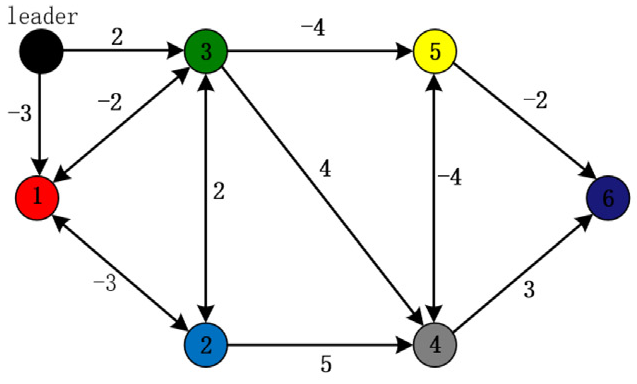
The "magic" happens when the network is structurally balanced. This means the agents can be split into two sets, and , where:
- Friends of friends are friends.
- Enemies of enemies are friends.
- Friends of enemies are enemies.
 In the figure above, the structural balance allows the system to split into two distinct opinion poles.
Key Results: Stationary vs. Dynamic Leaders
The paper differentiates between two scenarios:
1. The Stationary Leader
When the leader's opinion is fixed (), the group reaches bipartite consensus if and only if the graph contains a spanning tree with the leader as the root. Every follower eventually adopts either the leader's opinion or the exact negative of it.
2. The Dynamic Leader
If the leader acts as a moving target (), followers don't just converge to the value; instead, they maintain a constant velocity and a fixed "opinion distance" from the leader.
 Simulation results showing agents splitting into two symmetric groups (A and B) tracking the leader at the center or the mirror opposite.
Deep Insight: Why Does This Matter?
The most striking takeaway is the Power of the Root. Even in a network filled with "haters" (negative weights), as long as the leader is the root of the spanning tree and the network isn't "chaotic" (structurally unbalanced), the leader dictates the final polar values of the entire system.
Critical Analysis & Conclusion
This paper provides a rigorous mathematical framework for understanding polarization. However, it relies heavily on the assumption of Structural Balance. In real-world social media, networks are rarely perfectly balanced, which leads to "frustration" in the system where opinions may never settle.
Future Outlook: The next logical step is exploring Multi-Leader scenarios—what happens when two different leaders compete to pull the network toward their respective poles? That is where the battle for social influence truly begins.
Maintained by the Academic Tech Editor Editorial Team.