
Opinions Sandbox: Bridging the Gap Between Sentiment Analysis and Strategic Business Action
Opinions Sandbox: Turning Emotions on Topics into Actionable Analytics
The paper introduces "Opinions Sandbox," a decision-support framework that integrates LDA-based topic extraction with sentiment analysis to transform customer reviews into actionable business insights. It distinguishes itself by simulating the impact of rectifying service issues on overall sentiment and providing a cost-benefit optimization model for business interventions.
Executive Summary
TL;DR: Opinions Sandbox is a prototype framework that goes beyond simply telling a business "your customers are unhappy." By combining LDA-based topic clustering with a predictive simulation engine, it identifies specific service issues, simulates the positive sentiment impact of fixing them, and provides a cost-optimized roadmap for business improvements.
Positioning: While most sentiment analysis tools are descriptive (reporting the past), Opinions Sandbox is prescriptive (advising on the future). It sits at the intersection of Natural Language Processing (NLP) and Operations Research.
Problem & Motivation: Beyond the Sentiment Score
For years, businesses have used tools to track their "Star Rating" or "Net Promoter Score." However, a declining score often leaves managers with a "So what?" problem. Knowing that sentiment is "negative" provides little help if you don't know:
- Which specific aspect of the service (Price? Staff? Cleanliness?) is driving the negativity.
- How much it will cost to fix that specific aspect.
- How much the overall brand reputation will improve if that one fix is implemented.
The authors argue that current SOTA methods (like JST or Double-LDA) are excellent at extraction but ignore the economic reality of business interventions.
Methodology: The Core Engine
The Opinions Sandbox operates through a four-stage pipeline:
1. Topic Extraction & Sentiment Assessment
The system uses Latent Dirichlet Allocation (LDA) to partition a corpus of reviews (e.g., hotel reviews) into disjoint topics. Each comment is assigned a sentiment score based on a "bag-of-words" approach using the General Inquirer lexicon.
2. The "Sandbox" Simulation (Insight)
The true innovation lies here. To help a business owner visualize the "future," the system performs Opinion Injection. It simulates the scenario where a negative issue is resolved by injecting synthetic positive comments into the corpus. This allows the business owner to see a "Forecasted Sentiment" before spending a single dollar.
3. Cost-Benefit Optimization
The system treats each topic as a "Job" with an associated cost (supplied by the user). It then enumerates various combinations of jobs to find the Pareto frontier of sentiment improvement vs. expenditure.
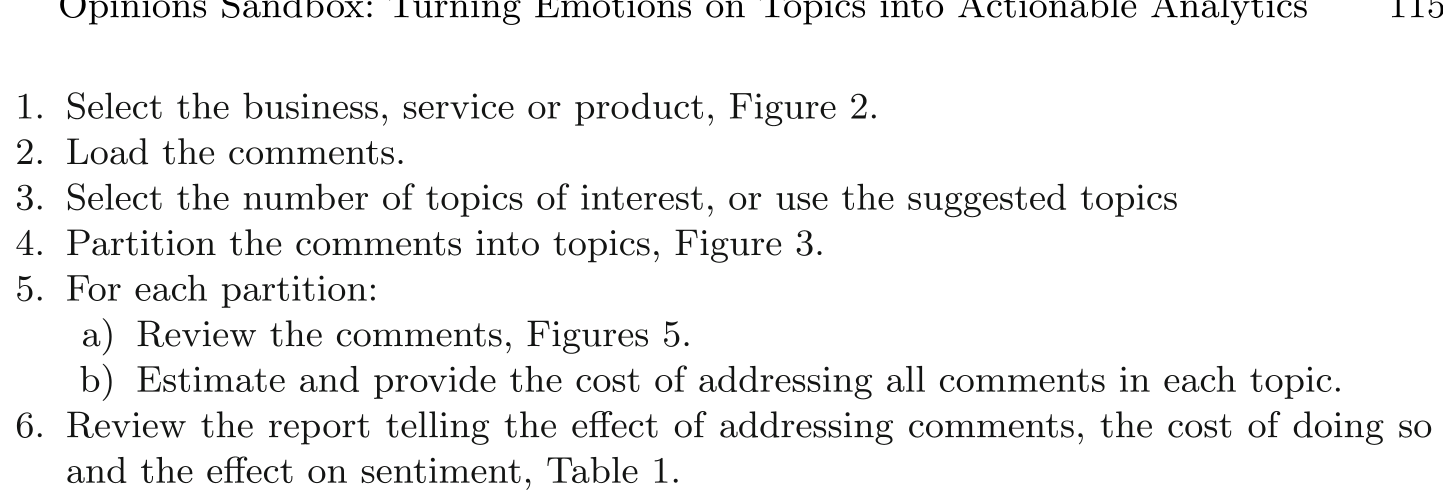 Figure 1: The operational workflow from raw comments to optimized recommendations.
Experiments & Results
The authors tested the framework using the Opinosis 1.0 Dataset (specifically hotel reviews).
Topic Breakdown
The LDA successfully identified key clusters such as "Staff," "Parking," and "Bathroom." For instance, "Topic 6" focused heavily on valet parking complaints, which were identified as high-priority negative drivers.
Strategic Trade-offs
The system generated a list of "Job Combinations." As shown in the data:
- Base Sentiment: 0.73 (Doing nothing, Cost 0).
- Budget Option: Addressing Topics 1, 2, and 3 raised sentiment to 0.86 for a cost of 1700.
- High-Quality Option: Addressing Topics 1, 2, 3, 4, and 7 raised sentiment to 0.93 for a cost of 3300.
- Total Overhaul: Achieving a perfect 1.00 sentiment required a cost of 5900.
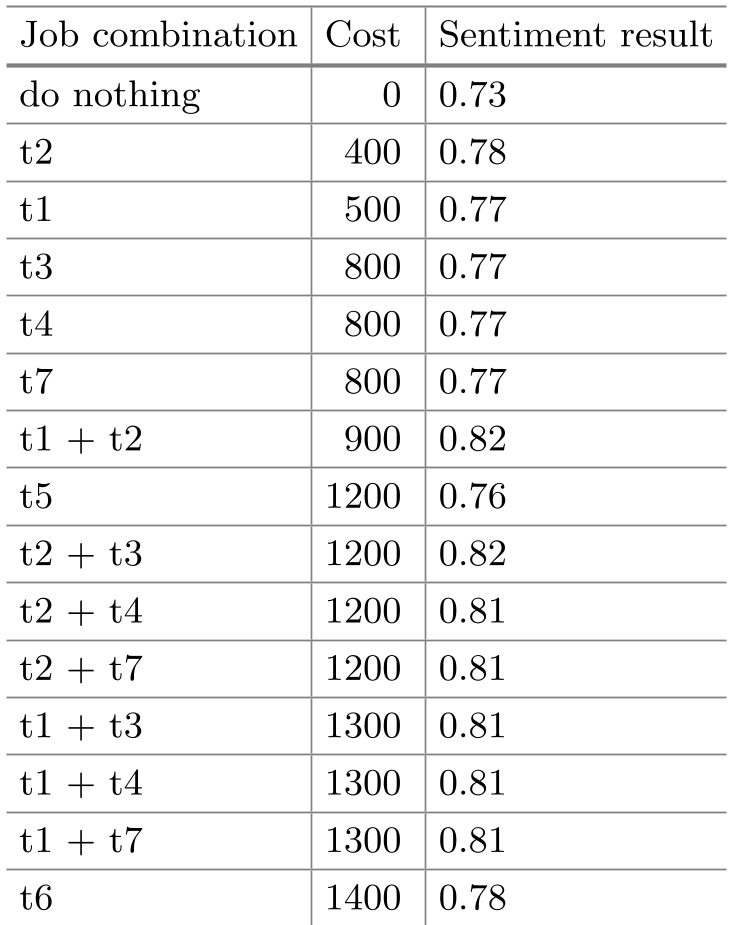 Figure 2: Cost vs. Sentiment result for various intervention strategies.
Critical Analysis & Conclusion
Takeaway
Opinions Sandbox transforms sentiment analysis from a "Report Card" into a Tactical Planning Tool. Its ability to simulate the effects of future actions—rather than just auditing the past—is a significant step toward making NLP truly "actionable" for the industry.
Limitations
- Manual Cost Estimation: The model relies on the business owner to provide accurate cost estimates for fixing issues (e.g., "how much does it cost to fix the bathroom?").
- Simple Sentiment Engine: The current implementation uses a basic bag-of-words approach, which may struggle with sarcasm or complex linguistic structures compared to modern Transformer-based models.
Future Outlook
With the rise of Large Language Models (LLMs), the "Comment Synthesis" and "Action Recommendation" parts of this framework could be exponentially improved, potentially automating the entire loop from reading a bad review to drafting a renovation plan.