
Resistance is NOT Futile: How Opposition Shapes Social Contagions
Effects of Opposition on the Diffusion of Complex Contagions in Social Networks: An Empirical Study
This study investigates the diffusion of complex contagions (threshold ) within Exponential Decay (ED) and Scale-Free (SF) social networks under the influence of opposing nodes ("failed nodes"). Using Synchronous Dynamical Systems (SyDS), the authors demonstrate how targeted opposition and network topology fundamentally alter cascade probabilities and propagation timelines.
TL;DR
Why do some social movements explode overnight while others fizzle out despite significant initial momentum? This paper explores the "complex contagion" model where individuals need multiple social cues to adopt a new behavior. By simulating opposition (nodes that refuse to change), the authors show that network structure—specifically the presence of high-degree hubs—determines whether a movement reaches a "cascade" or is effectively silenced by a strategic minority.
The Problem: The Complexity of Social Change
Most epidemiological models treat ideas like viruses: one "cough" (interaction) is enough to infect. This is a simple contagion. But real human behavior—switching political ideologies or joining a protest—involves risk. We usually require affirmation from multiple sources before committing. This is a complex contagion (threshold ).
The missing link in many models is opposition. In the real world, there are always "failed nodes"—individuals who are immune to the new idea and actively block its path. The authors set out to find how many opponents it takes to break a movement and how network topology (Scale-Free vs. Exponential Decay) changes the game.
Methodology: Simulating the Tug-of-War
The researchers used a Synchronous Dynamical Systems (SyDS) model.
- The Threshold: A node flips to state 1 only if neighbors are already in state 1.
- The Opposition: A fraction of nodes are permanently set to 0 (the "failed nodes").
- The Strategies: They compared Random Opposition (distributed uniformly) vs. Targeted Opposition (strategic resistance by the most connected hubs).
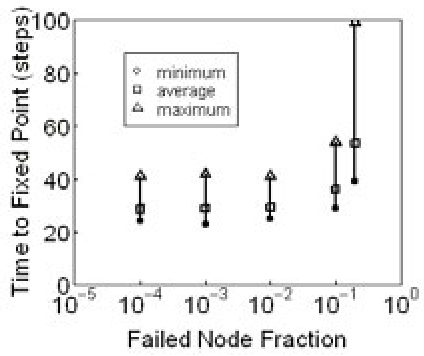 Figure: The interaction between average degree () and opposition (). Increasing connectivity significantly aids diffusion, but targeted opposition counteracts this gain.
Key Insights: Why Structure Matters
1. The Hub Effect
In Scale-Free (SF) networks (like Twitter, where a few people have millions of followers), if the hubs are on your side, the contagion spreads lightning-fast. However, if the opposition targets these hubs, they can kill a contagion almost instantly. In Exponential Decay (ED) networks, power is more distributed, making the system more resilient to targeted opposition but slower to reach a global cascade.
2. The "Critical Mass" Delusion
A vital contribution of this paper is the decoupling of Cascade Probability and Cascade Size.
- The Trap: A movement might have a low average spread size across many simulations.
- The Reality: This average is often binary. Either the movement fails entirely, or it hits a "tipping point" and converts nearly 90% of the network. Looking at "average spread" masks the fact that when it does happen, it happens at a massive scale.
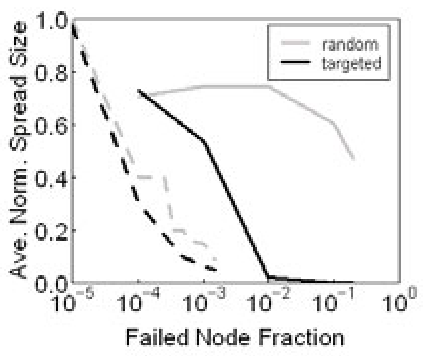 Figure: The "Phase Transition" of Cascades. Note the sharp vertical rise, indicating a binary "all-or-nothing" behavior typical of ratcheted systems.
3. The Time Factor
The "time to speed up" can vary by a factor of 10. A contagion might linger at a very low level for a long time, leading opponents to believe they have won, only to explode once it hits a specific local cluster.
Critical Analysis & Takeaways
The study highlights that connectivity is a double-edged sword. While higher engagement () makes it easier for ideas to spread, it also makes the network hypersensitive to who controls the hubs.
Limitations: The study uses synthetic networks. Real-world social networks often have "community structures" (homophily) where people tend to connect with those who already agree with them, which might create even higher barriers for complex contagions than these models suggest.
Future Outlook: For anyone trying to foster social change—or prevent the spread of harmful misinformation—this research suggests that "vigilant monitoring" is essential. Because complex contagions are "ratcheted" (once you're in, you stay in), the battle is won or lost in the early latent phase before the exponential "turnup" in the curve.