
Optimal Caching Timing: Balancing Virality and Storage Cost in Mobile Social Networks
Optimal caching time for epidemic content dissemination in mobile social networks
This paper proposes an optimal control framework for content dissemination in Mobile Social Networks (MSNs) using epidemic Modeling. It introduces two caching strategies—external Base Station (BS) caching and cooperative in-network caching—optimized via Pontryagin’s Minimum Principle to balance caching costs and distribution efficiency.
TL;DR
This research tackles the "when" of content caching in mobile social networks. By treating content spread like a viral epidemic (SIR model), the authors use optimal control theory to find the "sweet spot" for starting to cache content. This prevents the system from being overwhelmed by a viral outbreak while ensuring storage resources aren't wasted by caching too early.
Context: Why Caching is a Dynamic Game
In Mobile Social Networks (MSNs), information doesn't just flow through fixed fiber—it "hops" between users during opportunistic physical contacts. This makes content dissemination look remarkably like the spread of a virus.
While previous research focused on what to cache (popularity), this paper argues that when to cache is equally vital. If you cache too early, you waste precious storage; if you cache too late, the network becomes congested as everyone requests the same viral "infected" content simultaneously.
Methodology: The Epidemic Control Framework
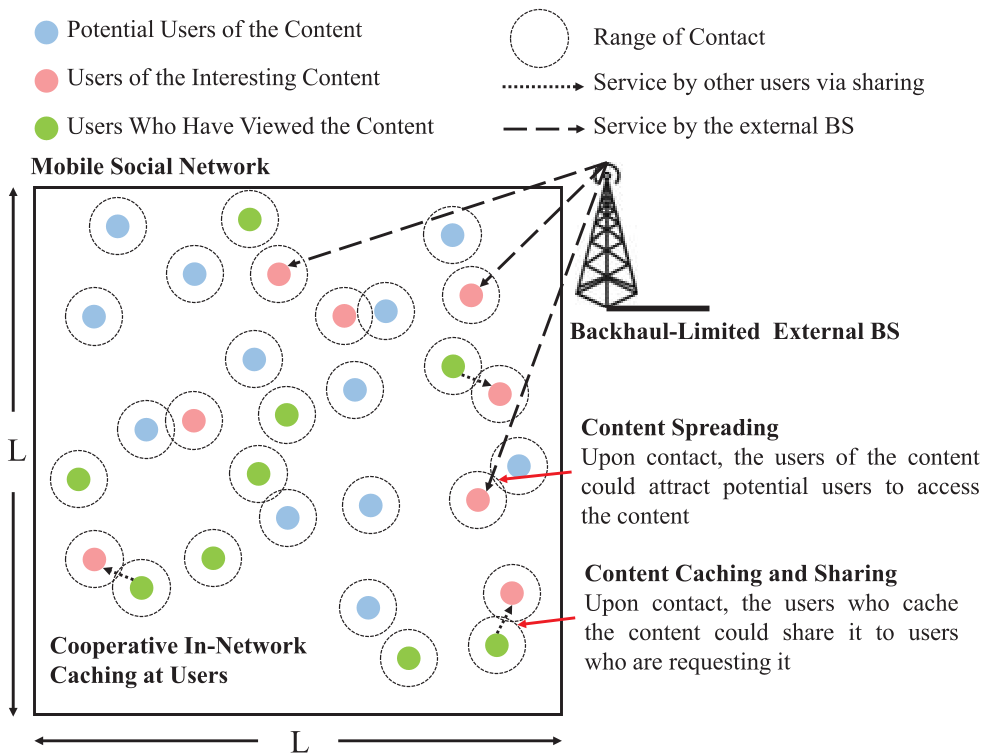
The authors model the network using three compartments:
- Susceptible (S): Potential viewers.
- Infected (I): Users who want the content but are waiting.
- Recovered (R): Users who have been served.
They investigate two primary architectures:
- External BS Caching: The base station increases its service rate once it caches the content to relieve backhaul pressure.
- Cooperative In-Network Caching: Recovered users act as "mobile caches," sharing content directly with others (D2D).
The Core Optimization
To find the optimal time , the authors minimize a cost function that adds the number of unserved users to the cost of caching (determined by duration and resource scarcity ):
By applying Pontryagin’s Minimum Principle, they derive a switching function that dictates the optimal control trajectory of the service rate.
Key Insights: Virality Matters
One of the most profound takeaways is the role of Virality (). Unlike static popularity, virality determines the speed of "infection."
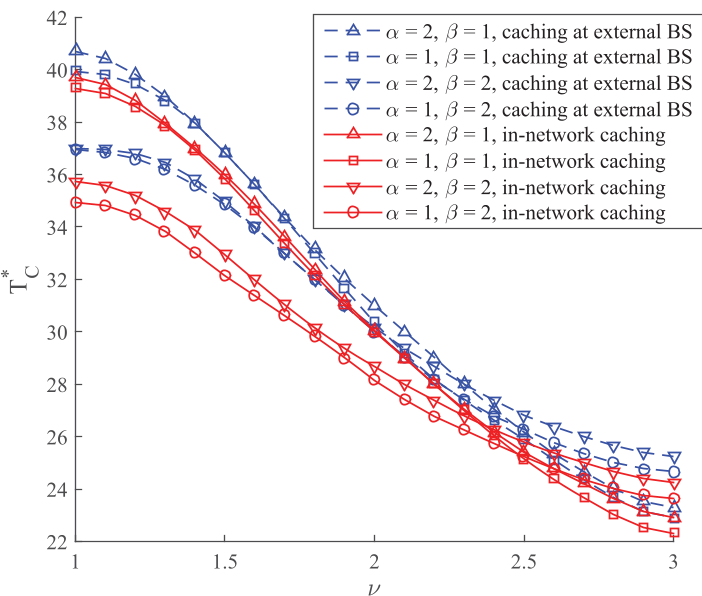
As shown in Figure 6, as content becomes more viral, the optimal system response is to cache significantly earlier. This shift is necessary to handle the "sudden outbreak" of requests that occurs in highly social environments.
Experimental Performance
The simulations, using a realistic Lévy walk mobility model, show that even slight social cooperation (users sharing what they've cached) dramatically lowers the number of unserved users compared to relying solely on a base station.
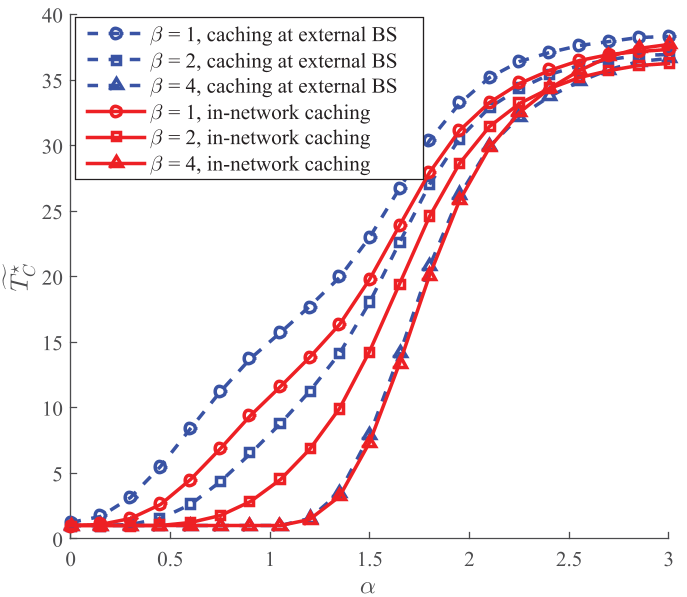
The authors also present a "Proactive Caching Analysis" for extreme outbreaks. While slightly less accurate than the full optimal control solution because it overestimates the outbreak, it provides a much simpler computational path for real-time systems to implement preventive caching.
Critical Analysis & Conclusion
This work successfully bridges epidemic mathematics with telecommunications control theory.
Strengths:
- Moves beyond static caching to a time-dynamic "Optimal Control" perspective.
- Quantifies the trade-off between user experience (waiting time) and system overhead (storage cost).
Limitations:
- The model assumes users are willing to share (cooperation coefficient is fixed). In reality, incentive mechanisms (like tokens or social credit) might be needed to maintain this cooperative behavior.
- The "Proactive" mode, while computationally efficient, may lead to higher resource waste in less viral scenarios due to its conservative nature.
Future Outlook: For 5G/6G engineers, this paper highlights that Virality Prediction is as important as signal processing. Future networks should integrate social-awareness modules into their MAC/Network layers to trigger caching events based on the predicted "infection rate" of social media content.