
Balancing Power and Peace: An Optimal Feedback Model to Prevent Manipulation in Social Network Decisions
15027_An Optimal Feedback Model to Prevent Manipulation Behavior in Consensus Under Social Network Group Decision Making.
The paper introduces a novel framework for Social Network Group Decision Making (SN-GDM) that utilizes a theoretically sound optimal feedback model. It specifically designs mechanisms to prevent "individual manipulation" in weight assignment and "group manipulation" in consensus reaching by minimizing adjustment costs.
TL;DR
In any group decision-making (GDM) scenario, from corporate boards to travel planning apps, two hidden "vices" often plague the process: Individual Manipulation (experts trying to grab more power) and Group Manipulation (the majority forcing the minority into expensive compromises). This paper proposes a robust framework using Social Network Analysis (SNA) and Optimal Feedback Models to ensure consensus is reached with minimum "drama" and minimum "cost."
The Core Conflict: Dictatorship vs. Democracy
The authors identify a fundamental tension in group dynamics. When we assign "weights" (importance) to experts based on their trust levels in a social network, we open the door for manipulation:
- Individual Manipulation: An expert might push for a "dictatorship" attitude if they are highly trusted, or a "democracy" attitude if they are the least trusted, simply to maximize their own weight.
- Group Manipulation: The group often uses a "fixed" recommendation parameter to force outsiders to agree quickly. This often results in the outsider paying a high "adjustment cost"—meaning they have to change their core values more than they theoretically should have to.
Methodology: The Math of Fairness
The authors leverage Distributed Linguistic Trust Functions (DLTF) to handle the fuzzy nature of human trust (e.g., "I trust him 'high' or 'medium'").
1. Thwarting Individual Manipulation
By using Yager’s Ordered Weighted Averaging (OWA) operator and an attitude parameter (), the model explores the spectrum between dictatorship () and democracy (). The brilliance here is the Minimum Adjustment Cost Policy: the system selects the that results in the lowest total change required for the whole group.
2. Thwarting Group Manipulation
Instead of a one-size-fits-all feedback parameter, the paper introduces a Minimum Cost Optimization Model. It calculates a boundary feedback parameter () that moves an inconsistent expert just enough to meet the consensus threshold (), but not a single inch further.
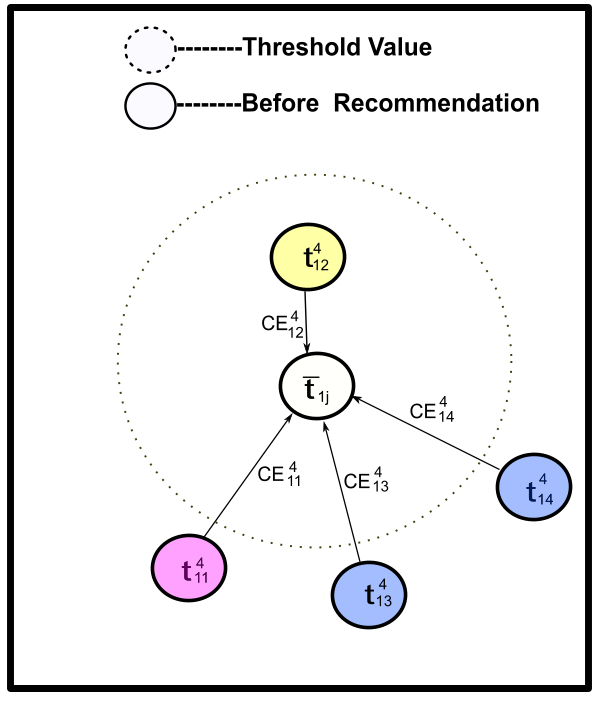 Figure 1: Visual representation of consensus indexes at three levels (Matrix, Alternative, and Element) before the feedback process.
Experiments and Results
The authors tested their model on a group travel decision scenario (choosing between Bali, Maldives, and Phuket).
- Cost Efficiency: Traditional models often overshoot. By applying the optimization, the "Total Cost" (the amount of opinion-shifting required) dropped significantly across all attitude settings.
- Equilibrium: The model identified as the optimal state for this specific group, balancing trust and adjustment effort perfectly.
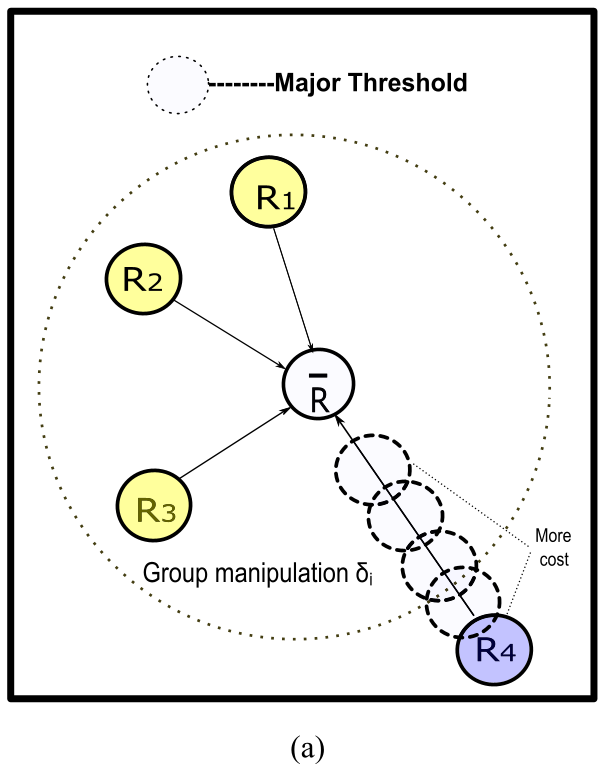 Figure 2: Comparing the feedback process with traditional group manipulation (left) vs. the optimal parameter (right). Notice how the optimal model brings experts exactly to the boundary of consensus without over-adjusting.
Critical Insight: Why This Matters
Most decision models treat "consensus" as a binary state—you either have it or you don't. This paper treats it as a dynamic negotiation. By quantifying "Adjustment Cost," the authors provide a mathematical proxy for "expert satisfaction." If an expert feels they aren't being "forced" to change their mind excessively, they are more likely to accept the group's final decision.
Conclusion & Future Work
The proposed model is a significant leap toward "Human-Centric AI" in decision support systems.
Limitations: The current model assumes a relatively small group and direct trust relationships. Future Outlook: The authors suggest extending this to Large-Scale GDM and incorporating Trust Propagation (transitive trust) to handle networks where not everyone knows each other directly.
Takeaway: True consensus is not just about agreement; it's about minimizing the friction of getting there.