
Optimal Energy Storage: Bridging Arbitrage and Intertemporal Consumer Demand
12684_Optimal Operation and Economic Value of Energy Storage at Consumer Locations.
This paper investigates the optimal operation and Economic Value of consumer-side energy storage using a stochastic dynamic programming framework. It establishes a robust two-threshold optimal policy for storage and proves that the Value of Storage (VoS) is a concave function of capacity, achieving state-of-the-art theoretical insights into intertemporal demand response.
TL;DR
The volatility of renewable energy necessitates consumer-side storage. This paper provides a mathematical foundation for how consumers should operate batteries to maximize utility while minimizing costs. By introducing a two-threshold policy and accounting for intertemporal demand, it proves that under symmetric pricing, storage is purely an arbitrage tool, and under deterministic conditions, the problem can be solved as a Minimum Cost Flow problem with linear efficiency.
Background & Positioning
In the landscape of Energy Storage Systems (ESS), research usually splits into "sizing/investment" (strategic) and "operation" (tactical). This paper sits firmly in the tactical camp, providing a PhD-level derivation of optimal control laws. It bridges the gap between classic Inventory Control (like policies) and modern Demand Response.
The Problem: Why Static Logic Fails
Most existing models treat electricity demand as inelastic (fixed) or memoryless. In reality, consumer behavior is intertemporally coupled—if you charge your EV today, your utility for energy tomorrow changes.
Previous SOTA methods often ignored:
- Asymmetric Pricing: The grid usually buys power back at a lower rate than it sells ().
- Non-ideal Efficiency: Round-trip losses () significantly impact the "break-even" point of storage.
- Intertemporal Substitution: The ability to defer loads (dishwashers, EVs) to future time slots.
Methodology: The Two-Threshold Policy
The authors prove via Bellman's equation that the optimal payoff-to-go function is concave. This leads to a beautiful physical intuition: the Two-Threshold Policy.
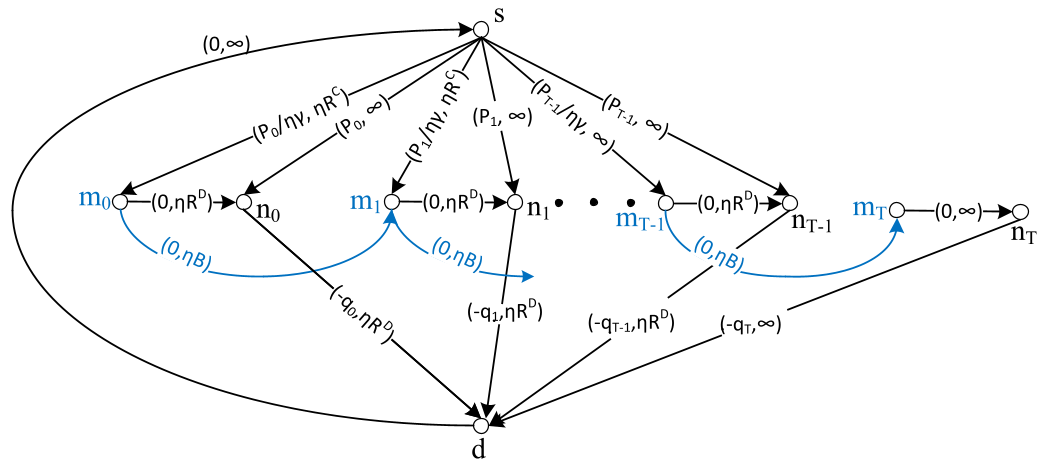 Figure 1: The problem mapped as a Minimum Cost Flow (MCF) network for deterministic conditions.
The Control Logic:
For any time , there are two thresholds (lower) and (upper):
- : The marginal value of future energy exceeds the current cost. Action: Charge.
- : The "Dead Band." Current prices and future expectations are in equilibrium. Action: Idle.
- : The cost of holding energy (or the selling price) makes it optimal to release power. Action: Discharge.
The Arbitrage Insight
One of the most striking theorems in the paper is that if (net metering), the consumer's specific utility function and demand profile become irrelevant. The battery should be operated purely as a "financial instrument" to buy low and sell high, regardless of whether the home needs the power or not.
Experiments & Results
The paper validates the theory using data from ISO New England.
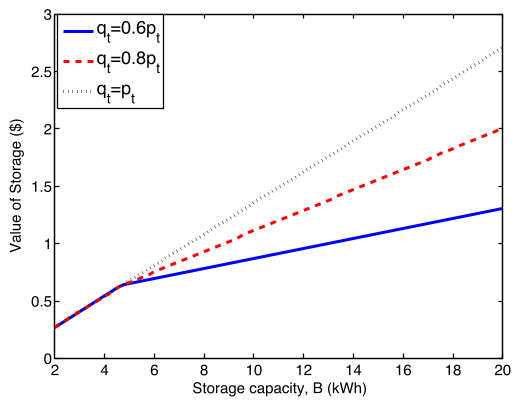 Figure 2: Value of Storage (VoS) vs. Capacity. Notice the concavity—diminishing marginal returns as capacity increases.
Key Findings:
- Value of Storage (VoS): VoS is non-linear. Initially, storage handles the "Critical Peak" price spikes (). Once capacity exceeds the peak hour demand, the marginal value drops to the "Sell-back" rate ().
- Benchmark vs. Heuristic: The authors compared their optimal policy against a "Certainty Equivalent" (CE) controller (which uses average expected prices). In volatile markets, the Optimal Policy saved 14% more than the CE approach.
Critical Insight & Conclusion
This work formalizes the "optimal greedy" behavior for energy storage. By proving that the optimal payoff is piecewise linear, they unlock the ability to solve complex stochastic problems using standard network flow algorithms.
Limitations: The model assumes a Markovian global state, which may not capture long-term battery degradation or battery "fatigue" over thousands of cycles.
Future Work: The logical next step is scaling this to Aggregators—where thousands of batteries following this two-threshold rule provide collective stability to the grid through wholesale market bidding.