
Strategic Campaigning: Optimizing Resource Allocation in Social Networks via Epidemic Control
Optimal Resource Allocation Over Time and Degree Classes for Maximizing Information Dissemination in Social Networks
The paper investigates the optimal allocation of campaigning resources across time and network degree classes to maximize information spread in social networks, modeled as a Susceptible-Infected (SI) epidemic. The authors propose a joint optimization framework for seed selection and time-varying controls, achieving significant performance gains over heuristic strategies in both synthetic (Scale-free, Erdős-Rényi) and real-world networks (Slashdot).
TL;DR
Information in social networks spreads like a virus. This paper provides a mathematical blueprint for campaigners—whether in politics or marketing—to decide exactly when to spend money and which degree classes (from influencers to the "quiet" nodes) to target. By treating information as a Susceptible-Infected (SI) process, the authors use Pontryagin’s Maximum Principle to prove that optimal controls are generally non-increasing over time and vary wildly based on network topology.
Problem & Motivation: Beyond Homogeneous Mixing
Most early models for information spread assumed that any person is equally likely to meet any other person. In reality, your social orbit is defined by your "degree"—how many connections you have.
The researchers identified a critical gap: Prior work didn't account for the trade-off between targeting hubs and the disadvantaged.
- The Hub Logic: Target high-degree nodes because they spread information fast.
- The Disadvantaged Logic: Target low-degree nodes because they rarely hear the message "naturally" through the network.
Which one is better? The answer isn't static; it depends on your budget and the network's structure (e.g., is it a "scale-free" network like Twitter, or more uniform like an Erdős-Rényi graph?).
Methodology: The Core Engine
The paper defines the dynamics using a degree-based compartmental model. Instead of tracking every individual node (which is computationally impossible for millions of users), they group nodes by their degree ().
The Optimization Framework
The objective is to maximize a "Net Reward":
The authors solve this using Pontryagin’s Maximum Principle (PMP). They derive a Hamiltonian that balances the immediate benefit of infecting a node with the future "shadow price" (adjoint variables) of that node's spreading potential.
 Equation (2a): The state equation where information spreads via both natural contact () and direct recruitment ().
To handle real-world scenarios with a fixed budget, they use a modified Forward-Backward Sweep Algorithm, iterating between solving the state evolution (forward) and the "importance" of nodes (backward) until the budget is perfectly utilized.
Experiments & Results: Hubs vs. Neighbors
The findings provide a fascinating look at social strategy:
- Scale-Free Networks: When resources are scarce, the optimal move is to "pay" for the hubs. They are the multipliers. However, when resources are abundant, you stop paying for hubs (they'll get infected anyway) and start targeting low-degree nodes directly.
- Time Sensitivity: The study proves that controls are non-increasing. You should go "all-in" at the start of the campaign to allow the natural "epidemic" effect the maximum time to run.
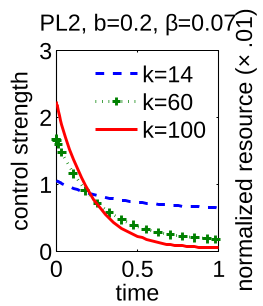 Fig 2c/f: Evidence that as the spreading rate increases, the importance shifts towards disadvantaged nodes.
Real-World Validation (Slashdot)
When tested on the Slashdot social network dataset (4,000 nodes), the model slightly overestimates spread because it assumes an "uncorrelated" network (ignoring the fact that your friends are likely friends with each other). However, it still significantly outperformed heuristic strategies, proving that the relative logic of the degree-based control remains valid even in clustered real-world scenarios.
Critical Analysis & Takeaways
This paper moves social media marketing from "gut feeling" to "optimal control."
Core Insight: The value of a node is contextual. A high-degree node's value is high at the start of a campaign but drops quickly once the natural epidemic takes over.
Limitations:
- Clustering: The model doesn't account for "echo chambers" or transitive triangles, which slow down real-world spread.
- Negative Information: It assumes an SI model (no one forgets). In the real world, "Susceptible-Infected-Recovered" (SIR) models might be needed for fleeting trends.
Future Outlook: The integration of these optimal control systems with real-time API data from platforms like X (Twitter) or Facebook could allow for "Dynamic Campaigning" where budgets are re-allocated hourly based on the current state of infection across degree classes.
Technical Keywords: Optimal Control, SI Epidemic, Pontryagin’s Maximum Principle, Scale-Free Networks, Information Dissemination.