
Smart HAEMS: Balancing the Scales Between Energy Bills and Lifestyle Comfort
15525_Optimal Smart Home Energy Management Considering Energy Saving and a Comfortable Lifestyle.
This paper introduces a Multi-Objective Mixed Integer Nonlinear Programming (MO-MINLP) model for Home Automation and Energy Management Systems (HAEMS). It aims to balance electricity cost reduction with inhabitant comfort, integrating domestic appliance scheduling, thermal comfort modeling, and micro-grid energy sources like fuel cells and batteries.
TL;DR
Efficient energy management in smart homes is more than just "turning things off when they are expensive." This paper presents a sophisticated Home Automation and Energy Management System (HAEMS) that uses a Multi-Objective Mixed Integer Nonlinear Programming (MO-MINLP) model. By treating Thermal Comfort and User Convenience as mathematical objectives rather than just constraints, the system achieves a 55-63% improvement in overall performance efficiency compared to traditional manual home management.
The Motivation: Why Savings Alone Are Not Enough
Most early research into Demand-Side Management (DSM) focused on a singular goal: Minimizing the Electricity Bill. While this sounds logical for the utility provider, it often leads to a "poor lifestyle" for the resident—tasks are delayed indefinitely, or the house becomes uncomfortably hot or cold during peak price hours.
The authors identify a critical gap: physical building dynamics (like heat loss through floors and solar gain through windows) are rarely integrated with electrical scheduling (like washing machines or battery charging). To solve this, they propose a system that sees the home as a unified thermal-electrical ecosystem.
Methodology: The "Smart" Architecture
The core of the paper lies in its Joint Scheduling approach. It manages three distinct domains simultaneously:
- Thermal Modeling: A detailed lumped model calculating heat flow between indoor air, the floor, the ground, and the outdoor environment.
- Resource Management: Coordinating a fuel cell-based micro-CHP (Combined Heat and Power) unit, a backup boiler, and battery storage.
- Task Scheduling: Modeling shiftable loads (washers, dryers) based on "Preferred Time Ranges" (PTR) rather than just "on/off" windows.
Building Thermal Dynamics
The model explicitly calculates the equivalent outdoor temperature () by accounting for solar radiation and surface emissivity.
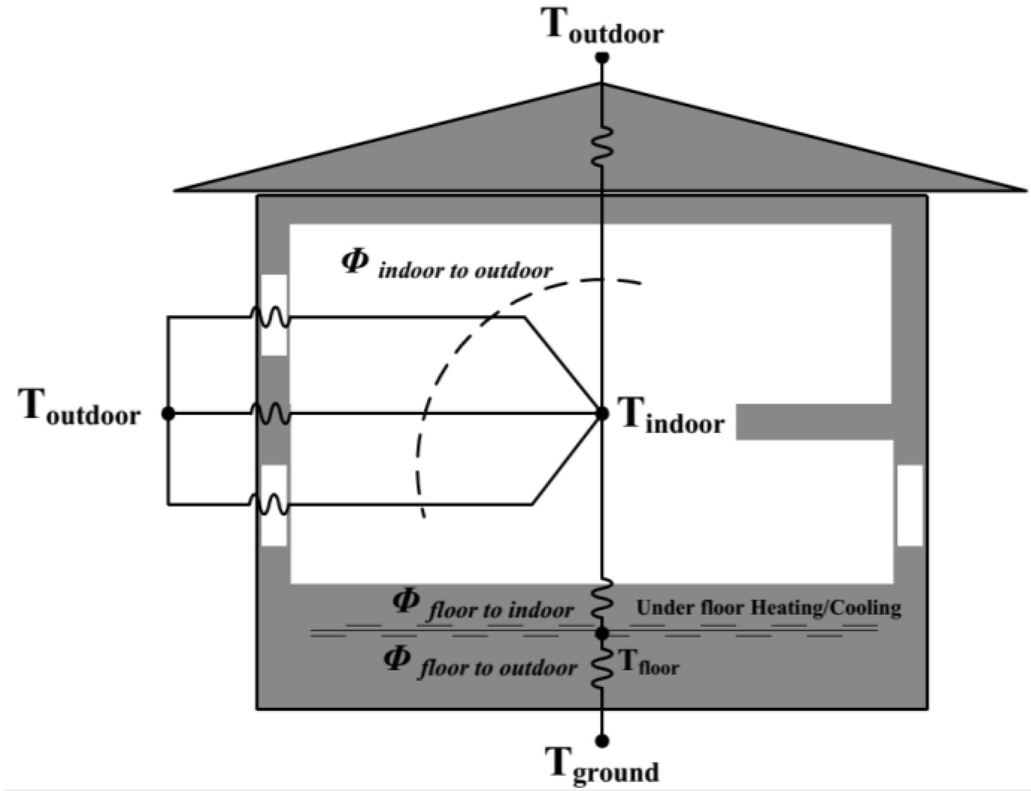 Figure: The heat transfer path model used to define the house thermal state.
The Mixed Objective Function: The Heart of the Controller
Instead of a simple cost function, the authors use a composite objective :
- UCL (User Convenience Level): Penalizes scheduling tasks outside the user's preferred time.
- TCL (Thermal Comfort Level): An exponential penalty function that triggers when the indoor temperature deviates from the user-specified set point (typically 23–27 °C).
Experimental Results: Performance Breakdown
The researchers tested three scenarios: Naive (no automation), Normal (cost-only automation), and Smart (the proposed multi-objective optimization).
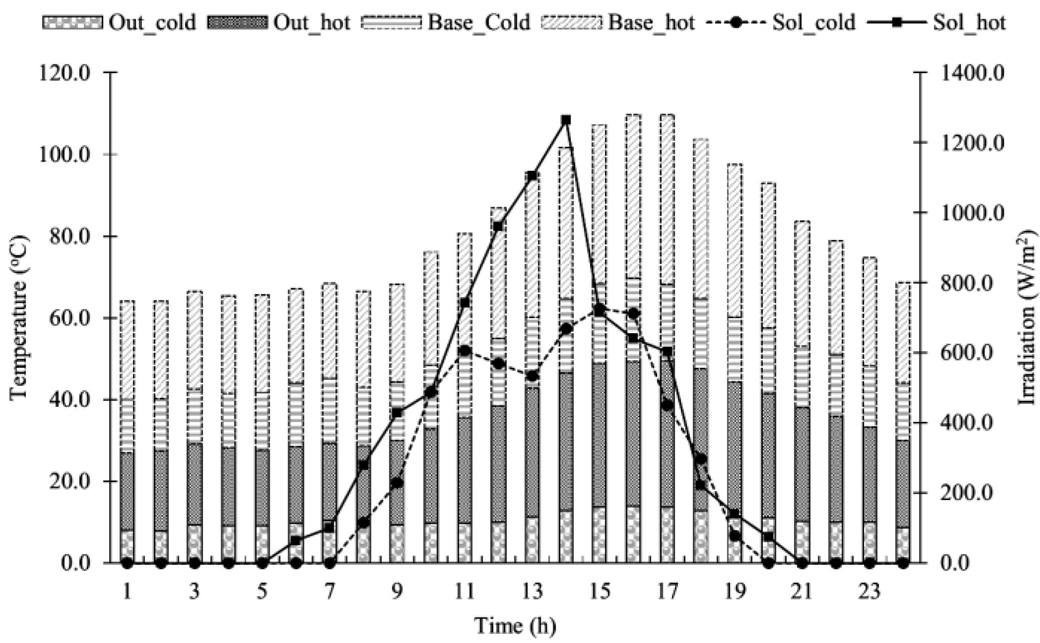 Figure: Comparison of performance indices across Naive, Normal, and Smart controllers.
Key Insights from Results:
- Cost Efficiency: The Smart controller matched the Normal controller in cost-savings but significantly outperformed it in user satisfaction.
- Thermal Resilience: In hot weather, the system successfully managed the "Peak Cooling Load" by pre-cooling and utilizing battery discharge when utility prices spiked.
- Computational Speed: Despite the complexity of MINLP, the solvers (CPLEX/DICOPT) reached optimal solutions in under 5 seconds, making real-time application feasible.
Critical Analysis & Conclusion
The value of this work lies in its granularity. By including the specific thermal conductivity of the floor and walls, the model predicts temperature drifts more accurately than simpler "thermostat-logic" models.
Limitations:
- The model assumes deterministic inputs (perfect knowledge of future prices and weather).
- It does not yet account for the stochastic nature of occupant behavior (e.g., someone unexpectedly opening a window).
Future Outlook: The next frontier for this research involves Scaling. Moving from a single-zone house to a multi-agent micro-grid where several "Smart Houses" trade energy with each other could revolutionize how residential neighborhoods interact with the macro-grid.
Final Takeaway
True smart homes must be "empathetic" to the user. This paper provides the mathematical framework to ensure that saving money doesn't come at the cost of a "sweaty afternoon" or an "interrupted laundry cycle."