
MFPB-HOSTP: Navigating the Complex Web of Trust in Social Networks
Finding the Optimal Social Trust Path for the Selection of Trustworthy Service Providers in Complex Social Networks
2011-12-20
Summary
Problem
Method
Results
Takeaways
Abstract
The paper addresses the selection of optimal social trust paths in complex online social networks. It introduces a "Quality of Trust" (QoT) framework and proposes the MFPB-HOSTP (Multiple Foreseen Path-Based Heuristic) algorithm, which significantly improves path utility compared to prior SOTA methods while maintaining polynomial time complexity.
## Executive Summary
In an era where online interactions dictate professional and personal success, evaluating the "trustworthiness" of a stranger through mutual connections is a critical challenge. This paper presents a sophisticated approach to solving the **Optimal Social Trust Path Selection** problem.
**TL;DR**: The authors introduce **Quality of Trust (QoT)**—a multi-dimensional metric including trust, social intimacy, and recommendation roles—and propose **MFPB-HOSTP**, a heuristic algorithm that outperforms previous SOTA models by up to 46% in path quality while maintaining high efficiency.
## The Problem: Why "Shortest Path" Isn't Enough
Most social network algorithms rely on the shortest path (Dijkstra-based) to connect two nodes. However, in the realm of trust, the "shortest" connection (e.g., a distant acquaintance) might be far less reliable than a "longer" path through highly intimate and expert recommenders.
The problem becomes even more complex when a user sets **end-to-end constraints** (e.g., "I need a path where the total trust > 0.4 and the average recommender expertise > 0.8"). This transforms trust selection into a **Multiconstrained Optimal Path (MCOP)** problem, which is numerically NP-Complete and prone to local optima.
## The Innovation: Handling Attribute Imbalance
The paper’s predecessor, the *H_OSTP* algorithm, often failed because it was "myopic." It would discard potentially great paths early on if one attribute (like intimacy) looked low, even if it could be compensated for later in the path. This is known as the **Attribute Imbalance Problem**.
### Methodology: The MFPB-HOSTP Workflow
The authors solve this by looking ahead more effectively. Instead of looking at just one potential outcome (a single foreseen path), the algorithm:
1. **Backward Search**: Starts from the target and identifies multiple **Backward Local Paths (BLPs)**—some optimized for trust, others for intimacy, and others for role impact.
2. **Composite Paths (CBLP)**: Creates hybrid paths that balance different attributes.
3. **Forward Search**: Starts from the source and uses these multiple "pre-computed" backward paths to accurately estimate if a current forward step is truly a dead end or a hidden gem.
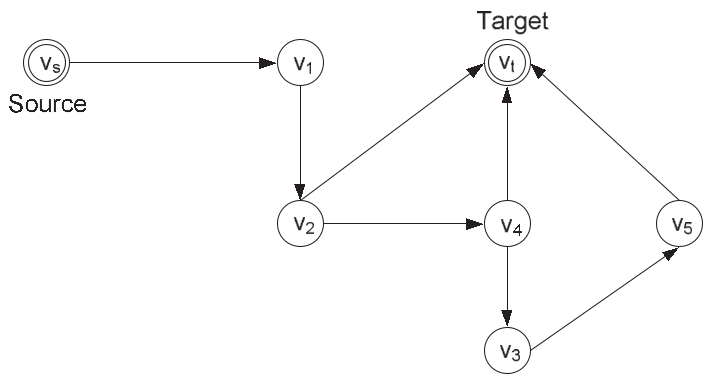
*Figure: The bidirectional search strategy showing how Multiple Foreseen Paths prevent premature pruning of valid trust chains.*
## Experimental Evidence: Slaying the Baseline
The researchers tested their algorithm on the famous **Enron E-mail Corpus** (87,474 nodes). The Enron dataset is ideal because social roles (CFO, Manager, Assistant) and interaction frequency (intimacy) are verifiable through email headers.
### Key Results:
* **Path Quality**: In 5-hop networks, MFPB-HOSTP delivered **46.51% higher utility** than H_OSTP.
* **Efficiency**: Despite checking more paths, the algorithm's time complexity remains **$O(N \log N + E)$**. In real terms, it is only about 28% slower than the previous fastest method while being significantly more accurate.
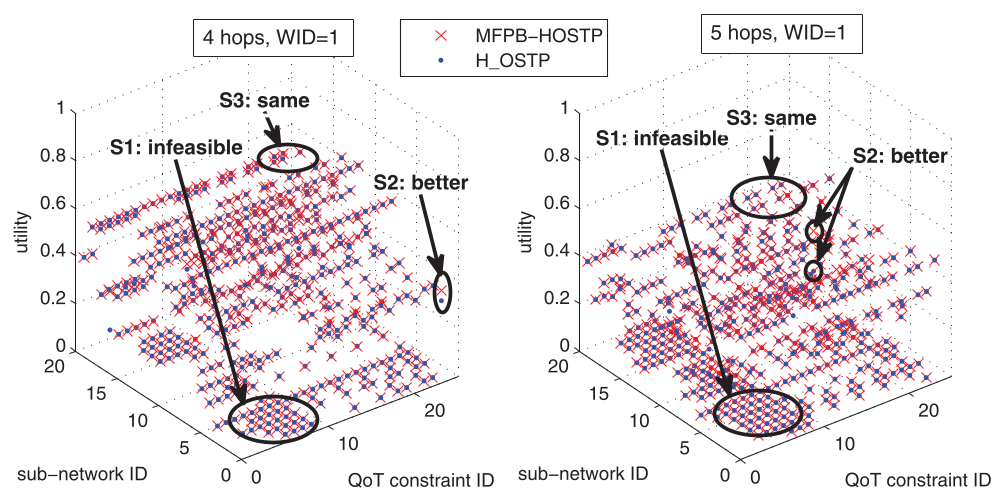
*Figure: Comparison of path utilities across different network hop-counts. MFPB-HOSTP (solid lines) consistently stays above or equal to the baseline.*
## Critical Insights & Future Outlook
The true power of this paper lies in its **holistic definition of trust**. By formalizing "Quality of Trust" (QoT) similarly to how engineers treat "Quality of Service" (QoS) in networking, it bridges the gap between social psychology and hard computer science.
**Limitations**: The model currently treats the network as static. In reality, trust and intimacy change every day.
**Future Work**: The next frontier involves integrating this into **decentralized service engines**, allowing users to find "trustworthy" sellers or providers in peer-to-peer markets without relying on a central authority.