
BOIS: Optimizing the Economy of Crowds through Bayesian-Bandit Hybrid Learning
What Prize Is Right? How to Learn the Optimal Structure for Crowdsourcing Contests
The paper introduces BOIS (Bayesian-Optimisation-based Incentive Selection), a novel algorithm designed to optimize crowdsourcing contests. It addresses the simultaneous challenge of selecting the best contest structure and tuning its continuous parameters to maximize requester utility under fixed financial and time budgets.
TL;DR
Running a successful crowdsourcing contest is more than just offering a prize; it's about finding the "Goldilocks zone" of prize money, participant limits, and evaluation rules. This paper introduces BOIS, a hybrid algorithm that uses Bayesian Optimization and Multi-Armed Bandits to autonomously learn the most effective contest structures and fine-tune their parameters, outperforming current state-of-the-art methods by up to 63%.
The "Prize" Dilemma: Why Static Contests Fail
In the world of Amazon Mechanical Turk or TopCoder, requesters face a daunting "Incentive Selection Problem" (ISP). If the prize is too low, quality suffers. If the group size is too large, the "discouragement effect" kicks in.
Current literature largely relies on Game Theory, which assumes participants are perfectly rational robots. In reality, humans are influenced by task boredom, project purpose, and limited time. Furthermore, existing Budgeted Multi-Armed Bandit (MAB) algorithms treat every variation of a contest as an independent "arm," failing to understand that a contest with a 11 prize.
Methodology: The BOIS Architecture
The authors propose BOIS (Bayesian-Optimisation-based Incentive Selection). The core insight is to treat contest types (e.g., "Winner-Take-All" vs. "Top-3 Split") as discrete clusters, and their parameters (prizes, group sizes) as continuous surfaces to be optimized.
1. The Strategy: Decoupling Learning from Tuning
BOIS operates in three distinct phases:
- Sampling Step: Uses a miniMax distance design to spread initial samples across the parameter space, ensuring the Gaussian Process has a broad "view" of the landscape.
- Stepped Exploitation: This is where the magic happens. The algorithm uses Gaussian Process Regression (GPR) to model the utility of each cluster and an Upper Confidence Bound (UCB) to pick the next candidates.
- Pure Exploitation: In the final time steps, it hammers the best-performing incentive discovered to maximize the remaining budget.
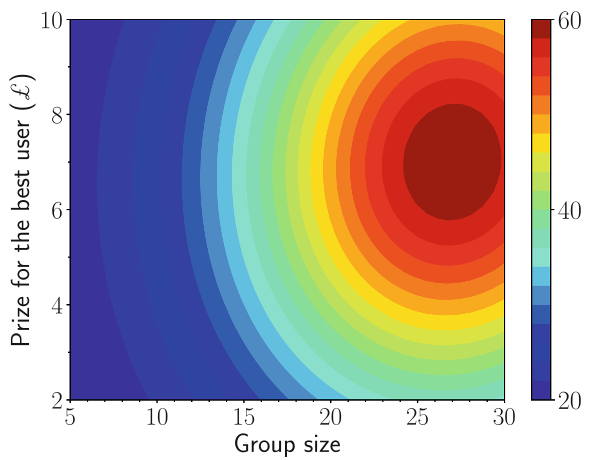 Visualizing how utility changes with group size and prize money—a non-linear landscape that BOIS aims to navigate.
2. The Dynamic UCB Formula
The selection relies on a modified UCB: As time approaches the deadline , the factor shrinks to zero, gracefully transitioning the agent from a curious explorer to a utility-focused exploiter.
Experimental Results: Setting the Benchmark
The researchers tested BOIS against -first and -greedy strategies. The results were clear:
- Deadline Sensitivity: BOIS thrives with more time. As the time budget increases, its ability to find the global optimum via BO becomes significantly more pronounced compared to simpler bandit strategies.
- Budget Efficiency: Even with small financial buckets, BOIS identifies high-performing clusters faster due to its ability to generalize performance across similar parameter values.
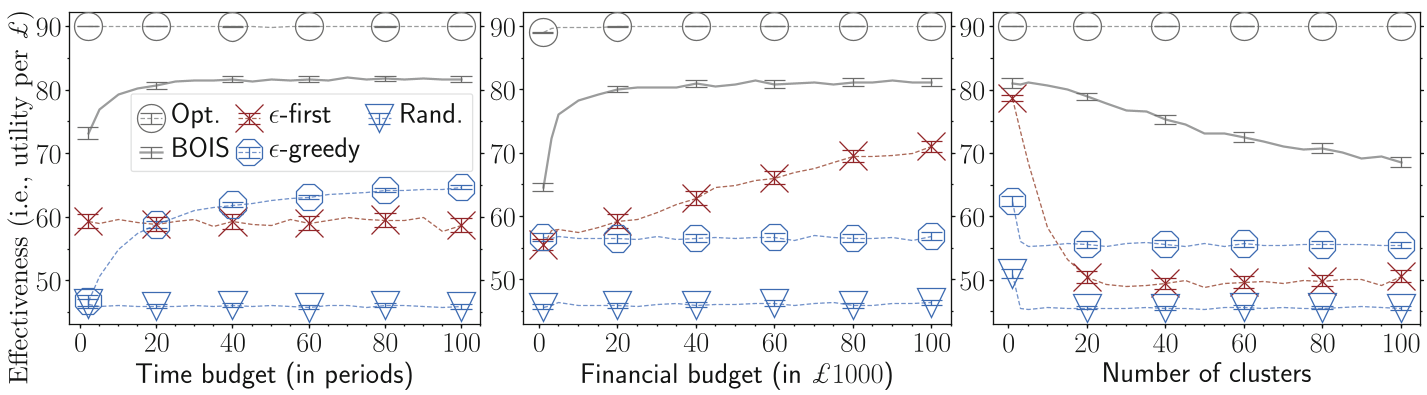 The charts suggest that as time and budget grow, BOIS widens its lead over traditional benchmarks.
Critical Insight & Future Outlook
The true value of BOIS lies in its scalability. By using Gaussian Processes, it avoids the "curse of dimensionality" that plagues standard bandits when actions are near-infinite.
Limitations: Currently, BOIS assumes static costs and homogeneous time steps. In the real world, the "cost" of a contest might fluctuate, and users might drop out mid-way.
The Takeaway: For AI-driven platforms, BOIS offers a blueprint for "Self-Tuning Incentives." It moves crowdsourcing away from "set-it-and-forget-it" prizes toward an autonomous, adaptive economy that maximizes value for both the requester and the crowd.
Conclusion
BOIS closes the gap between theoretical contest design and practical autonomous management. By treating incentive design as an optimization problem over a correlated space rather than a blind choice, it provides a significantly more robust way to engage the global workforce.