
Beyond Proximity: Optimizing Multi-Skill Team Formation in Spatial Crowdsourcing
Finding Optimal Team for Multi-skill Task in Spatial Crowdsourcing
The paper introduces the Software Development Team Formation (SDTF) problem in spatial crowdsourcing, aiming to find an optimal worker team that satisfies multi-skill requirements while minimizing a joint cost of movement distance and labor price. It proves the problem is NP-hard and proposes a high-performance greedy algorithm, DP-SDTF, which achieves near-optimal results compared to exact solvers.
TL;DR
Modern O2O platforms like Meituan or Didi rely heavily on spatial matching, but what happens when a task requires a specific team of experts rather than a single individual? This paper defines the Software Development Team Formation (SDTF) problem, proves its NP-hardness, and introduces a utility-driven greedy algorithm (DP-SDTF) that balances spatial distance with labor costs to form the "perfect" team efficiently.
The Problem: The Complexity of "Skills + Space"
Most spatial crowdsourcing research treats workers as interchangeable units, focusing only on who is closest to the task. However, professional tasks—like software development—require a specific composition of skills (e.g., Python, Database, CSS).
The challenge is twofold:
- Skill Synergy: No single worker might have all the skills; you need a team whose union of skills covers the task requirements.
- Cost-Distance Trade-off: An employer wants the cheapest team, but workers want the shortest commute. Minimizing a weighted sum of the maximum distance traveled by any team member and the total price of the team is a complex combinatorial optimization problem.
Methodology: The DP-SDTF Utility Insight
The authors prove that SDTF is a variation of the Weighted Set Cover problem, making it NP-hard. While simple greedy strategies (picking the nearest or the cheapest) fail in complex scenarios, the authors propose the DP-SDTF (Distance-Price) algorithm.
The Universal Utility Function
The core of the method is a greedy selection process governed by a utility formula:
- The Logic: It prioritizes workers who provide the most "new" skills relative to the "extra" cost they add to the current team.
- (Marginal Distance): This is ingenious—it only penalizes a worker if their distance to the task exceeds the current maximum distance of the existing team members, reflecting the "bottleneck" nature of team arrival times.
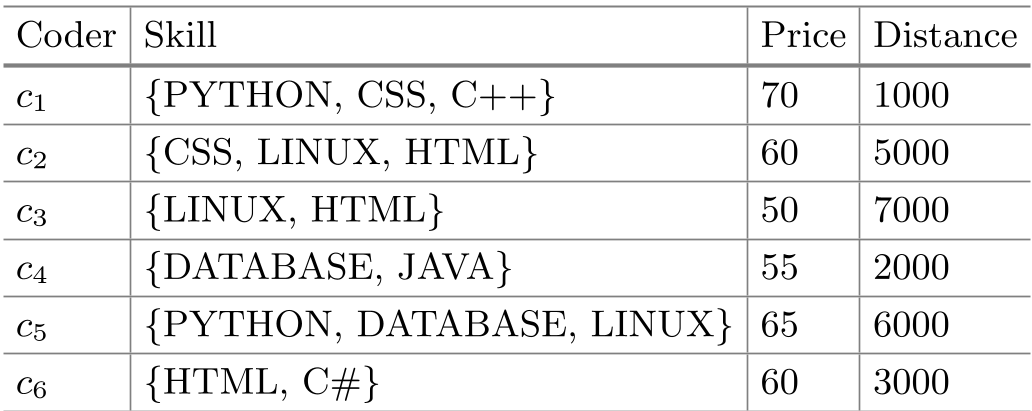 Table 1: Example of Coder profiles including Skills, Price, and Distance used for algorithm validation.
Experimental Validation
Using real-world data from CSTO (a software outsourcing platform), the researchers tested the algorithms across varying parameters:
- (Balance Factor): Adjusting the weight between distance and price.
- Task Complexity: Number of skills required.
- Scalability: Tested with up to 100,000 coders.
Key Findings:
- Cost Efficiency: DP-SDTF consistently achieved costs 3-4 times lower than the "Distance-First" or "Price-First" baselines.
- Near-Optimality: In small-scale tests where an exact (but slow) solution could be calculated, DP-SDTF's results were almost identical to the theoretical optimum.
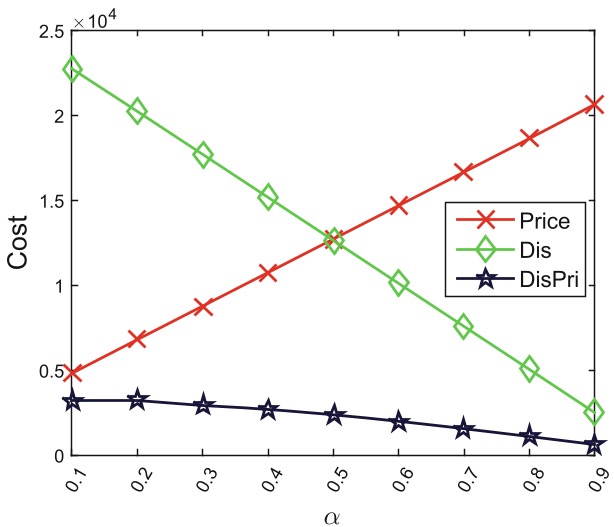 Figure: Analysis showing how DP-SDTF maintains lower costs as task complexity (|t.S|) and coder skill sets vary.
Critical Insight & Future Outlook
The brilliance of this work lies in the bottleneck distance consideration (). In team-based spatial tasks, the team can only start when the last person arrives; therefore, adding a worker who is closer than the current furthest member effectively costs "zero" in terms of additional distance.
Limitations: The current model assumes workers always accept tasks (server-assigned). In real-world scenarios, a "worker-selection" model where coders can reject offers based on their own utility would add another layer of complexity (Game Theory). Furthermore, communication costs between team members—an important factor in software success—could be integrated into future iterations.
Conclusion
The SDTF problem bridges the gap between social team formation and spatial logistics. For platforms looking to move beyond food delivery into professional service crowdsourcing, the DP-SDTF algorithm provides a robust, scalable framework for balancing economic efficiency with geographic reality.