
PRS-NMP: Optimizing HIV Interventions via Multiplex Network Prioritization
18840_Optimizing HIV Interventions for Multiplex Social Networks via Partition-Based Random Search.
This paper introduces a multiplex social network framework to model HIV transmission across interconnected key populations (Female Sex Workers and People Who Inject Drugs). It proposes a novel optimization algorithm, Partition-based Random Search with Network and Memory Prioritization (PRS-NMP), to identify optimal subsets of individuals for targeted intervention, outperforming traditional centrality-based metrics and standard nested partitions.
TL;DR
Controlling HIV transmission is becoming increasingly complex as high-risk populations—once thought to be isolated—begin to overlap through multiple transmission modes. This paper tackles the "network immunization" problem by introducing a multiplex social network framework and a high-efficiency search algorithm, PRS-NMP. By combining the physical intuition of network topology with a memory-enhanced random search, the authors significantly outperform traditional centrality-based interventions and existing optimization benchmarks in both speed and infection reduction.
Problem & Motivation: The Simplex Fallacy
Most epidemiological models treat social interactions as a "simplex" network—one type of connection, one mode of transmission. However, field studies in Southwest China reveal a different reality: Female Sex Workers (FSW) and People Who Inject Drugs (PWID) interact through a mix of sexual contact and needle sharing.
From a computational perspective, identifying which individuals to "isolate" (through education, testing, or resource allocation) to minimize infection spread is NP-hard. While we often use "hubs" (high-degree nodes) as targets, these local metrics are rarely globally optimal in a complex, multi-layered topology.
Methodology: Bridging Topology and Global Search
The core contribution is the PRS-NMP (Partition-based Random Search with Network and Memory Prioritization) algorithm. It moves beyond simple greedy heuristics by treating the selection as a global optimization problem.
1. Multiplex Modeling
The authors define the network as , where (FSW) forms a bipartite subgraph and (PWID) forms a scale-free subgraph. The "bridge nodes" connecting these communities are the primary conduits for cross-population outbreaks.
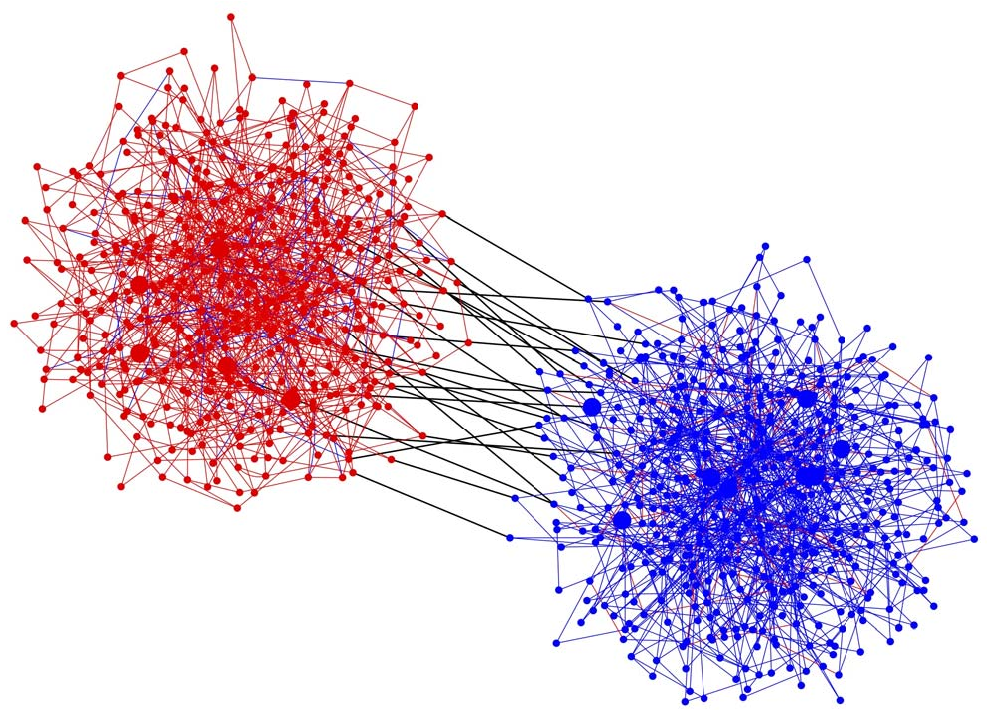 Fig 1. Visualization of the multiplex social network consisting of FSW (red) and PWID (blue) communities.
2. The PRS-NMP Algorithm
The algorithm improves upon the "Nested Partitions" (NP) method through two specific innovations:
- Prioritization (The "Why"): Instead of partitioning the solution space blindly, it uses nodes' Degree or Betweenness Centrality to prioritize "promising" regions. This creates an inductive bias that high-value nodes are likely part of the optimal set.
- Memory Mechanism (The "How"): Standard NP methods often lose information when backtracking. PRS-NMP retains the history of partitioned subregions, allowing the search to "jump" back to the most fertile ground (the promising index) more accurately.
Experiments and Results
The researchers tested three scenarios: S-D (infection starts in both communities), S-S (starts in FSW), and D-D (starts in PWID).
Performance Gains
In all cases, the PRS-NMP variants (particularly those using Degree and Memory - DM) achieved the lowest ratio of "risk nodes."
- Efficiency: PRS-NMP reduced CPU time by nearly 60% compared to the classic Nested Partitions while finding better solutions.
- Segregation: The algorithm successfully identified "segregation points"—the minimum intervention budget required to stop an epidemic from jumping between communities. For example, in the S-S scenario, it found a way to bridge the communities with only a 12.5% budget.
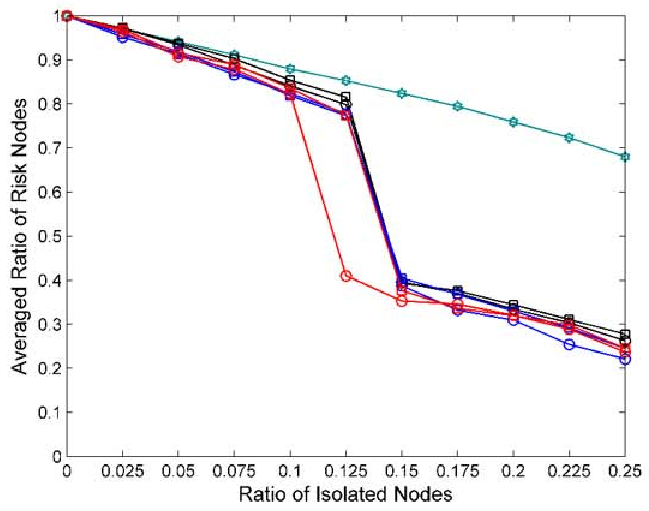 Fig 2. Comparison of the ratio of risk nodes across different intervention strategies (Network-based vs. Search-based).
Critical Insight: Bipartite Vulnerability
An interesting academic takeaway from the study is the difference in "controllability." The FSW community, modeled as a bipartite network, proved more difficult to constrain than the PWID community. This aligns with control theory research suggesting that bipartite structures are more "vulnerable" to being driven by specific nodes, which in this context means infection spreads more efficiently unless precisely targeted.
Conclusion & Future Outlook
PRS-NMP represents a bridge between Social Network Analysis (SNA) and Simulation Optimization. The study moves public health policy away from simple "targeted lists" toward "optimized strategies."
The next frontier for this work will likely involve dynamic epidemics (SIR/SIS models) where the timing of the intervention is as critical as the target. For now, PRS-NMP provides a robust framework for maximizing the impact of limited public health budgets in the real world.
Takeaway: Optimal intervention isn't just about finding the "hubs"; it's about finding the specific combination of nodes that effectively cuts the multiplex bridges of transmission.