
Hybrid Graph Sharding: Escaping Local Optima in Distributed Social Network Partitioning
Optimizing Iterative Algorithms for Social Network Sharding
This paper presents a comparative study and optimization of distributed graph sharding algorithms for massive social networks. It focuses on enhancing the Balanced Label Propagation (BLP) and Bayesian Stochastic Block Modeling (SBM) approaches, achieving state-of-the-art partitioning quality through hybrid methodologies.
TL;DR
Processing massive social networks requires dividing them into "shards" across multiple machines while minimizing cross-shard edges—a problem known as graph sharding. This paper demonstrates that current distributed favorites like Balanced Label Propagation (BLP) and Stochastic Block Modeling (SBM) have significant architectural blind spots. By combining SBM’s community-awareness with BLP’s iterative refinement and adding "disruptive" Kernighan-Lin swaps, the authors achieve partitioning quality that rivals sequential industry standards like METIS while maintaining the potential for massive scale.
Background: The Scalability Wall
As social networks like Facebook grow to billions of users, their underlying graphs become too large for any single machine. Graph sharding must be distributed, iterative, and scalable.
- BLP (Balanced Label Propagation): Moves individual nodes to maximize local edges but is highly sensitive to its starting state.
- SBM (Stochastic Block Modeling): Groups nodes into "blocks" based on connectivity probabilities but lacks a robust refinement mechanism once blocks are assigned to shards.
The authors identify a critical gap: BLP often gets "stuck." If two nodes in different shards want to swap places but moving either individually would temporarily violate capacity constraints, BLP's Linear Programming (LP) solver will block the move, leading to a sub-optimal local equilibrium.
Methodology: The Hybrid Refinement Framework
The core contribution is a three-tiered optimization strategy that treats BLP as a base refiner and introduces "disruptors" to shake the system out of local optima.
1. Superior Initialization
Instead of random assignment, the authors use SBM to detect underlying communities. This provides a "warm start" that places densely connected nodes together from the outset.
2. The Disruptor Mechanisms
When standard BLP iterations converge (i.e., marginal gains drop), the framework triggers a "disruption" phase:
- Clustered Constrained Relocation: Instead of moving one user, it treats an entire SBM-detected community as a single unit and moves them collectively.
- Round-Robin KL Swaps: Pairs up every shard in a tournament style and performs pairwise swaps. This bypasses the LP solver's limitations, allowing "zero-sum" moves that improve overall locality without changing shard sizes.
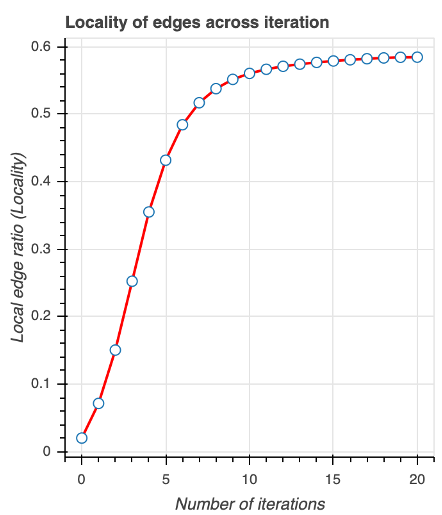 Fig 1: The iterative nature of edge locality improvement across different initialization methods.
Experimental Insights
The researchers tested their methods on datasets including LiveJournal (4M nodes) and Orkut (3M nodes).
Key Findings:
- Random is Not Enough: BLP started with random initialization never catches up to SBM-initialized versions, regardless of how many iterations run.
- The Power of KL Swaps: Adding Kernighan-Lin swaps (BLP-KL) provided the most consistent boost, especially for social networks where community structures are overlapping and complex.
- Graph Type Matters: While these optimizations work wonders for "Power Law" social networks, they offer little benefit for planar-like structures such as Road Networks, where METIS already achieves near-perfect cuts.
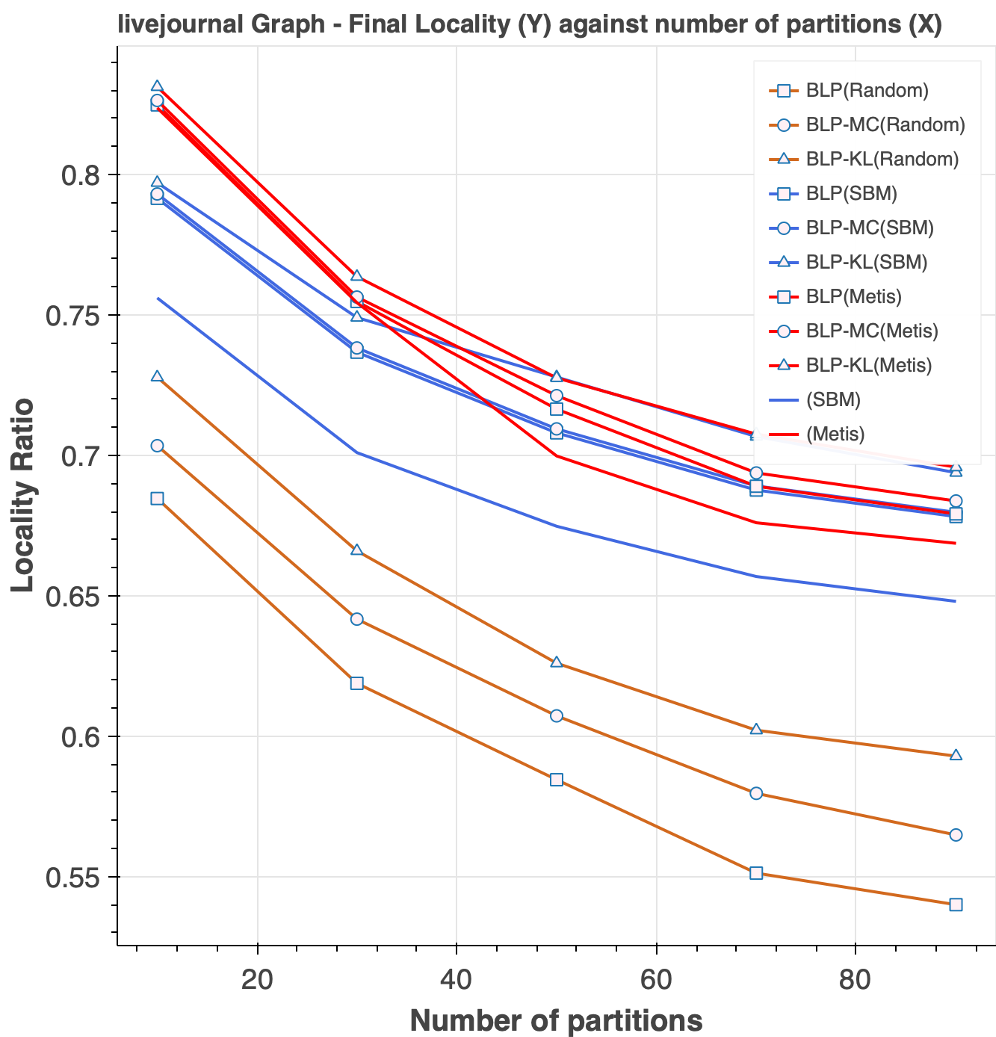 Fig 2: Final locality comparison on LiveJournal across 10-90 shards. Note how SBM-BLP-KL outperforms standard distributed baselines.
Critical Analysis & Conclusion
This work highlights a profound truth in distributed systems: Local greedy moves are insufficient for global optimization. By re-introducing "block moves" and "pairwise swaps"—techniques traditionally used in sequential algorithms—into a distributed-friendly framework, the authors bridge the gap between quality and scalability.
Limitations: The current study was evaluated on a single node in C++. While the logic is MapReduce-ready, the actual communication overhead of performing round-robin KL swaps across a thousand-node cluster remains an implementation challenge for the future.
The Takeaway: If you are architecting a graph processing system, don't rely on simple label propagation. Combining a Bayesian community inference step with a swap-based refinement phase is the most robust way to ensure shard locality and minimize network latency in production environments.