
Optimizing the MapReduce Balancing Act for Parallel Machine Learning
Optimizing Multiple Machine Learning Jobs on MapReduce
The paper introduces an optimization method for assigning multiple Machine Learning (ML) jobs, such as hyper-parameter tuning and cross-validation, on a MapReduce framework. By utilizing an execution cost model and integrating memory-based execution with job sharing, the method achieves optimal cluster partitioning, significantly outperforming standard scheduling.
TL;DR
Training machine learning models often requires running the same algorithm dozens of times with different parameters. Simply throwing a massive cluster at these jobs can be surprisingly inefficient. This paper proposes a mathematical cost model to find the "Goldilocks" zone—partitioning a cluster into groups that balance I/O bottlenecks and communication overhead—resulting in performance gains of up to 77%.
The Hidden Inefficiency of Scale
When we run 20 machine learning jobs on a 20-node cluster, we have two intuitive but extreme options:
- The Wide Approach: Run one job at a time using all 20 nodes, sequence them 20 times.
- The Parallel Approach: Partition the cluster into 10 groups of 2 nodes, running 10 jobs simultaneously.
The Wide Approach speeds up the Map phase (processing data) but creates a massive communication bottleneck during the Shuffling and Reduce phases. The Parallel Approach reduces communication but forces each node to read a larger portion of the dataset, potentially leading to I/O starvation. Deciding between these isn't trial-and-error; it's an optimization problem.
The Strategy: Extended MapReduce
The authors don't just use standard Hadoop; they build upon two critical extensions:
- Memory-Based Execution: Caching datasets in RAM to avoid repeated disk reads.
- Job Integration: Merging multiple jobs with different parameters into a single "Integrated Map" function so the raw data is read only once.
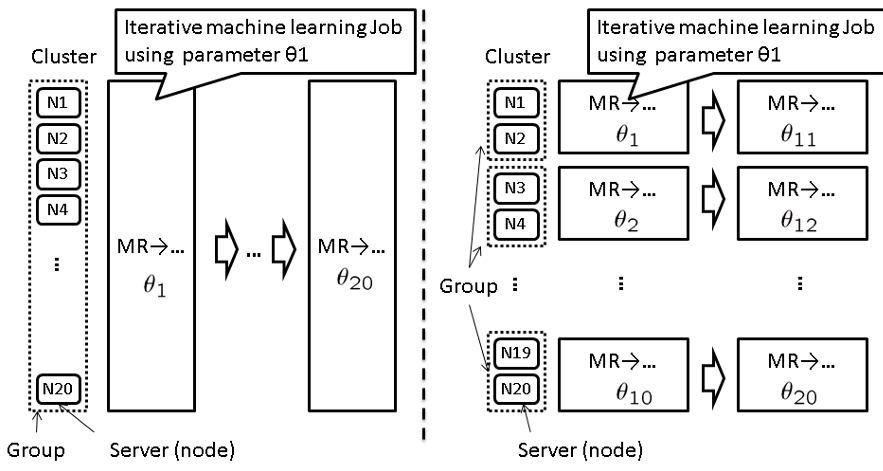 Figure 1: Comparison between a single large group and multiple smaller groups.
Methodology: The Cost Model
The core contribution is a cost model .
1. The Map Phase ()
The model identifies the Critical Point () where the bottleneck shifts from Computation to I/O.
- If you have many nodes in a group, the computation is fast, and you wait for the disk (I/O Bound).
- If you have few nodes, the disk is fast enough, but you wait for the CPU to process multiple parameter sets (Computation Bound).
2. The Reduce Phase ()
Using Regression Analysis, the authors modeled the Reduce phase (specifically vector summation). They found that is proportional to the number of nodes in a group because communication complexity increases as more nodes need to synchronize.
3. Solving for
By combining these, they find the optimal (number of nodes per group). As the number of jobs increases, the optimal typically decreases, favoring more smaller groups to handle the high computational load per data point.
Experiments: Logistic Regression at Scale
The authors tested their theory using a 32GB blog dataset. They implemented their runtime using MPI (Message Passing Interface) for high-performance communication and POSIX AIO for overlapping I/O and computation.
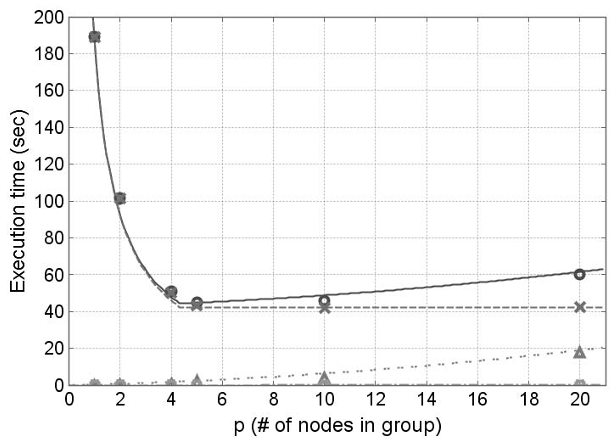 Figure 2: Performance results showing the "U-shaped" curve where the optimal point exists between I/O and communication bottlenecks.
Key Findings:
- Accuracy: The predicted optimal matched the measured minimum execution time in cases with 10, 20, 40, and 80 labels (jobs).
- Efficiency: In the case of 10 labels, picking the optimal assignment was 77% faster than the worst assignment.
- Bottleneck Transition: The graphs clearly show the shift from I/O bounds (inversely proportional to ) to communication bounds (linear with ).
Critical Analysis & Future Outlook
While this work provides a rigorous foundation for scheduling, it assumes homogeneous nodes and static job characteristics. In modern cloud environments (AWS/GCP), nodes may have varying speeds (stragglers), and dataset sizes might fluctuate.
Takeaway: This research highlights that "distributed" does not mean "linearly scalable." The optimal configuration for a machine learning pipeline is a moving target that depends heavily on the ratio of data size to the number of hyper-parameters being tested. For specialized ML platforms, embedding these cost models into the scheduler is no longer optional—it's a requirement for cost-effective computing.