
From Search to Discovery: Optimizing Social-Multimedia Exploration via Graph Linearization
Optimizing strategies for the exploration of social networks and associated data collections
This paper proposes a unified multigraph model to integrate multimedia documents and social network data for optimized exploration. By mapping navigation onto the Symmetric Traveling Salesman Problem (S-TSP) through the Lin-Kernighan heuristic, it builds coherent traversal paths and diverse summary subsets to enhance user browsing in Cultural Heritage collections.
TL;DR
The paper introduces a unified graph-based framework that merges multimedia documents and social networks into a single navigable structure. By solving the Symmetric Traveling Salesman Problem (S-TSP), the authors convert complex high-dimensional similarity clusters into intuitive one-dimensional "paths" and representative summaries, allowing users to browse vast collections without the usual "lost in hyperspace" feeling.
Background: Beyond the Search Bar
Most information systems are reactive: you provide a query, and they return a result. But what if you don't know what to look for? This is the bootstrapping problem. Traditional Query-by-Example (QBE) systems often start by showing a random grid of images, which is statistically unlikely to help a user find a specific needle in a haystack.
The authors argue that we need a "map" that considers not just the documents themselves, but the social tissue surrounding them—who created them, who liked them, and how they relate across different "dimensions" (color, text, time).
Methodology: The Multigraph Approach
The researchers model the entire ecosystem as a multigraph.
- Document Graph: Nodes are documents; edges represent similarities (e.g., visual features, metadata).
- User Graph: Nodes are users; edges represent social proximity (e.g., "is friend of").
- Bipartite Bridge: Edges connecting users to the documents they interact with.
The Optimization Insight: S-TSP for Navigation
To turn this complex web into a navigation tool, the authors treat the transition from one item to another as a "cost." They minimize the total cost of a traversal by solving the Symmetric Traveling Salesman Problem (S-TSP).
By finding the shortest Hamiltonian path through the collection, they create a sequence where every item is as similar as possible to its predecessor, effectively "unknotting" high-dimensional data into a linear string.
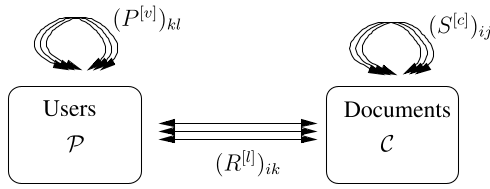 Figure 1: The proposed unified modeling of social networks and multimedia documents.
Experiments & Results: Navigating Cultural Heritage
The team applied this to a Cultural Heritage collection. To solve the NP-hard S-TSP at scale (up to 70,000 items), they utilized the Lin-Kernighan heuristic, which swaps sub-tours to find a "good enough" path quickly.
Two Browsing Modes:
- Proximity-Based Path: A localized "walk" through similar items.
- Summary-Based Jumping: To prevent users from getting stuck in a single cluster, the system samples the TSP path at regular intervals (geodesic distance) to provide a representative "summary" of the whole space.
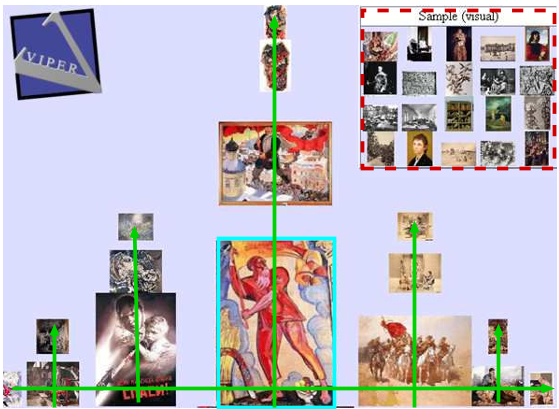 Figure 2: The MultiMATCH interface. The central image is the focal point, with vertical and horizontal paths representing different similarity dimensions (e.g., time vs. color).
Critical Analysis & Conclusion
This work stands out for its geometric intuition. Instead of just projecting data into a 2D cloud (like t-SNE), which can be overwhelming, it forces the data into a sequence—a format humans are naturally better at processing (like a timeline or a photographic film strip).
Limitations:
- Updating Dynamics: Re-solving the TSP when new data is added can be computationally expensive.
- Social-Document Fusion: While the model supports it, the interface demonstrated focused largely on the document side. The true utility of the "social graph" in navigation remains to be fully stress-tested in a live environment.
Future Outlook:
This paper predates the modern "Vector Database" era, yet its core philosophy is more relevant than ever. As we move toward Latent Space Exploration in generative AI, using discrete optimization to create "curated paths" through high-dimensional embedding spaces could be the key to making AI-generated content truly discoverable.