
Optimizing Tensor Contractions for Embedded Devices: A Racetrack Memory Revolution
Optimizing Tensor Contractions for Embedded Devices with Racetrack and DRAM Memories
This paper presents a hardware-software co-optimization framework for performing tensor contractions on embedded devices. It introduces an optimized data layout for Racetrack Memory (RTM) based Scratch-Pad Memory (SPM) and contention-aware scheduling for DRAM, achieving a 32% performance boost and up to 80% DRAM energy reduction.
TL;DR
Embedded systems are increasingly tasked with heavy tensor computations (AI, Vision), but traditional SRAM is power-hungry. This paper introduces a specialized compiler/architectural stack that leverages Racetrack Memory (RTM) to replace SRAM. By using an "alternating" data layout and contention-aware DRAM scheduling, the authors slash energy consumption by 73-80% while actually beating SRAM performance by 32%.
The Problem: The Memory Wall in Tiny Devices
Embedded devices like wearables and autonomous drones are caught between two fires:
- SRAM Leakage: Traditional on-chip memory (SRAM) is "leaky," consuming up to 33% of its energy even when idle.
- Sequential Overhead: Racetrack Memory (RTM) is ultra-dense and low-leakage, but it stores data on magnetic "tapes." To read a bit, you must shift the tape to a port—a process that adds latency and "overhead shifts" if not managed perfectly.
Current tensor libraries treat memory as Random Access (RAM), which is a "worst-case" scenario for the sequential nature of RTM.
Methodology: Orchestrating the "Magnetic Tape"
1. Minimal Shifting with Bi-Directional Layouts
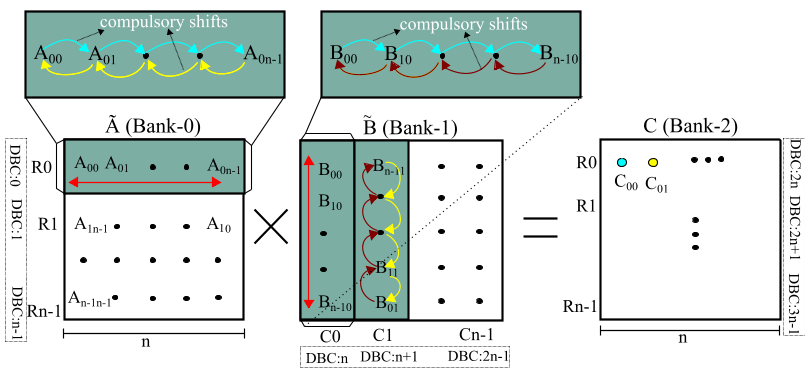
The core innovation is an optimized SPM layout. In a naive setup, after reading a row from left to right, the RTM port must "rewind" to the start. The authors propose an alternating layout:
- Rows of Tensor A are accessed back-and-forth.
- Columns of Tensor B are stored in alternating directions.
- Result: Access ports naturally end up where they need to be for the next operation, cutting overhead shifts by nearly 50%.
2. Preshifting & Prefetching
To hide the remaining physical latency:
- Preshifting: While the CPU computes , the RTM hardware autonomously shifts the tape to and . By the time the CPU asks for the next data, the port is already aligned.
- Prefetching: Tiling is used for large tensors. New tiles are fetched from DRAM into SPM while the previous tile is still being computed.
3. Contention-Aware DRAM Mapping
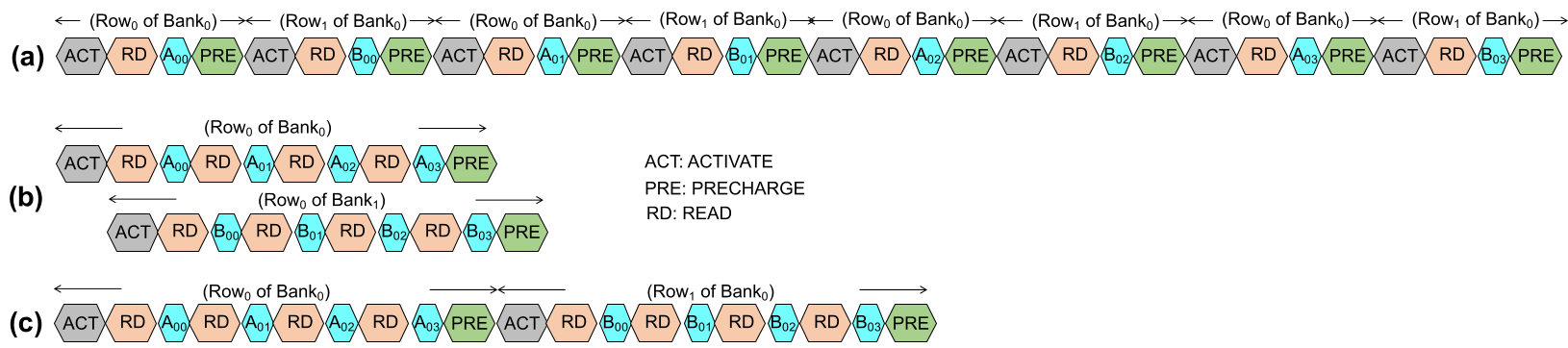
Off-chip DRAM energy is often wasted on "Row Buffer Conflicts" and "Read-Write Interference." The authors map different tensors to disjoint DRAM banks. This ensures that reading an input doesn't "kick out" the row buffer needed for another input or the output, drastically reducing the number of expensive ACTIVATE and PRECHARGE commands.
Experimental Results
The authors evaluated their work using the RTSim cycle-accurate simulator and DRAMPower.
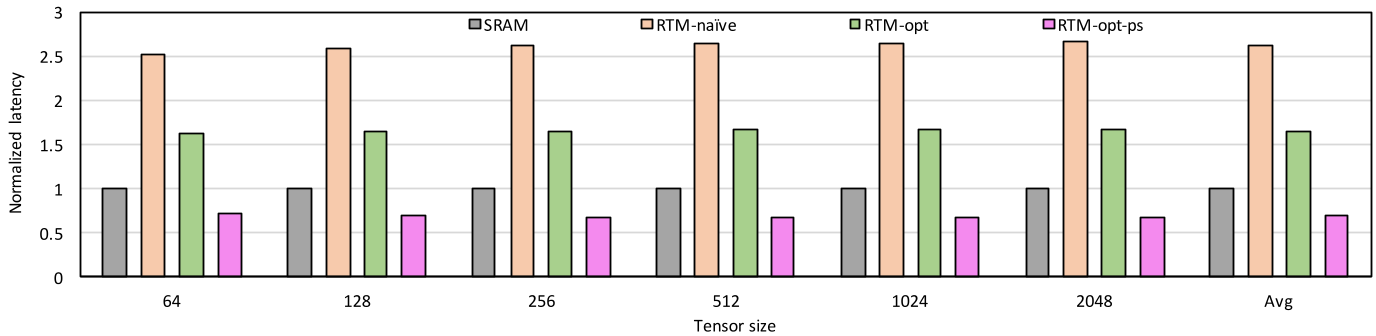
- RTM vs. SRAM: The optimized RTM-SPM (with preshifting) achieved 1.92x better performance than a naive RTM and 32% better than standard SRAM.
- Energy Efficiency: Due to the near-zero leakage of RTM and the bank-aware DRAM scheduling, total DRAM dynamic energy dropped by 80%.
- Area: RTM achieved a 71% area reduction over SRAM, critical for footprint-constrained IoT devices.
Critical Insight: Why This Matters
For years, the sequential nature of Racetrack Memory was seen as a "tax" that made it slower than SRAM. This paper proves that for tensor contractions—where the access pattern is 100% predictable—we can turn the sequentiality into an advantage. By matching the compiler's loop order to the memory's physical movement, we create a "hardware-software resonance" that delivers SOTA efficiency.
Conclusion & Future Work
This research provides a blueprint for next-generation embedded AI accelerators. The next step is integrating these data placement strategies into modern Deep Learning compilers like TVM or Glow, allowing high-level Python code to automatically benefit from the unique physics of spintronic memories.