
Beyond the Box Office: Decoding Superstar Persuasion via Ordinal Machine Learning
Ordinal classification/regression for analyzing the influence of superstars on spectators in cinema marketing
This paper presents a machine learning framework for quantifying superstar influence in cinema marketing by reformulating the problem as an Ordinal Classification/Regression task. Utilizing Support Vector Ordinal Regression (SVOR), the authors model spectator intentions based on knowledge, attitudes, and emotions toward stars, achieving superior predictive accuracy over traditional multiclass classification and standard regression.
TL;DR
Does a "Star" guarantee a hit? Not necessarily. This research moves beyond aggregated box office numbers to analyze individual psychology using Support Vector Ordinal Regression (SVOR). By treating the "intention to see a movie" as an ordered set of ranks rather than just numbers, the study proves that a superstar's influence is a complex cocktail of perceived talent and emotional popularity, with distinct "persuasion routes" for different genders.
Background: The Superstar Paradox
In the high-stakes laboratory of the cinema industry, casting a superstar is the ultimate risk-mitigation strategy. However, the industry suffers from "mixed results"—big names don't always translate to big sales. The authors argue that previous research failed because it looked at outcomes (revenue) rather than the drivers (individual spectator persuasion).
The Core Insight: Ordinality Matters
The breakthrough of this paper isn't just what they studied, but how they modeled it. Most researchers treat a 5-point Likert scale (1: No Intention to 5: High Intention) in two flawed ways:
- As Categorical Data: Treating "4" and "5" as different as "Apple" and "Orange," ignoring that 5 is actually "higher" than 4.
- As Metric Data: Assuming the "distance" between 1 and 2 is exactly the same as between 4 and 5—a dangerous assumption in human psychology.
By using Ordinal Regression, the authors respect the order without forcing a fake mathematical distance.
Methodology: The SVOR Framework
The researchers used a dual-faceted approach to quantify "Stardom":
- Central Aspects (Talent): Measured via the Ulmer Scale and spectator knowledge.
- Peripheral Cues (Popularity): Measured via IMDB's STARmeter, attitudes, and specific emotional responses (Anger, Happiness, Pride, etc.).
Architecture: Parallel Hyperplanes
The Support Vector Ordinal Regression (SVOR) model finds a set of parallel hyperplanes in a high-dimensional space. Unlike standard SVM which draws a single line to separate groups, SVOR finds thresholds () that define the boundaries between ranks.
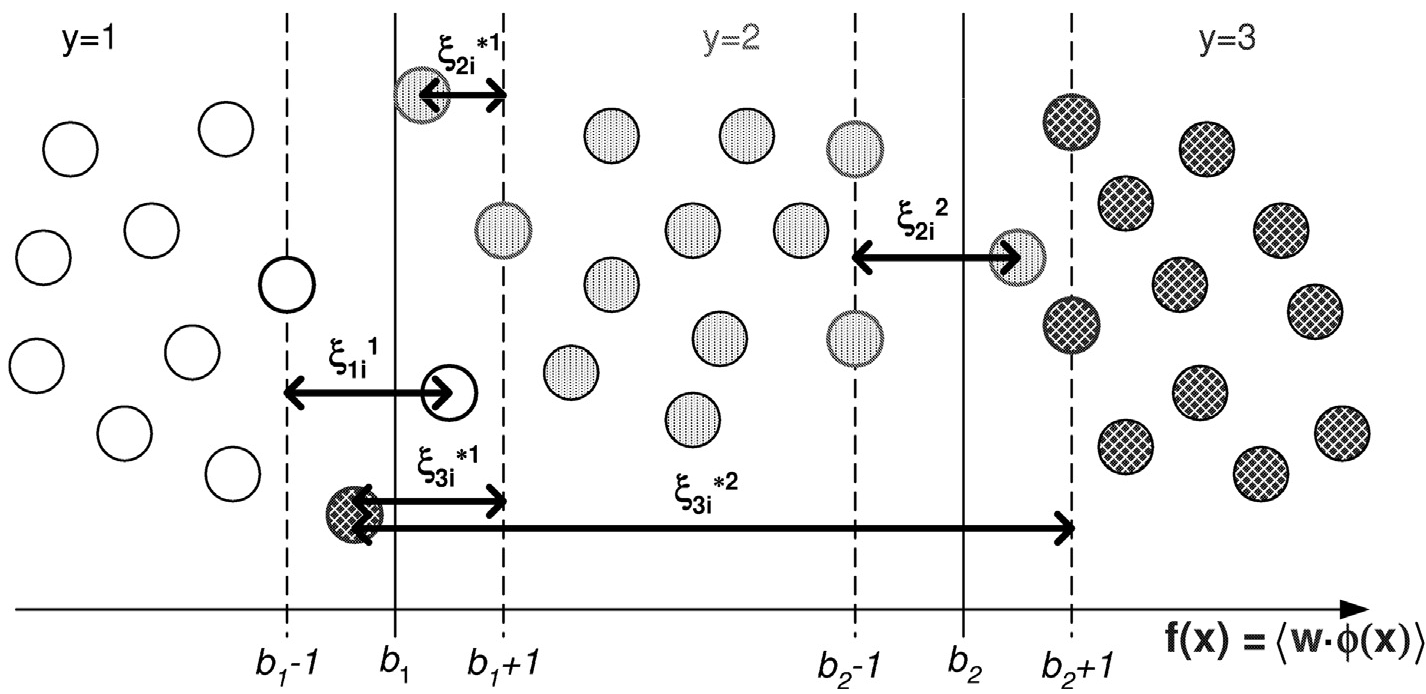 Figure 1: Illustration of the SVOR principle where thresholds define boundaries for ordered classes.
Experimental Battleground
The authors tested several models on a dataset of 320 individuals evaluating 17 top stars (including Brad Pitt, Johnny Depp, and Leonardo DiCaprio).
Key Findings:
- Ordinal Supremacy: SVOR and SVR (regression) significantly outperformed standard Classification (SVM). This confirms that "order" is a vital signal in the data.
- The Gender Divide:
- Males: Persuasion is driven primarily by a Knowledge-Attitude route.
- Females: Persuasion is more complex, integrating a Knowledge-Attitude-Emotion route.
- Non-Linearity: Gaussian kernels outperformed linear ones, suggesting the relationship between knowing a star and wanting to see their movie is nuanced and non-linear.
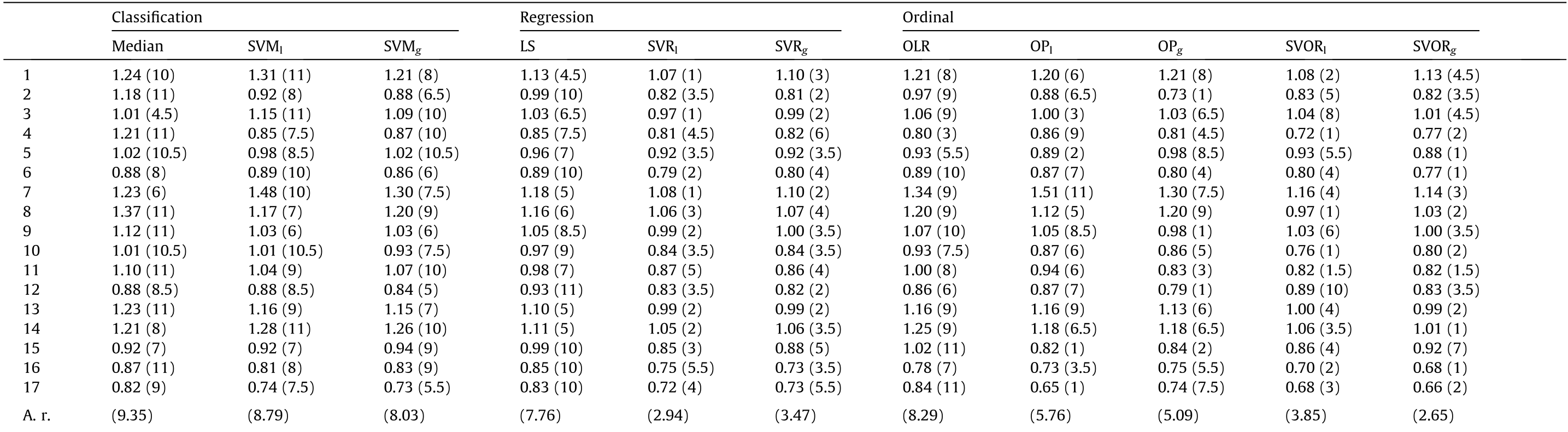 Figure 2: Performance (Linear Loss) of different methods across superstars for the male segment.
Critical Insight & Conclusion
The study’s success in using SVOR highlights a broader truth in Tech and Marketing: The structure of your target variable dictates the ceiling of your model's performance.
Takeaways for Industry:
- Cast Smarter: Don't just pick a "popular" star. Analyze if their "Attitude" and "Emotional" association matches your target demographic's persuasion route.
- Data Strategy: Marketing teams should move from "Yes/No" surveys to "Graded/Ordinal" scales and use specialized ML models to process them.
Limitations:
While the 2014 study was groundbreaking, it relied on survey data. In 2026, we could extend this by replacing questionnaires with Natural Language Processing (NLP) on social media sentiment, using the same Ordinal Logic to gain real-time insights into superstar "Persuasion Power."