
SocialBlue: How Social Networking Bridges the Gap in Global Corporate Acculturation
Organizational acculturation and social networking
This study investigates "SocialBlue," an internal enterprise social networking site (SNS) at IBM, to evaluate its role in organizational acculturation. The research demonstrates that newcomers and geographically distributed employees derive significant value from SNS content to understand corporate culture and improve work productivity.
TL;DR
Integrating into a massive global company like IBM is daunting. This paper reveals that Enterprise Social Networking Sites (SNS) serve as a critical tool for "organizational acculturation"—the process of learning a company's hidden values and beliefs. The study finds that newcomers and geographically distant employees (non-HQ) are the primary beneficiaries, using SNS content to navigate their professional identity and boost productivity.
The Problem: The High Cost of Cultural Isolation
Acclimatizing to a new company isn't just about reading a handbook; it's about "sense-making." For global entities, two specific groups are often left behind:
- The Newcomer: Lacks the historical context of the organization.
- The Distant Employee: Located thousands of miles from headquarters, they lack the "water cooler" moments that transmit culture organically.
Existing studies often focus on socialization (being accepted by a group), but this paper dives into acculturation—the deeper integration of organizational values into an employee's identity.
Methodology: Surveying the Global Hive
The researchers analyzed SocialBlue (formerly Beehive), IBM's internal SNS. With 400,000 employees globally, IBM provided the perfect lab. The team used a dual approach:
- A Survey of 802 users: Measuring perceived benefits via Likert scales.
- Log Analysis: Tracking actual viewing behaviors (photos and profiles) to see if self-reports matched reality.
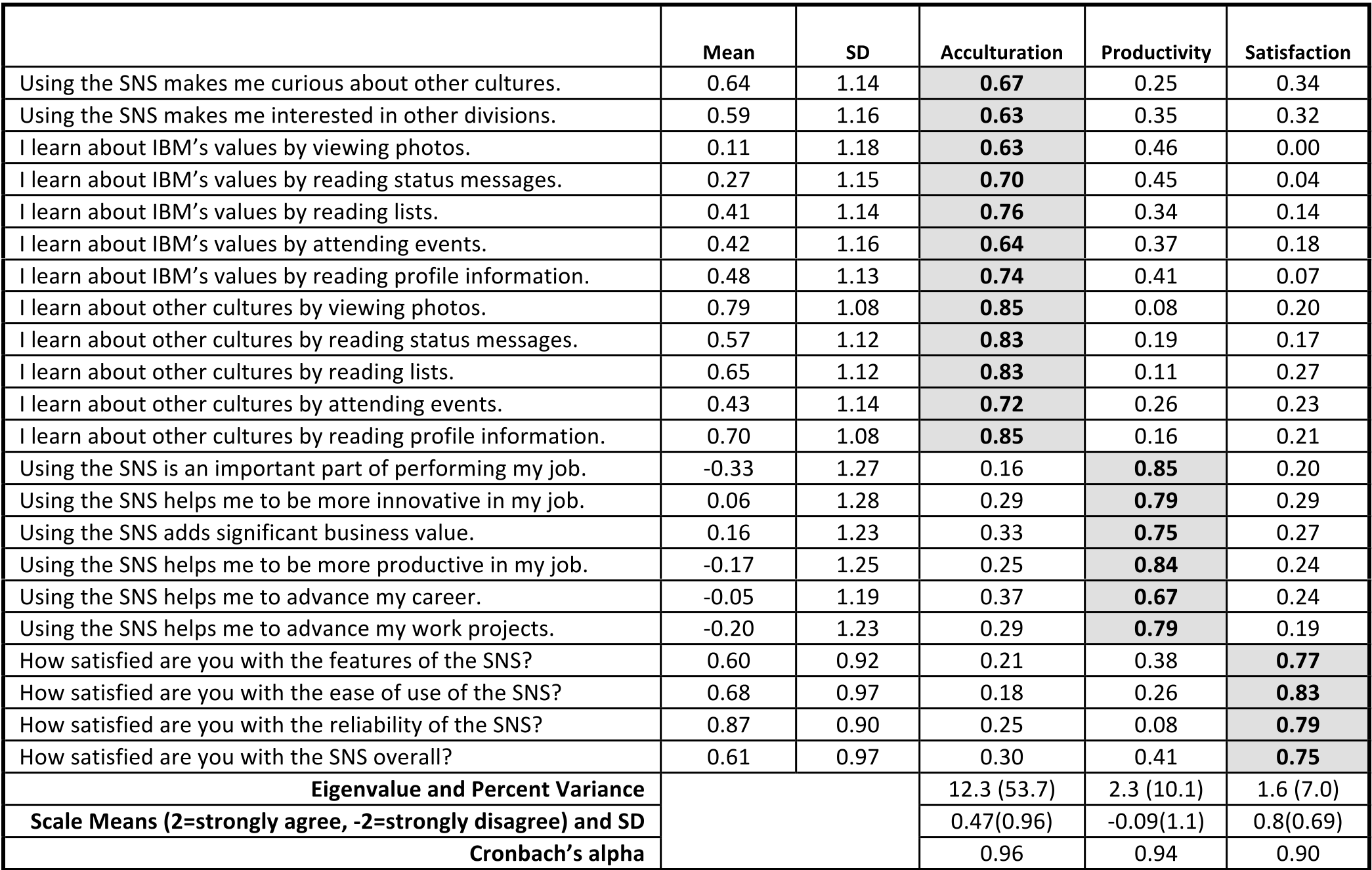 Table 1: The three dimensions that emerged from factor analysis: Acculturation, Productivity, and Satisfaction.
Key Insights: Why "Passive" Consumption Matters
The findings confirm that the SNS isn't just for socializing—it's for working.
1. The Power of "Seeing"
New employees were significantly more likely to agree that they "learn about IBM's values by viewing photos/reading lists." This suggests that "lurking" or passive consumption is a low-risk exploration strategy. It allows a new hire to understand the corporate tone without the fear of appearing "clueless" in a direct interaction.
2. The Geographic Advantage
Employees outside the US (non-headquarters) reported higher agreement on both the acculturation and productivity scales. For a developer in India, the SNS is a window into the "mothership" in New York, providing a sense of belonging that local offices might lack.
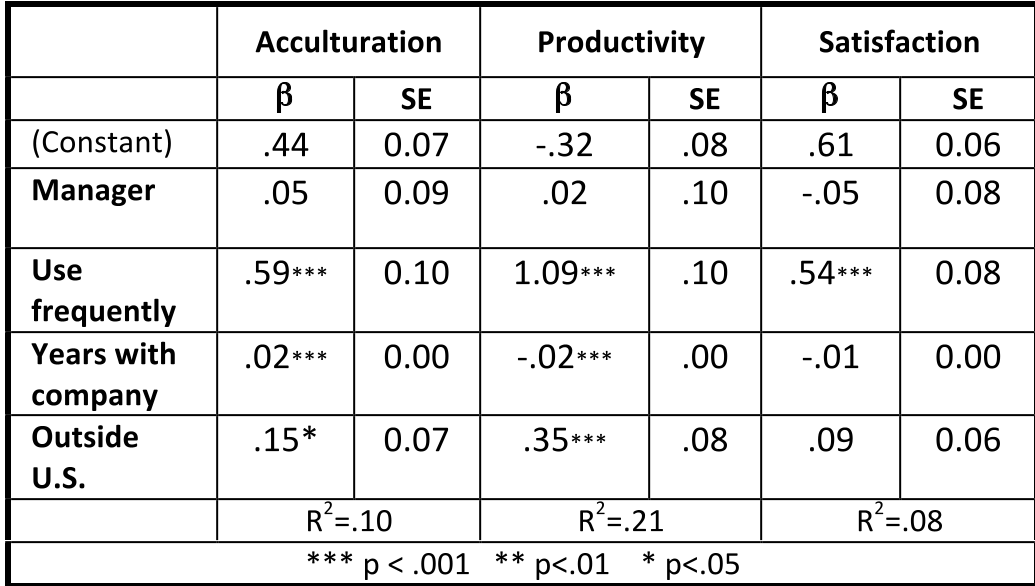 Table 2: Regression results showing that "Years with company" negatively correlates with acculturation perceived benefit—meaning the newer you are, the more you value the SNS.
Regional Surprises: The India vs. US Gap
Perhaps the most striking finding was the behavioral difference between regions.
- Indian Newcomers: Viewed an average of 154 photos and 182 profiles.
- US Newcomers: Viewed only 12 photos and 16 profiles.
This massive disparity suggests that in regions where the corporate culture is "imported" (like a US firm in India), employees are much more aggressive in their "information-seeking" activities to bridge the cultural distance.
Critical Analysis & Conclusion
Takeaways
- Don't ignore the "Lurkers": Passive consumption of profiles and photos is a valid and vital part of onboarding.
- Bridge the HQ Gap: For global companies, digital tools aren't just for "chatting"; they are identity-building infrastructure.
Limitations
The study relies on self-reported data for the survey portion, which can be biased. Furthermore, it doesn't prove causality—we don't know for sure if the SNS caused better acculturation, only that the most successful "acculturators" were active on the site.
Future Outlook
As corporate culture moves toward "hybrid" and "remote-first," the lessons from SocialBlue are more relevant than ever. Future research should look at how multimedia (video, TikTok-style internal clips) further accelerates the sense-making process for the next generation of workers.
Final Thought: In the global enterprise, "learning by seeing" is the new digital apprentice model.