
Safeguarding Social Networks: A Constraint Programming Approach to Outlier Detection
Outlier and anomalous behavior detection in social networks using constraint programming
This paper introduces a novel approach for detecting structural anomalies in social networks by combining Graph Pattern Matching with Constraint Programming (CP). It specifically targets the identification of anomalous nodes and edges through a specialized Neighborhood Constraint, achieving high matching accuracy and real-time performance across various social network datasets.
TL;DR
In the evolving landscape of online social networks (OSNs), detecting cyber-malefactors requires more than just statistical summaries; it requires precise structural analysis. This paper proposes a Constraint Programming (CP) framework that treats anomaly detection as a graph pattern matching problem. By leveraging a unique Neighborhood Constraint, the system identifies replaced nodes and altered relationships with 100% accuracy and sub-150ms latency, making it a viable candidate for real-time security.
Background: The Structural Identity of an Outlier
Traditional outlier detection often asks, "Is this node unusual?" This paper shifts the focus to: "Has this node been replaced by an impostor, and how has the neighborhood changed?" In a social graph, your identity is defined by your connections. An attacker might take over a node but will inevitably tip their hand by deleting old friendships or aggressively creating new ones. Identifying these specific structural "mutations" is the core mission of this research.
The Problem: The Complexity of Graph Matching
Matching an original graph () to a modified pattern () containing outliers is a variation of the Subgraph Isomorphism problem, which is notoriously NP-Hard. Most existing solutions either:
- Look Global: Missing small, local, yet harmful changes.
- Lack Insight: They can flag an anomaly but can't explain what exactly happened to the neighborhood.
Methodology: Detection via Constraint Satisfaction
The authors transform the matching task into a Constraint Satisfaction Problem (CSP). Instead of brute-force searching, they define a logical space where a solution must satisfy three rules:
- ID Filtering: If a node's ID in the pattern matches the original, it's flagged as "normal" and pruned from the search space.
- All-Different (alldiff): Ensures that no two original nodes are matched to the same outlier.
- The Neighborhood Constraint (The Secret Sauce): For nodes that don't match by ID (the suspected victims), the algorithm matches them to the value in the pattern that shares the maximum number of common neighbors.
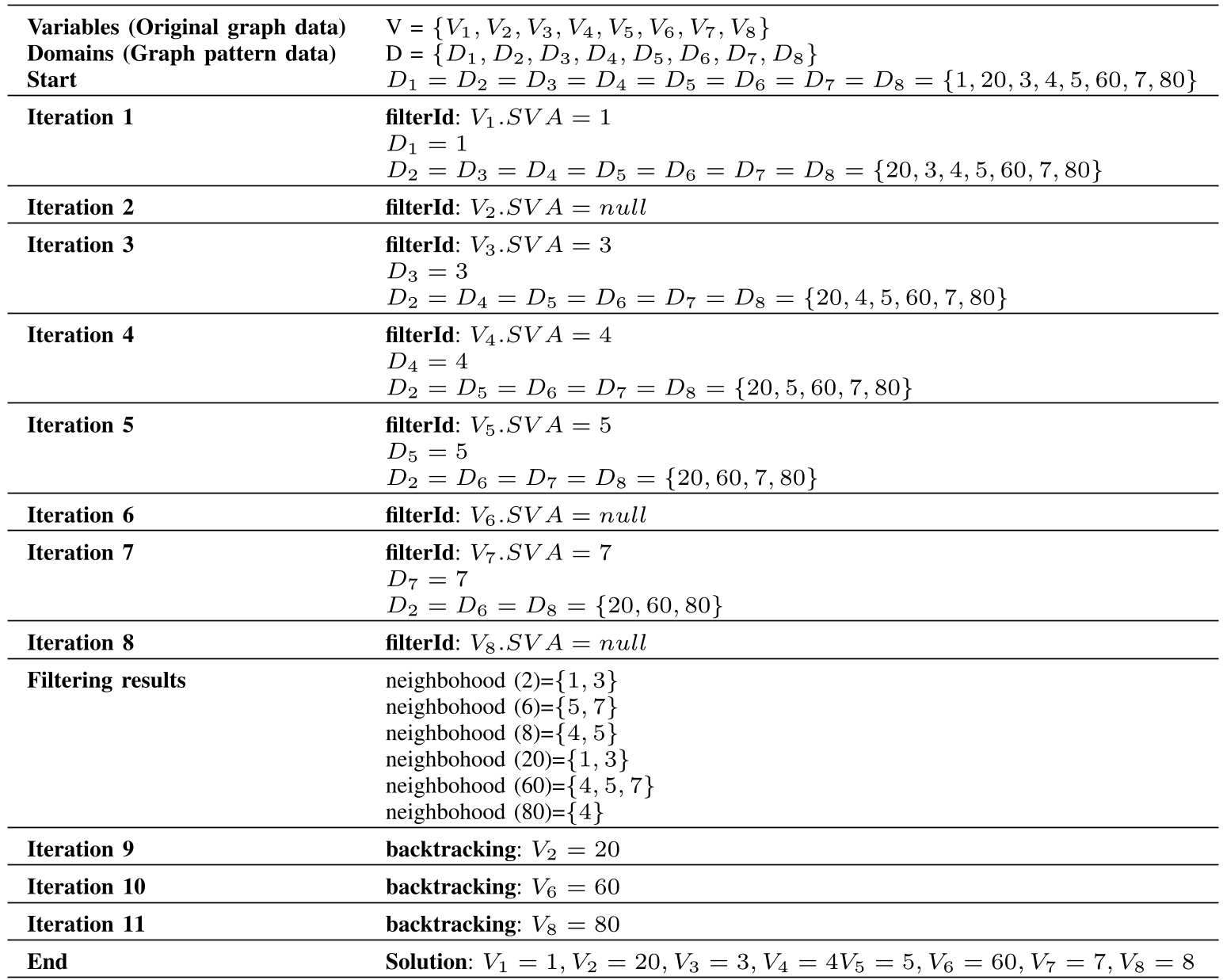
The table above illustrates the execution flow: from initial ID filtering to the final backtracking that uses neighborhood overlaps to resolve the identity of outliers.
Experiments: Real-World Latency and Accuracy
The researchers tested their approach on three diverse datasets: WikiSigned (trust interactions), HEP-PH (physics collaborations), and Cond-mat (authorship networks).
Key Performance metrics:
- Accuracy: Across four scenarios (5 to 200 injected outliers), the Detection Rate was a perfect 100%.
- Speed: Even on the largest graphs, the computation time was extraordinarily low.

As seen in the results, the HEP-PH dataset, despite being smaller in node count, took slightly longer because of its high edge density (237k edges for 12k nodes). This confirms the intuitive logic that a denser neighborhood requires more "checks" during the backtracking phase.
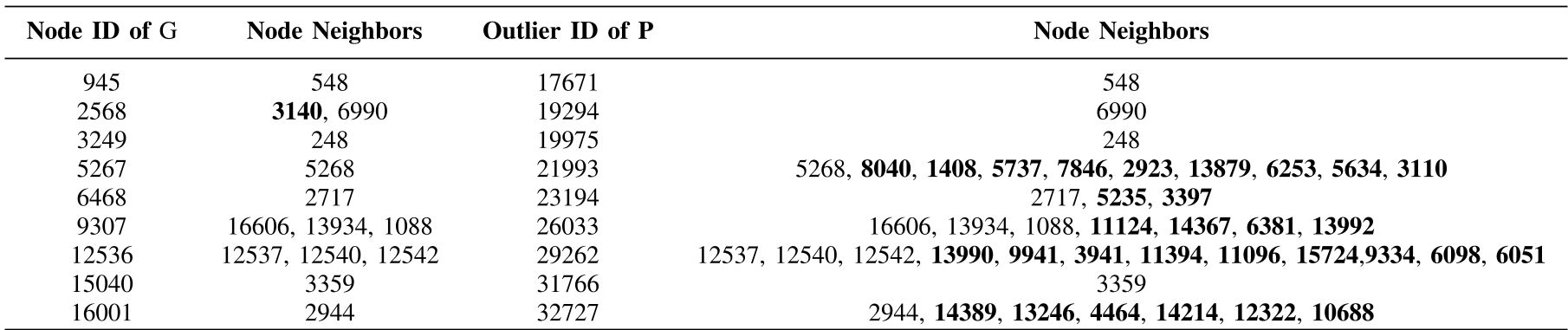
This breakdown from the Cond-mat dataset shows how the algorithm successfully identified specific behaviors: Node 32727, for instance, was flagged as "harmful" because it added 6+ new relationships that didn't exist in the original graph.
Depth Insight: Why it Works
The brilliance of this approach lies in the Filter-then-Search strategy. By using filterId() as a preprocessing step, the algorithm reduces the search space of the NP-Hard matching problem to only the "damaged" parts of the graph. The Neighborhood Constraint effectively uses the social "DNA" of a node (its friends) to re-identify it even after it has been tampered with.
Conclusion & Limitations
While the current work is optimized for static graphs, it provides the foundational logic needed for real-time streams. The speed results suggest that a sliding-window implementation for dynamic graphs is within reach. However, the approach currently assumes we have access to a "ground truth" (Original Graph ). In real-world scenarios, finding the point of divergence in a purely streaming environment without a reference graph remains a challenging next step.
For security professionals, this methodology offers a mathematically rigorous way to define "suspicious behavior" not as a vibe, but as a provable violation of structural constraints.