
Outsourcing Rework: Optimizing the EPQ Model with Imperfect Items and Backorders
14377_Outsourcing Rework of Imperfect Items in the Economic Production Quantity (EPQ) Inventory Model With Backordered Demand.
This paper develops an extended Economic Production Quantity (EPQ) inventory model that incorporates random imperfect items and backordered shortages, specifically focusing on the strategy of outsourcing rework to an external repair store. It identifies three distinct scenarios based on the timing of receiving repaired items and provides closed-form optimal solutions for production lot size () and backorder levels ().
TL;DR
In modern manufacturing, producing the "perfect" lot is often impossible. This paper tackles a realistic scenario where a company faces a random rate of imperfect items but cannot repair them in-house due to technical or scheduling constraints. By outsourcing rework and allowing backordered demand, the authors provide a mathematical framework to determine the optimal production quantity and backorder levels across three timing-based scenarios.
Context: Why Traditional EPQ is Not Enough
Standard inventory models (EOQ/EPQ) are built on the "Ideal World" premise: machines never fail, and products are always perfect. However, real-world yields are stochastic. When items are defective, a manufacturer has three choices: scrap them, sell them at a discount (salvage), or repair them (rework).
The authors argue that for many SMEs (Small and Medium Enterprises), in-house rework is a trap. It interrupts production schedules for new orders and requires specialized machinery (like welding or precision turning) that might not be cost-effective to own. Thus, outsourced rework is the focal point of this study.
The Core Insight: Timing is Everything
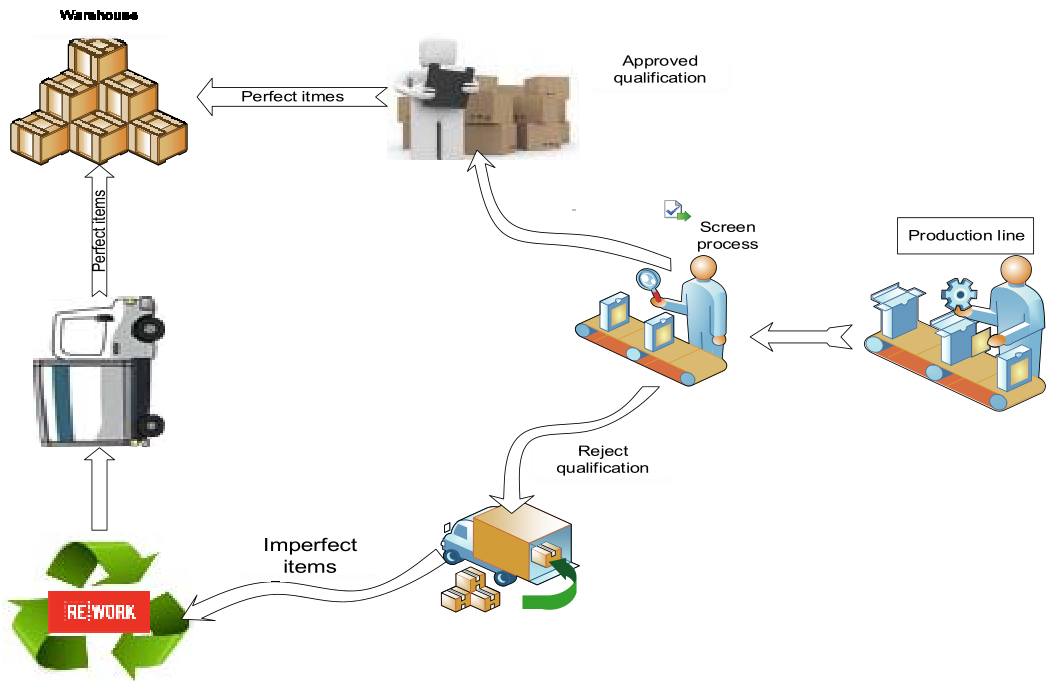
The papers's primary contribution lies in analyzing the re-entry timing of repaired items into the inventory. The system follows a lifecycle: Production Screening Outsourcing Return. But when should those "healed" items arrive?
- Case I: Returned when the main inventory is still positive.
- Case II: Returned exactly when the main inventory hits zero.
- Case III: Returned when the system is in a state of shortage (negative inventory).
Methodology & Mathematical Intuition
The authors define the total cost at the repair shop () using a markup on top of fixed setup costs , transportation , and variable labor . One key assumption—borrowed from Jaber et al.—is that the holding cost for repaired items () is higher than initial holding costs, reflecting the added value and investment.
The optimization is achieved by minimizing the total cost function . By proving that the Hessian Matrix of this function is positive definite, the authors confirm the function is convex, ensuring that the derived and are global optima.
Experimental Findings: Which Case Wins?
Through numerical examples using uniform distributions for imperfect rates , the study reveals a clear hierarchy.

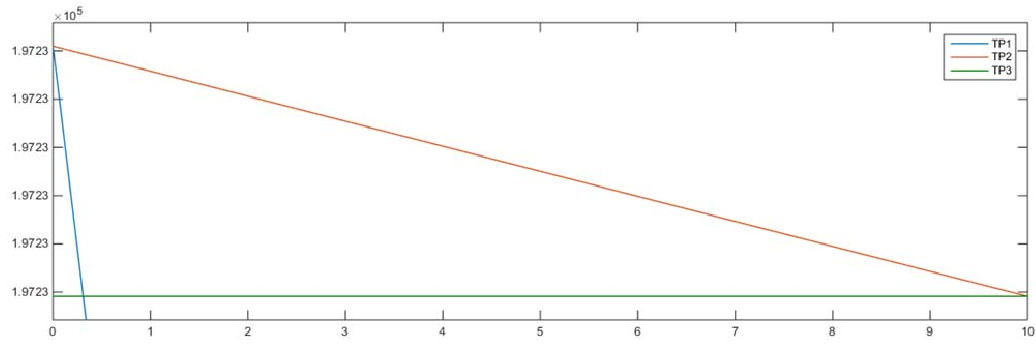
- The Winner: Case II usually provides the highest total profit.
- The Logic: If the holding cost of repaired items is less than the backorder cost, receiving items when inventory is zero avoids unnecessary holding time while preventing deepened shortages.
- Sensitivity: As the markup () from the repair shop increases, profit drops linearly, but the optimal (Lot Size) remains relatively stable, suggesting the model is robust for scheduling.
Critical Insight & Industry Value
The value of this research is its operational flexibility. It gives production managers a "cheat sheet" (Equations 22 and 23) to calculate exactly how many units to produce and how many backorders to tolerate based on their specific outsourcing contract terms.
Key Takeaways for Future Research:
- Stochasticity: While the rate of defects is random, the demand is fixed. Integrating stochastic demand would be the next frontier.
- Multi-Product: Managing diverse product lines with a single outsourcing partner adds combinatorial complexity that this single-item model paves the way for.
Conclusion
This paper elevates the EPQ model from a textbook abstraction to a pragmatic tool for SMEs. By mathematically justifying outsourced rework, it proves that "paying someone else to fix your mistakes" is not just a convenience—it is an optimizable strategy for profit maximization.