
Beyond 140 Characters: Bootstrapping Twitter for Deep Autism Content Analysis
Overcoming Data Scarcity of Twier: Using Tweets as Bootstrap with Application to Autism-Related Topic Content Analysis
This paper introduces a novel "bootstrapping" framework for Twitter data mining that overcomes the 140-character limit by extracting content from URLs linked within tweets. Applied specifically to Autism Spectrum Disorder (ASD) communities, the method utilizes a Hierarchical Dirichlet Process (HDP) and similarity graphs to track the temporal evolution of complex topics with greater semantic depth than traditional hashtag analysis.
TL;DR
Social media mining on Twitter has long been hampered by the platform's brevity. This paper presents a breakthrough approach: instead of treating tweets as the final data source, it uses them as bootstraps to fetch rich content from embedded URLs. By combining this "data enrichment" with a Hierarchical Dirichlet Process (HDP) and a temporal similarity graph, the authors successfully mapped and tracked complex discussions within the Autism Spectrum Disorder (ASD) community over 13 months.
Problem & Motivation: The Semantic Gap of Brevity
The core challenge in social media analytics is data scarcity. With an average of only 13 terms per tweet, traditional topic models struggle to find meaningful co-occurrence patterns. For specialized fields like public health and Autism research, this "semantic gap" is devastating.
Existing methods often rely on hashtags, but as the authors point out, hashtags are meta-data labels that often fail to capture the actual "essence" of a conversation. For a community dealing with sensitive issues—ranging from vaccine myths to educational hurdles—relying on a few keywords is insufficient for policy makers or researchers who need to understand the nuance of public sentiment.
Methodology: The URL-as-Enrichment Trick
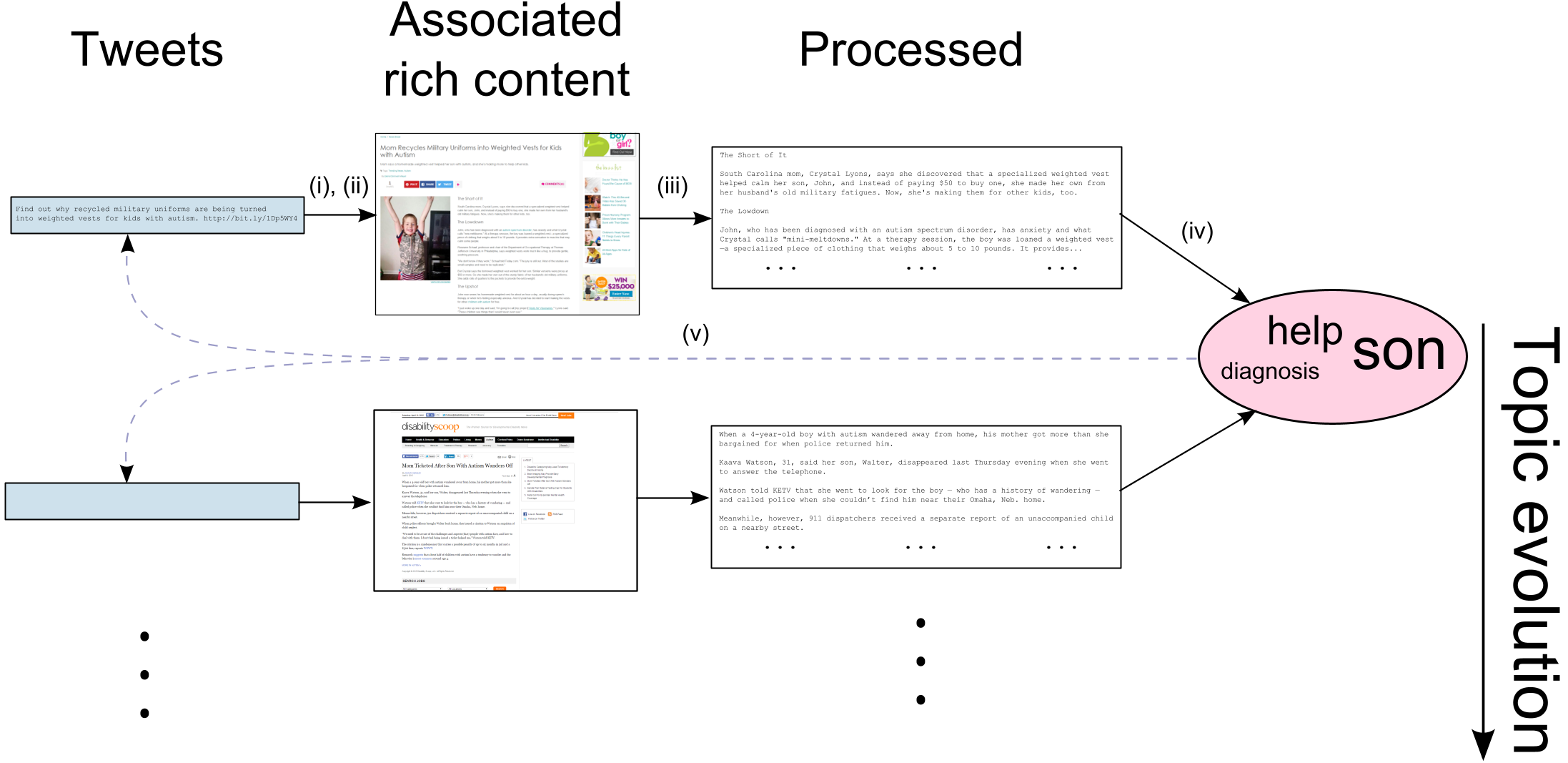
The authors' research intuition was simple yet powerful: users who share informative content on Twitter usually include a link. By following these links, researchers can access full-length articles, blogs, and reports that provide the semantic context the tweet itself lacks.
The Analytical Pipeline:
- Identification: Extract URLs from ASD-related tweets (detected via keywords like "autism," "asperger," etc.).
- Web Scraping: Automatically fetch HTML content, discarding noise (headers, menus, ads) while retaining the core article text.
- HDP Modeling: Use a Hierarchical Dirichlet Process to discover an unspecified number of topics within short time "epochs" (3-day windows).
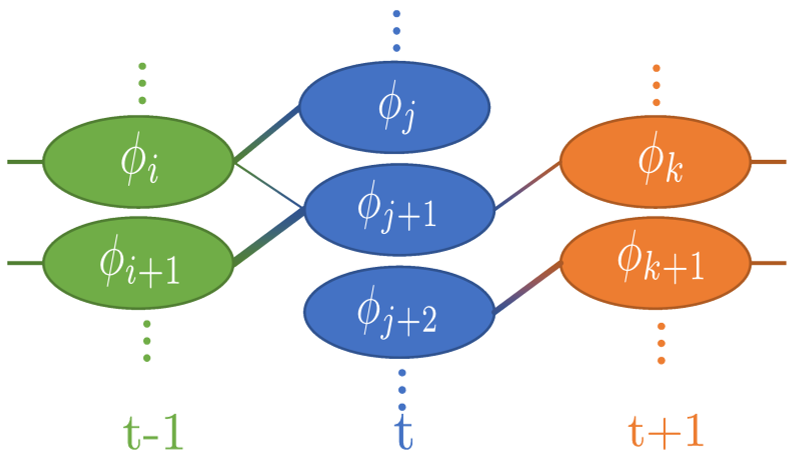
- Temporal Tracking: Link topics across epochs using a Jaccard similarity graph to observe how ideas evolve.
Analyzing the Topic Evolution
The HDP model allows for a non-parametric approach where the number of topics isn't fixed, which is perfect for the "ephemeral" nature of social media. The authors introduce a Similarity Graph to visualize the lifecycle of a topic.
- Emergence (Birth): A new topic appears with no prior connection.
- Splitting: A general topic diverges into specialized discussions.
- Merging: Two separate conversations (e.g., "schooling" and "vaccination myths") converge into a single narrative.
Experiments & SOTA Insights
The study analyzed 5.6 million tweets over a 13-month period. By using enriched URL data, the dictionary size expanded from a paltry 1,500 terms (tweet-only) to over 6,500 terms, allowing for much finer granularity.
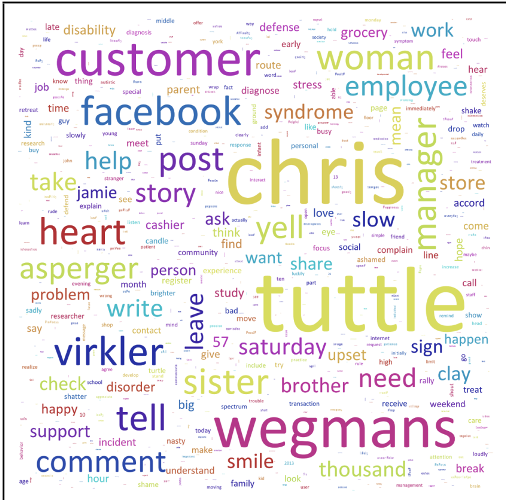
As shown in the word clouds below, the model successfully identified specific real-world events, such as the media firestorm surrounding Chris Tuttle (an employee with Asperger's) and persistent debates over thimerosal in vaccines.
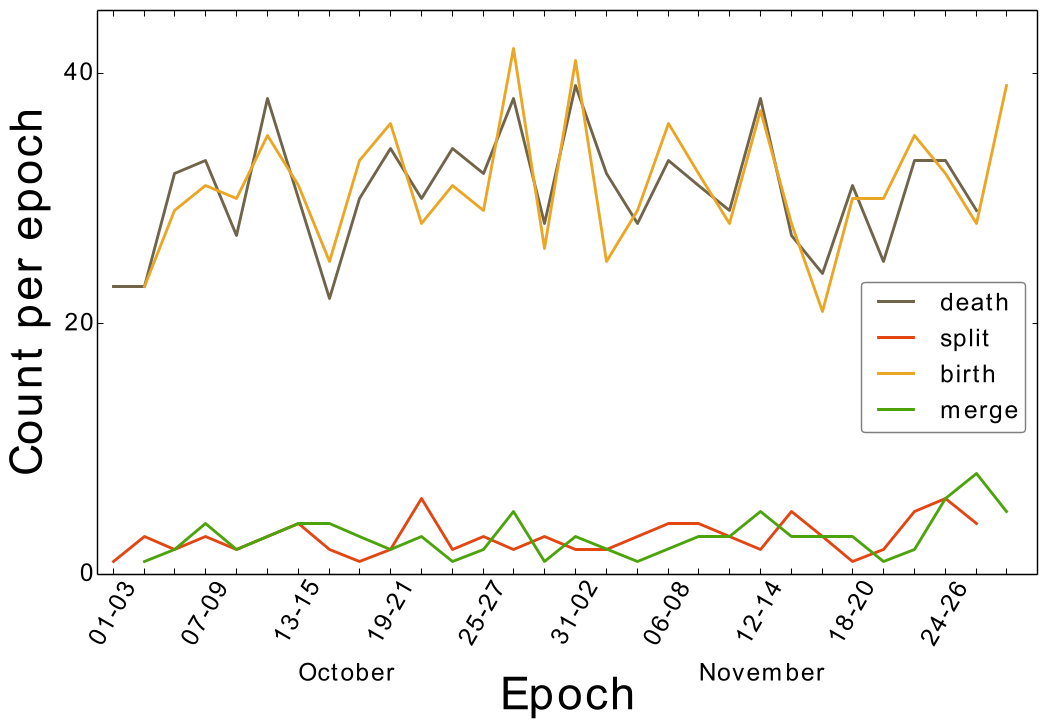
The temporal analysis (graph below) confirms Twitter's dynamic nature: new topics emerge constantly ("Births"), but many are "ephemeral," dying out quickly after a news cycle ends.
Critical Analysis & Conclusion
Takeaway: This work demonstrates that effectively mining social media requires looking past the platform itself. By using tweets as pointers rather than endpoints, researchers can bridge the semantic gap.
Limitations: While powerful, the method currently focuses on HTML text. A significant portion of social media content is now video-based (YouTube, TikTok). Future iterations would benefit from including audio-to-text or computer vision modules to "read" the videos linked in tweets.
This framework represents a significant step forward for Digital Phenotyping and public health surveillance, providing a lens into communities that are often excluded from traditional surveys.