
MOEA-DIM: Bridging Influence and Diversity via Overlapping Community Detection
An Overlapping Community Detection Based Multi-Objective Evolutionary Algorithm for Diversified Social Influence Maximization
The paper introduces MOEA-DIM, a Multi-Objective Evolutionary Algorithm designed for Diversified Social Influence Maximization. It leverages overlapping community detection to balance influence spread and audience diversity without requiring manual trade-off parameters or external node metadata.
TL;DR
Social Influence Maximization is no longer just about reaching the most people; it's about reaching the right, diverse groups. This paper introduces MOEA-DIM, a multi-objective evolutionary approach that maximizes both influence and diversity. By utilizing overlapping community structures, the algorithm bypasses the need for sensitive node metadata and manual parameter tuning, achieving superior efficiency and a better trade-off front than traditional greedy methods.
Context & Motivation: Why Diversity Matters
In viral marketing, targeting a single tight-knit cluster might yield high influence numbers but fails to "spread the word" across different social strata. Existing solutions to "Diversified Social Influence Maximization" (DSIM) suffer from two fatal flaws:
- Data Dependency: They require "category information" (e.g., user interests, demographics) which is often private or unavailable.
- The Dilemma: They combine influence and diversity into one score using a weight . In practice, picking the right without prior knowledge is nearly impossible.
The authors' insight is simple yet powerful: Topology is Destiny. If we can identify overlapping communities, we can define diversity based on how many different "social circles" a seed set penetrates.
Methodology: The Core of MOEA-DIM
1. Defining Structural Diversity
Instead of categories, the authors use StructDiversity. Each node is mapped to a distribution across overlapping communities (detected via the SLPA algorithm). Diversity is then calculated as the Shannon entropy of the influence distribution across these communities.
2. The MOEA-DIM Framework
The algorithm treats DSIM as a true multi-objective problem, seeking the Pareto Front—a set of solutions where you cannot increase influence without decreasing diversity.
Key Innovation: Network Reduction
To handle large networks, the authors don't search the whole graph. They prune it down to a candidate set using two new metrics:
- StructDegree: Measures influence potential by weighing connections to "overlapping nodes" (the bridges between communities).
- NeiDiversity: Measures the diversity of a node's immediate neighbors.
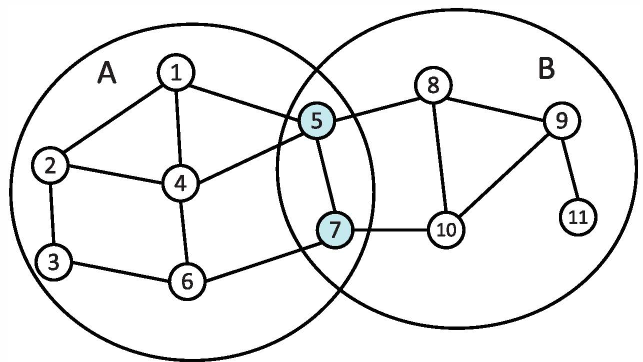 Figure 1: Illustration of nodes bridging different communities (A and B).
3. Population Initialization
Standard evolutionary algorithms start with random guesses. MOEA-DIM uses a Random Walk-based RScore to pick "smart" starting points, significantly speeding up the time it takes to find the Pareto Front.
Experimental Validation
The authors tested MOEA-DIM on 6 real-world networks. The competition included D-Inf (the state-of-the-art greedy algorithm).
Performance & Efficiency
- Effectiveness: MOEA-DIM consistently found solutions that provided more diversity for the same level of influence compared to D-Inf.
- Speed: On the Anybeat network, MOEA-DIM was nearly 55x faster than the greedy approach.
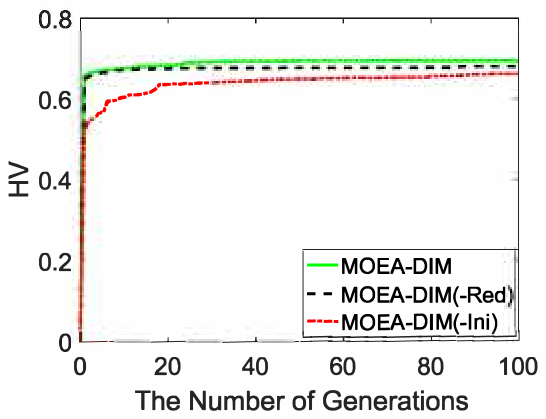 Figure 2: Objective Space plots showing the Pareto Front of MOEA-DIM compared to D-Inf. Note the wider and more optimized distribution of MOEA-DIM.
Critical Analysis & Takeaways
The brilliance of this work lies in its Inductive Bias: the assumption that social diversity is mirrored in graph topology. By moving from a single-objective greedy search to a multi-objective evolutionary search, the authors solve the "tuning" problem—practitioners can now choose from a menu of optimal solutions based on their specific budget or goals.
Limitations: While internal network reduction helps, the reliance on Monte Carlo simulations for influence estimation remains a bottleneck for billion-scale graphs. The MOEA-DIM(EDV) variant attempts to fix this with heuristics, but at a slight cost to accuracy.
Future Outlook: This framework paves the way for "Diversity-Aware" AI in social media, potentially mitigating echo chambers by ensuring information doesn't just stay within a single community.