
Bridging the Gap: A Two-Step Genetic Approach to Overlapping Community Detection
Overlapping Community Detection in Social Network Using Disjoint Community Detection
This paper introduces a two-step genetic algorithm (GA) for detecting overlapping community structures in social networks. The method first identifies disjoint communities by optimizing Newman's modularity and subsequently determines overlapping nodes by evaluating boundary node connectivity using a novel MinMax rate metric.
TL;DR
Social networks are rarely composed of isolated clusters; in reality, we live in "overlapping" worlds. This paper proposes a robust two-step framework: first, it uses a Genetic Algorithm (GA) to find the most stable disjoint communities, and then it applies a specialized boundary-node analysis (the MinMax rate) to identify which individuals actually bridge multiple groups. The result is a highly scalable method that achieves state-of-the-art accuracy on classic benchmarks.
Background: The Limits of Hard Partitioning
In network science, community detection is often treated as a "hard" clustering problem—every node belongs to exactly one group. However, think of a university professor: they belong to their academic department, a research lab, and perhaps a faculty sports club.
Previous methods like the Clique Percolation Method (CPM) struggle with scalability in sparse or very large graphs. Meanwhile, pure Genetic Algorithms often face a massive search space when trying to account for overlaps from the start.
Methodology: The GA-MinMax Pipeline
The authors break the problem into two distinct phases to balance global optimization with local refinement.
1. The Global Search (Disjoint Phase)
The algorithm employs a node-centric genetic representation. Each "individual" in the population represents a potential partition.
- Encoding: Nodes and their adjacent edges are encoded as genes.
- Optimization: The fitness function is Newman’s Modularity (Q), which measures the density of connections within groups versus a random null model.
- Decoding: It uses Breadth-First Search (BFS) to interpret these genetic strings into actual community clusters.
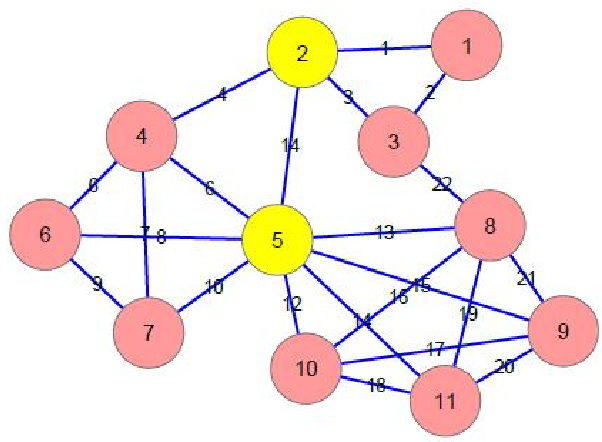
2. Identifying the "Bridges" (Overlapping Phase)
Once the disjoint communities are set, the algorithm looks at boundary nodes—those with links pointing to outside groups. It introduces the MinMax rate:
If a node’s MinMax rate exceeds a threshold (), it implies the node has a significant presence in both the internal community and an external one. It is then classified as an overlapping node.
Experimental Results & Performance
The algorithm was tested on several iconic datasets, including the Zachary’s Karate Club and Protein Interaction networks.
- Modularity Gain: The study found that (overlapping modularity) is consistently higher than (disjoint), proving that allowing nodes to overlap reflects the true network topology more accurately.
- NMI Superiority: On the Dolphin network, the method achieved an NMI of 0.8448, vastly outperforming the GA-NET baseline of 0.3400.
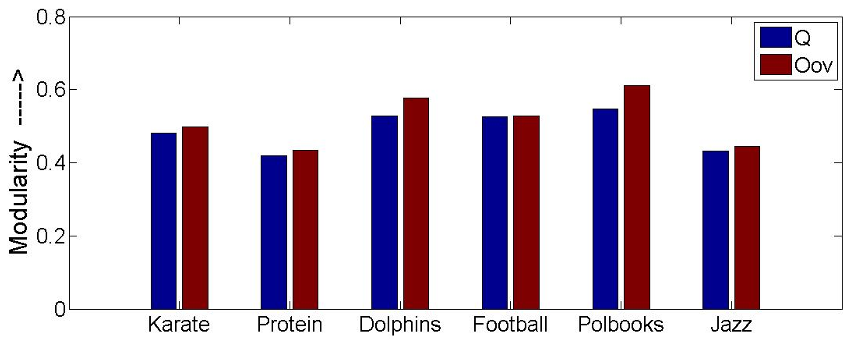 Fig: Comparison of NMI values showcasing the algorithm's stability across different datasets.
Convergence Analysis
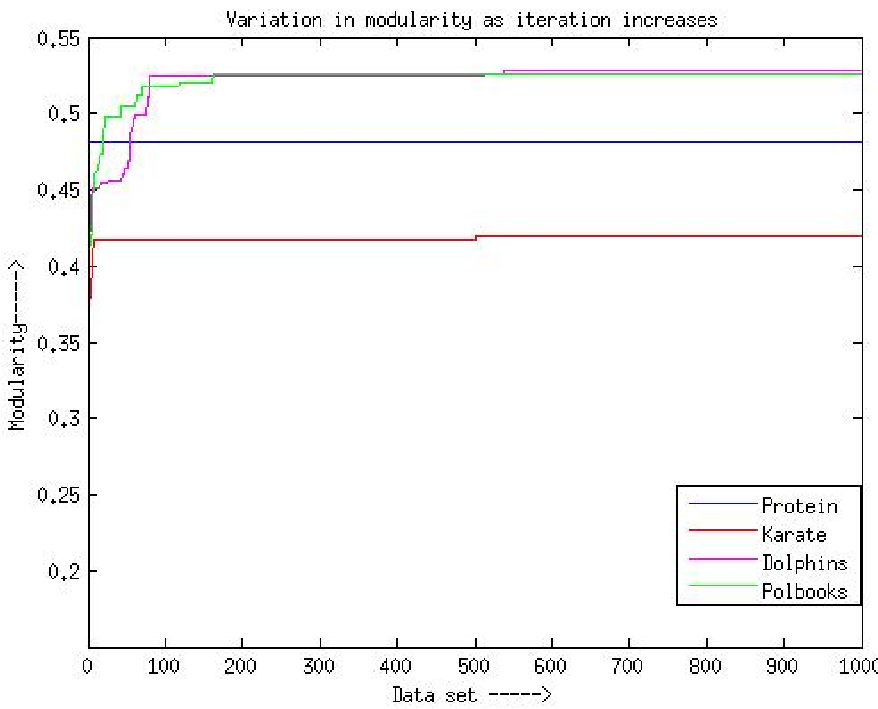
One of the highlights of this GA approach is its convergence behavior. The modularity score typically plateaus around 600 iterations, suggesting that the search strategy is efficient even for complex social graphs.
Critical Insight & Conclusion
The genius of this work lies in its simplicity. Instead of redesigning the GA to handle the exponential complexity of overlapping permutations, it leverages the efficiency of disjoint detection and cleans up the "fuzzy" boundaries using a logical, connectivity-based heuristic (MinMax).
Future Outlook: While the approach is effective, the threshold is currently static. Future iterations of this research could benefit from an adaptive thresholding mechanism that adjusts based on the local density of specific community neighborhoods.