
Overlay SNS: Redefining Social Interaction Through Virtual Layering
12789_Overlay SNS Next generation social network service.
This paper introduces Overlay SNS (OSNS), a next-generation social network framework that creates a virtual abstraction layer over existing "physical" networks such as legacy SNSs, email, and telephone contacts. By decoupling social media generation from specific platforms, it enables intelligent content propagation and consumption based on user context and "Social Bandwidth."
TL;DR
Overlay SNS (OSNS) is a visionary framework designed to act as a "smart mediator" between users and the fragmented world of social media. By treating existing platforms like Facebook or Email as mere physical infrastructure, OSNS creates a virtual overlay that automatically routes, filters, and summarizes content based on a user's "Social Bandwidth" and real-world relationships.
The "Physical" Limit of Social Networks
Current social media ecosystems are siloed and "caller-driven." If you want to share an update, you must decide where (LinkedIn? Twitter?) and to whom (Public? Friends-only?). Conversely, readers are bombarded with a literal "firehose" of information, much of which is redundant or untrustworthy.
The authors identify three critical pain points:
- Information Overload: Constant notifications exceeding human processing capacity.
- Privacy Threats: The lack of granular, cross-platform control over who sees what.
- Device/Network Fragmentation: The difficulty of maintaining a seamless social experience when switching between professional and personal devices.
Methodology: The Anatomy of OSNS
The core innovation lies in treating social interaction as a dynamic routing problem. Instead of a user pushing content to a destination, the OSNS framework calculates the optimal path and audience based on the content's context.
Key Architectural Components:
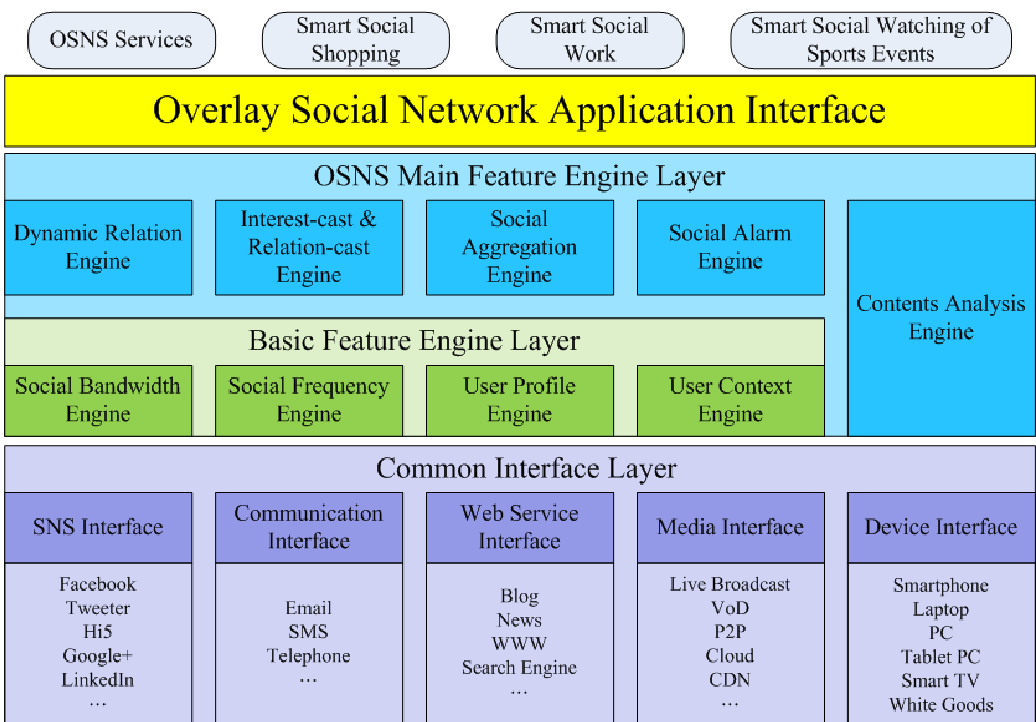
- Social Bandwidth & Frequency: These metrics define the "quota" of social data a user is willing to consume in a given time frame.
- Interest-cast & Relation-cast: Rather than broadcasting, OSNS "casts" content to specific overlay networks created on the fly based on the author's intent and the reader's interests.
- Social Aggregation: This module functions as an intelligent filter, summarizing massive streams of data into reliable, non-redundant insights.
Real-World Scenarios
The paper highlights three distinct use cases illustrating the framework's versatility:
- Smart Social Shopping: Instead of browsing multiple sites, a user snaps a barcode, and OSNS aggregates reviews from friends, experts, and blogs into a single summarized page.
- Smart Social Work: In a corporate setting, OSNS automatically routes a problem report to the correct person in charge by analyzing the text and the organizational chart.
- Co-Watching Sports: It connects fans in real-time without the "noise" of a global public feed, focusing on high-relevance interactions.
Critical Analysis & Results
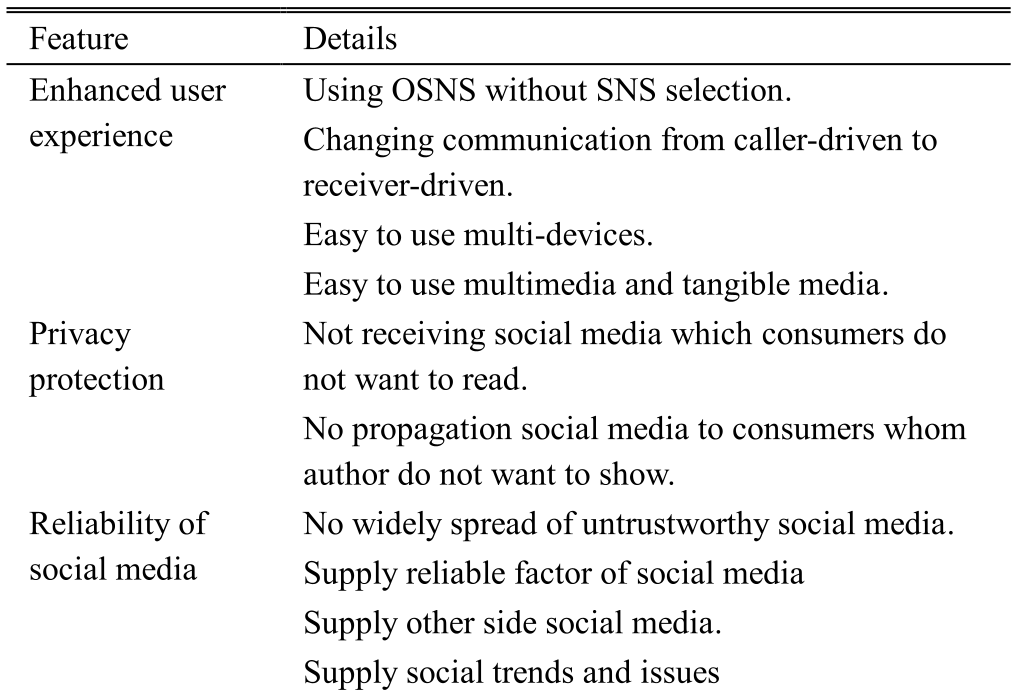
By moving from a platform-centric model to a context-aware overlay, OSNS solves the "SNS Selection" problem. As shown in the feature breakdown, the system provides a significant boost to Reliability and Privacy Protection.
Insights & Takeaways
The brilliance of OSNS is its recognition that a user’s social life is a single continuum, regardless of whether they are using Email, SMS, or a modern SNS. The "Social Bandwidth" concept is particularly prescient, pre-dating the current industry focus on "digital wellbeing" and notification management.
Limitations: While the framework is conceptually strong, the paper remains at a high architectural level. The implementation challenges—specifically how to gain API access to proprietary "physical networks" (like Meta's ecosystem) and the computational cost of real-time multi-source aggregation—remain open questions.
Conclusion
Overlay SNS represents a shift toward Receiver-Driven Communication. In an age where our attention is the most valuable commodity, a system that respects our "Social Bandwidth" while cross-referencing trust across multiple platforms is not just a luxury—it's a necessity for the next generation of the social web.