
Twitter as a Global Sensor: A Deep Dive into Event Extraction Challenges
An Overview of Event Extraction from Twitter
This paper provides a comprehensive survey of Event Extraction (EE) from Twitter, categorizing methods into open-domain and domain-specific approaches. It identifies a three-stage pipeline (EMI, SEE, and EC) and evaluates techniques ranging from unsupervised pattern matching to supervised machine learning.
TL;DR
Twitter has evolved into a "global sensor network" capable of reporting disasters and social unrest faster than traditional media. However, extracting structured data from this chaotic stream is an immense challenge. This survey explores the methodologies of Event Extraction (EE), breaking down how researchers filter out "digital noise" to identify the Who, What, When, and Where of global occurrences in real-time.
The Motivation: Why Traditional NLP Fails on Tweets
Most Event Extraction research originated in the 1990s, focused on well-formatted news articles (e.g., MUC and ACE programs). When applied to Twitter, these models encounter three major roadblocks:
- The Needle in the Haystack: 90% of tweets are personal "ego-centric" updates (e.g., "I'm sleepy") rather than event reports.
- Informal Syntax: Creative spellings ("Wooooow"), irregular abbreviations ("ruok"), and the absence of punctuation break standard dependency parsers.
- Brevity and Sparsity: A single tweet lacks the context found in a full news story, requiring models to "aggregate" information across thousands of messages to build a complete event profile.
Methodology: The Three-Step Pipeline
The authors define the EE process on Twitter through a structured three-subtask framework:
- Event Message Identification (EMI): A binary classification task to determine if a tweet describes a real-world event.
- Semantic Elements Extraction (SEE): Identifying the n-tuple components of an event, such as .
- Event Categorization (EC): Mapping the event to a taxonomy (e.g., Natural Disaster vs. Civil Unrest).
Taxonomy of Approaches
Existing research is categorized by the degree of supervision and the domain scope:
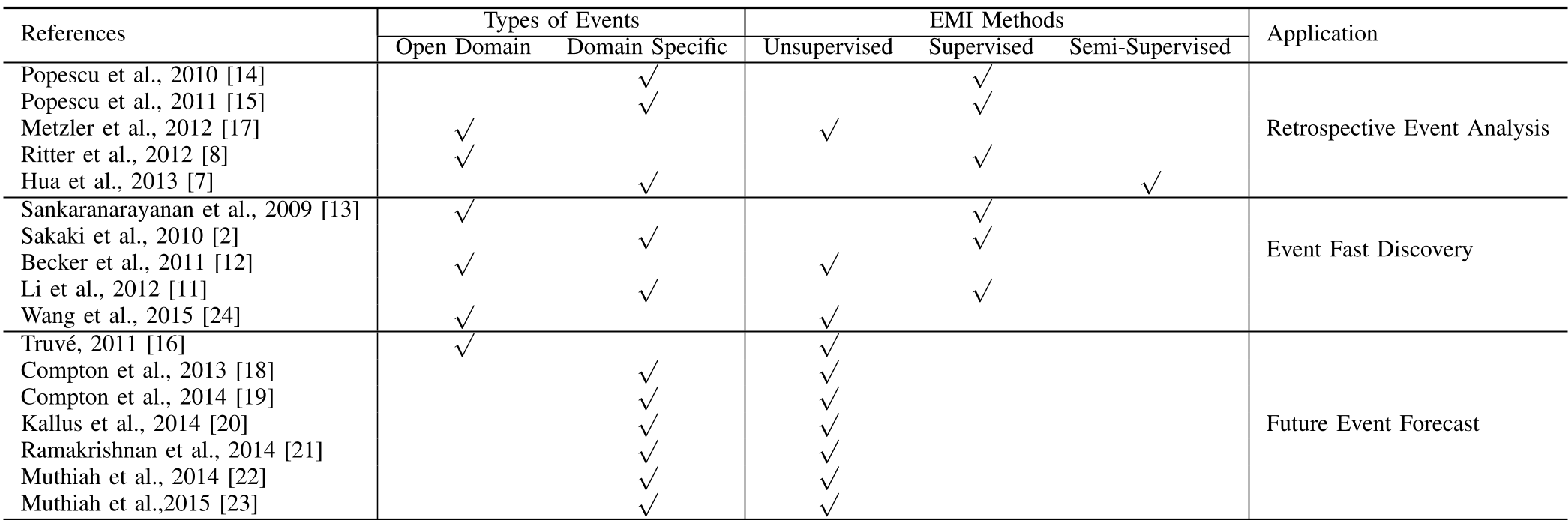
- Open Domain: Aims to extract any significant event using external knowledge bases like WordNet or Wikipedia.
- Domain Specific: Targets high-value events (e.g., "Earthquakes" or "Protests") using specialized keyword expansion.
Key Insights: From Supervised to Semi-Supervised
The survey reveals a critical trend: while Supervised Learning (SVMs, Naive Bayes) provides higher precision for specific tasks, it struggles with the "temporal shift" of Twitter—the way people talk about events changes every week.
Unsupervised Methods leverage "bursty" feature detection. If the word "shaking" suddenly spikes in frequency within a specific geographic coordinate, the system detects an earthquake without needing a pre-trained classifier.
Critical Analysis & Future Directions
The survey concludes by identifying three "missing links" in the current state-of-the-art:
- Online Streaming: Most current papers treat Twitter as a static dataset. True application requires Event Detection and Tracking (EDT), where a model continuously updates an event's "story" as new tweets arrive.
- Multi-Modality: A tweet is more than text; it contains images, hashtags, and a "social graph." Future models should look at the attached photo of a protest or the user's follower network to verify the event's location and credibility.
- Evaluation Crisis: There is a lack of standardized, large-scale corpora for Twitter EE. Most researchers create their own "Gold Standard Reports" (GSR), making it nearly impossible to compare different algorithms' performance fairly.
Conclusion
Event Extraction from Twitter is moving from simple keyword matching to complex, context-aware systems. As we move toward 2026, the integration of multi-modal features and incremental online learning will be the deciding factors in building a truly responsive "World Sensor."
Reference: Deng, J., et al. "An Overview of Event Extraction from Twitter." National University of Defense Technology.