
Precise P2P Monitoring: Leveraging Topological Potential and Social Network Analysis
P2P networks monitoring based on the social network analysis and the topological potential
The paper introduces a P2P network monitoring framework that leverages Social Network Analysis (SNA) and Data Field Theory. It specifically proposes a community-dividing algorithm driven by "Topological Potential" and "Topological Potential Entropy" to identify authoritative center nodes for efficient supervision.
TL;DR
To tackle the security risks of decentralized P2P networks—such as virus spreading and illegal content sharing—this paper presents a method to "divide and conquer." By calculating the Topological Potential of each node (a measure of its influence field), the system automatically identifies central "leader" nodes. Monitoring these few critical nodes allows for efficient oversight of the entire network structure.
Problem & Motivation: The P2P Security Paradox
P2P technologies (like BitTorrent or eMule) have revolutionized resource sharing through multi-point transmission. However, this same efficiency makes them a breeding ground for intellectual property theft and rapid malware propagation.
The core difficulty lies in the Topological Complexity:
- Small-World Effect: Most nodes are separated by very few hops.
- Scale-Free Character: A few "hubs" hold the network together, but finding them in real-time is computationally expensive.
The authors' insight is grounded in Social Network Analysis (SNA): If we treat a P2P network like a human social circle, we can use "Data Field Theory" to reveal the hidden hierarchy.
Methodology: The "Field" of Influence
The core of the paper is the Topological Potential Formula. The authors posit that every node generates a "field" that affects another node based on their shortest path distance .
The interaction is defined as:
Key Concepts:
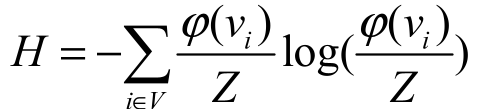
- Impact Factor (): This determines the "visibility" of a node. A small means a node only influences its immediate neighbors, while a large considers the global structure.
- Topological Potential Entropy (): This measures the uncertainty of the network's potential distribution. By minimizing , the authors find the "natural" scale of the network, allowing communities to emerge clearly.
Experiments & Case Study
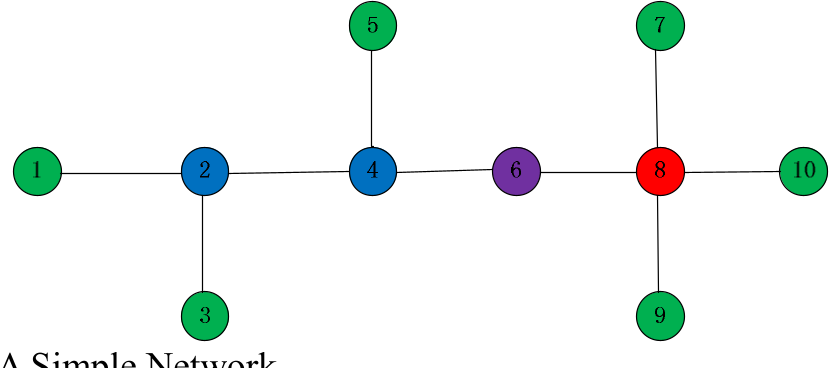
The authors validated their approach using a 10-node network sample. By calculating the potential for each node, they discovered two clear "power centers":
Quantifiable Results:
- Node 8 was identified as the primary center (Potential: 3.5165).
- Node 4 was identified as a secondary center (Potential: 3.1737).
- The algorithm successfully partitioned the 10 nodes into two distinct communities.
Instead of monitoring all 10 nodes, a security system only needs to target nodes 4 and 8 to capture the majority of the network's traffic and behavioral trends.
Critical Analysis & Conclusion
Takeaway
The transition from monitoring connections to monitoring potential fields is a significant step forward. It provides a mathematically rigorous way to handle the "influence" of a node rather than just its raw degree of connectivity.
Limitations
- Computational Complexity: Calculating the shortest distance () between all pairs in a million-node P2P network is or , which may be too slow for real-time monitoring without approximation.
- Static vs. Dynamic: The paper assumes a static snapshot of the network. P2P networks are notoriously "churny" (nodes join and leave constantly), which means the entropy would need to be recalculated frequently.
Future Prospect
Applying this "Topological Potential" to contemporary decentralized systems—like Blockchain P2P layers or Federated Learning networks—could offer a new way to detect sybil attacks or "eclipse attacks" by identifying abnormal potential spikes in the network field.