
Panda: Decoding Chaos with Pretrained Patched Attention
Panda: A pretrained forecast model for chaotic dynamics
Panda (Patched Attention for N onlinear DynAmics) is a pretrained foundation model specifically architected for forecasting chaotic dynamical systems. It leverages a novel synthetic dataset of 20,000 algorithmicly-discovered chaotic ODEs and achieves SOTA zero-shot performance on unseen chaotic systems, experimental data, and even high-dimensional PDEs.
Executive Summary
TL;DR: Researchers from UT Austin have introduced Panda (Patched Attention for N onlinear DynAmics), a foundation model trained purely on synthetic chaotic ODEs that can forecast unseen, real-world dynamical systems zero-shot. By shifting from "climate" modeling (long-term stats) to "weather" modeling (short-term pointwise accuracy), Panda breaks the generalization barrier in Scientific Machine Learning (SciML).
Placement in SOTA: Panda sits at the intersection of time-series foundation models and dynamical systems theory. Unlike generic models like Chronos, Panda is an inductive-bias-heavy architecture that treats chaoticity not as noise, but as a structured mathematical domain to be mastered via pretraining.
The "Generalization" Bottleneck in Chaos
Predicting chaotic systems is a nightmare because even the smallest error in initial conditions or model parameters grows exponentially—the famous "Butterfly Effect."
Most prior work followed two paths:
- Specialized Solvers: Train a model on one specific system (e.g., Lorenz). It works perfectly there but fails on a double pendulum.
- Generic Foundation Models: Chronos or TimesFM. They see enough data to "parrot" patterns but ignore the deterministic coupling between variables (e.g., how velocity dictates position).
Panda's authors asked: Can we build a model that understands the underlying "grammar" of nonlinear dynamics itself?
Methodology: Evolution Meets Transformers
1. The Synthetic "Evolutionary" Dataset
To teach a model global dynamics, you need data. The authors created a "founding population" of 129 known chaotic systems and used an evolutionary algorithm involving mutation (parameter jittering) and recombination (skew-product coupling) to discover 20,000 novel chaotic ODEs.
2. The Architecture: Patching and Coupling
Panda introduces several critical architectural innovations:
- Kernelized Patch Embeddings: Instead of simple linear projections, it uses polynomial and Fourier features. This is a nod to Koopman Operator Theory, attempting to "lift" nonlinear dynamics into a space where they behave more linearly.
- Channel Attention: Most time-series models are univariate. Panda interleaves temporal attention with channel attention, allowing it to learn how variables "talk" to each other.
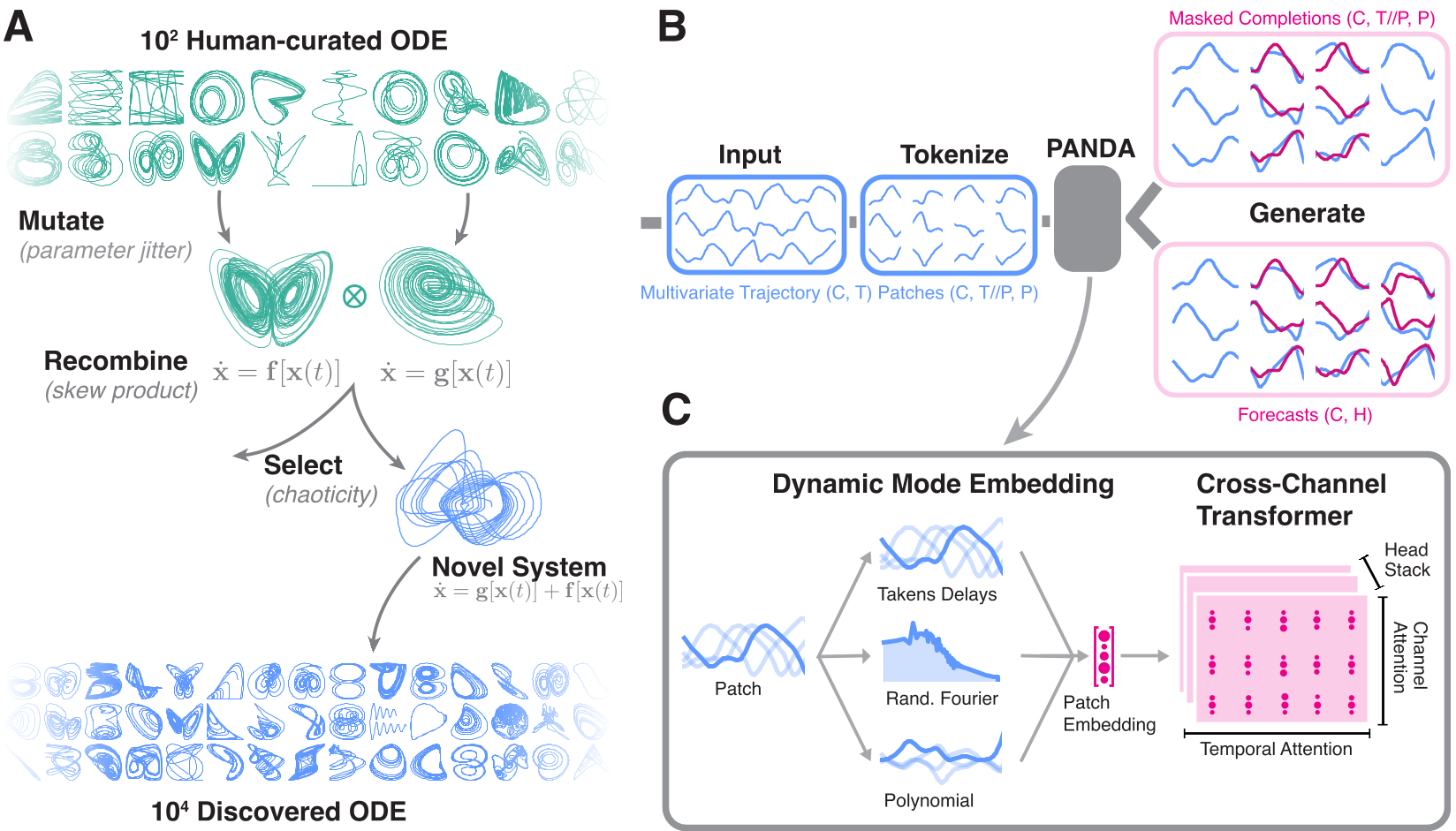 Figure 1: Overall schematic of Panda’s evolutionary discovery and transformer-based forecasting pipeline.
Emergent Capabilities: From ODEs to PDEs
One of the paper's most startling findings is zero-shot PDE forecasting. Even though Panda was only trained on 3D Ordinary Differential Equations (ODEs), it successfully predicted the evolution of 512D Partial Differential Equations (PDEs) like the Kuramoto-Sivashinsky flame front.
Performance Comparison
Panda consistently beats larger models (like Chronos 200M) in short-term pointwise accuracy. More importantly, it preserves the attractor geometry—meaning its forecasts look like the real system even when the exact timing starts to drift.
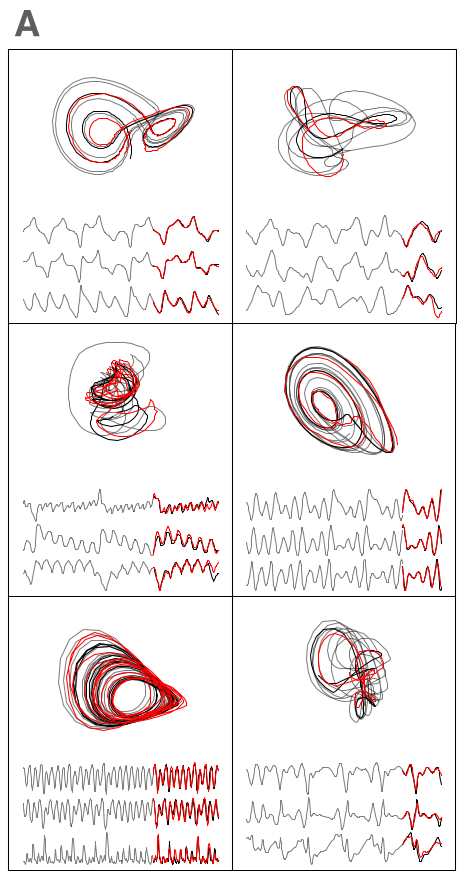 Figure 2: Zero-shot performance comparison. Panda shows lower error (sMAPE/MAE) much further into the forecast horizon compared to TSFM baselines.
The Neural Scaling Law for Dynamics
The authors discovered a unique scaling law: Accuracy scales with system diversity, not just data volume. Holding the total number of timepoints constant, Panda performed significantly better when trained on 20,000 different systems versus 100 systems with more versions of each. This suggests that "topological diversity" is the key to mastering the abstract domain of nonlinear physics.
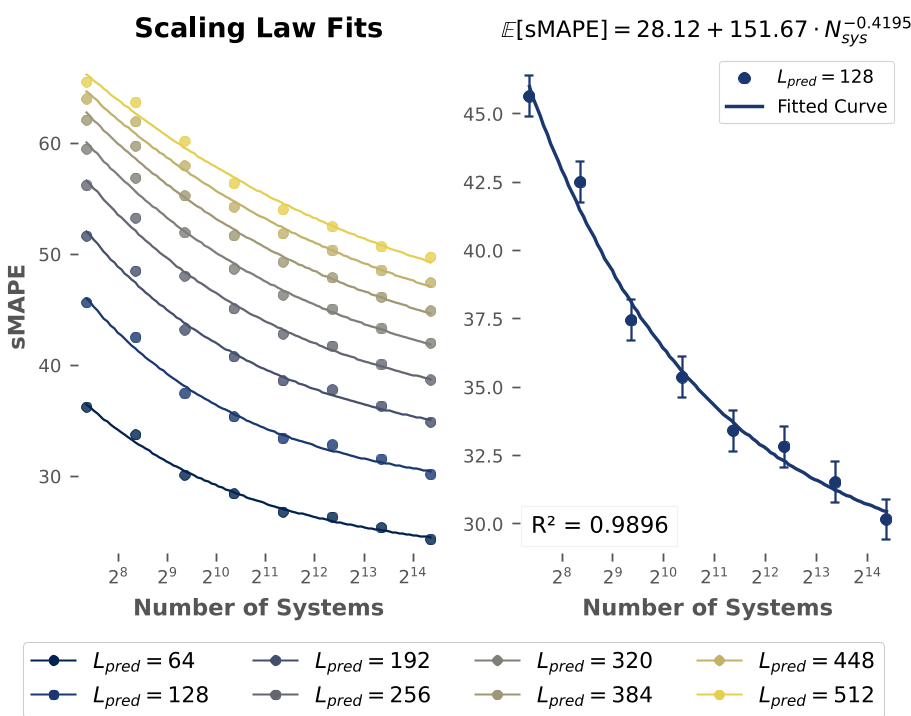 Figure 3: Power-law scaling of zero-shot error as the number of unique training systems (N_sys) increases.
Critical Analysis & Conclusion
Takeaway
Panda demonstrates that chaotic world models can be "pre-solved" using synthetic data. Its ability to handle experimental noise from electronic circuits and biological motion (C. elegans) proves its robustness.
Limitations
- Mean Regression: On very long horizons, the model still tends to revert to the mean (a common Transformer "blurring" effect).
- Low-D Bias: It was trained on low-dimensional ODEs. While it generalizes to PDEs, a high-D native trainer might be even more powerful.
Future Work: This opens the door for "Physics Foundation Models" that could one day provide zero-shot surrogates for weather, finance, and engineering simulations without ever needing to see the specific system's equations.