
Decoding the Coder: Insights from the PR-SOCO Personality Recognition Challenge
PAN@FIRE: Overview of the PR-SOCO Track on Personality Recognition in SOurce COde
The paper presents an overview of the PR-SOCO track at PAN@FIRE 2016, focusing on "Personality Recognition from SOurce COde." It evaluates 11 teams (48 runs) on their ability to predict the Big Five personality traits (Extroversion, Neuroticism, Agreeableness, Conscientiousness, Openness) from Java source code using regression models and linguistic analysis.
Executive Summary
TL;DR: The PAN@FIRE 2016 PR-SOCO track explored whether a programmer's Java source code reveals their personality. By analyzing programs from 70 students across the "Big Five" traits, the challenge demonstrated that while predicting personality from code is difficult, certain traits—specifically Openness to Experience—leave distinct digital fingerprints in how code is structured, commented, and named.
Background: This work moves Author Profiling from the "noisy" world of Twitter to the "strict" world of Source Code. It bridges the gap between software engineering metrics and psychological assessment.
The Core Challenge: Personality in a Constraint-Rich Environment
Why is this difficult? Unlike a blog post, source code is governed by strict syntax. If a developer is "Agreeable," they can't simply express it through word choice; they must do so through "soft" stylistic choices like indentation, the helpfulness of comments, or adherence to naming conventions. The researchers hypothesized that even in a constrained environment, human idiosyncrasies—like the tendency to over-comment or use specific white-space patterns—are manifestations of personality.
Methodology: From N-Grams to Deep Learning
The 11 participating teams tackled the problem using three distinct categories of features:
- Lexical Features: Classic -grams and Bag-of-Words (BoW) applied to identifiers and comments.
- Structural & Stylistic Features: This was the "secret sauce." Teams used tools like Antlr to parse code into Abstract Syntax Trees (ASTs), extracting metrics such as:
- Average methods per class.
- Frequency of single-line vs. multi-line comments.
- Indentation styles (spaces vs. tabs).
- Halstead metrics: e.g., effort, difficulty, and time to implement.
- Neural Representations: Some teams used LSTMs at the byte level or Skip-thought vectors to capture the "flow" of the code without manual feature engineering.
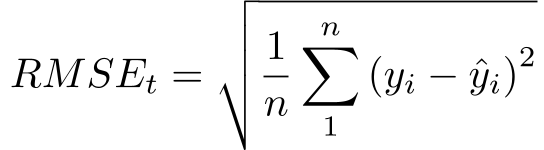 The evaluation utilized RMSE to measure error magnitude and Pearson Correlation to ensure results weren't just "lucky" guesses near the mean.
Exploring the Results
The findings were revealing:
- Openness wins: Across almost all approaches, "Openness to Experience" was the most predictable trait. This aligns with linguistic research suggesting creative individuals utilize more diverse structures.
- The "Mean" Trap: Systems that predicted values near the training average showed low RMSE but zero correlation. This highlighted the importance of using Pearson Correlation to identify truly "perceptive" models.
- Feature Superiority: For Neuroticism, specific features (comment types, naming conventions) outperformed generic -grams. For Extroversion, traditional text analysis (BoW) remained surprisingly competitive.
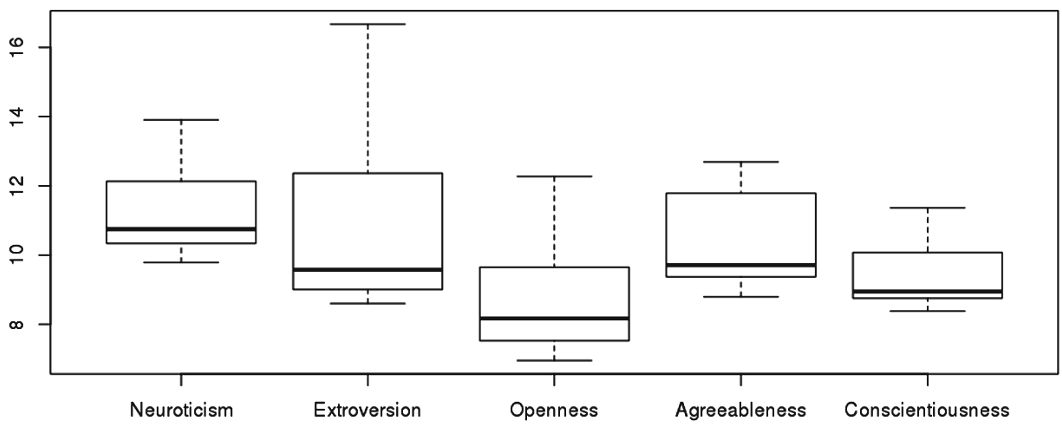 Distribution of RMSE across participants, highlighting the variance in trait predictability.
Critical Insight: Why Does It Work?
The effectiveness of structural features suggests that Conscientiousness might manifest as "clean code" (high adherence to standards, proper imports), while Neuroticism might correlate with inconsistent indentation or erratic commenting. Deep learning models like LSTMs showed high correlation but suffered from high RMSE (overfitting), suggesting that the dataset (70 authors) is still too small for purely end-to-end "black box" approaches.
Conclusion and Future Outlook
The PR-SOCO track proves that source code is a valid psychometric artifact. While we are not yet at a stage where a GitHub profile can replace a personality test, the baseline is set.
Limitations: The dataset was restricted to Java and a student population. Professional developers, who often follow strict corporate style guides (e.g., Google Java Style), might "mask" their personality traits more effectively than students.
Future Work: The logical next step is combining these stylistic markers with Pre-trained Code Models (like CodeT5 or GraphCodeBERT) to see if semantic understanding of code logic further refines personality prediction.