
Panning for Gold: Automating the Reconnaissance of Social Engineering
Panning for gold: Automatically analysing online social engineering attack surfaces
The paper presents an automated framework for analyzing the social engineering attack surface of organizations by leveraging Open Source Intelligence (OSINT). It introduces methods to identify employees from an organization’s social media followers and resolve their identities across multiple platforms (Twitter, Facebook, LinkedIn, Google+) to passively harvest sensitive information.
TL;DR
Social engineering is often seen as a "human" problem requiring manual effort, but this paper proves that the reconnaissance phase can be entirely automated. By combining web scraping with machine learning, the authors developed a tool that identifies an organization's employees on social media and links their professional identities to personal accounts, exposing a massive "attack surface" without ever sending a single "friend request."
Background: The Invisible Reconnaissance
In the kill chain of a cyber-attack, the reconnaissance phase is the most critical and often the most tedious. For social engineers, this involves "panning for gold"—sifting through mountains of social media data to find specific employees and their personal interests. Historically, this was either a manual slog or an "active" process using "zombie profiles" that risk detection. This paper shifts the paradigm to Passive Automation, allowing an attacker (or a defender) to map an entire company's human vulnerability at scale.
The Problem: The Noise in the Signal
Most followers of a corporate Twitter or LinkedIn account are customers, fans, or competitors—not employees. An automated tool must first solve the Target Resolution problem: How do we find the "insiders" in a crowd of "outsiders"?
Secondly, once an employee is found (e.g., on LinkedIn), they are often guarded. However, they might be much less careful on personal accounts (e.g., Facebook or Instagram). Linking these disparate identities across the web—Identity Resolution—is the holy grail of social engineering reconnaissance.
Methodology: The Automated Scanner
The researchers built a pipeline that requires only an organization's homepage URL to start.
1. Identifying the Targets (Target Resolution)
The system uses a C5.0 Decision Tree to classify social media profiles. Key features include:
- OnWeb: Does the profile name appear on the company’s official website or press releases?
- HasFirmName: Is the company explicitly mentioned in the user's bio?
- Network Topology: Does the user follow the same niche accounts as the employer?
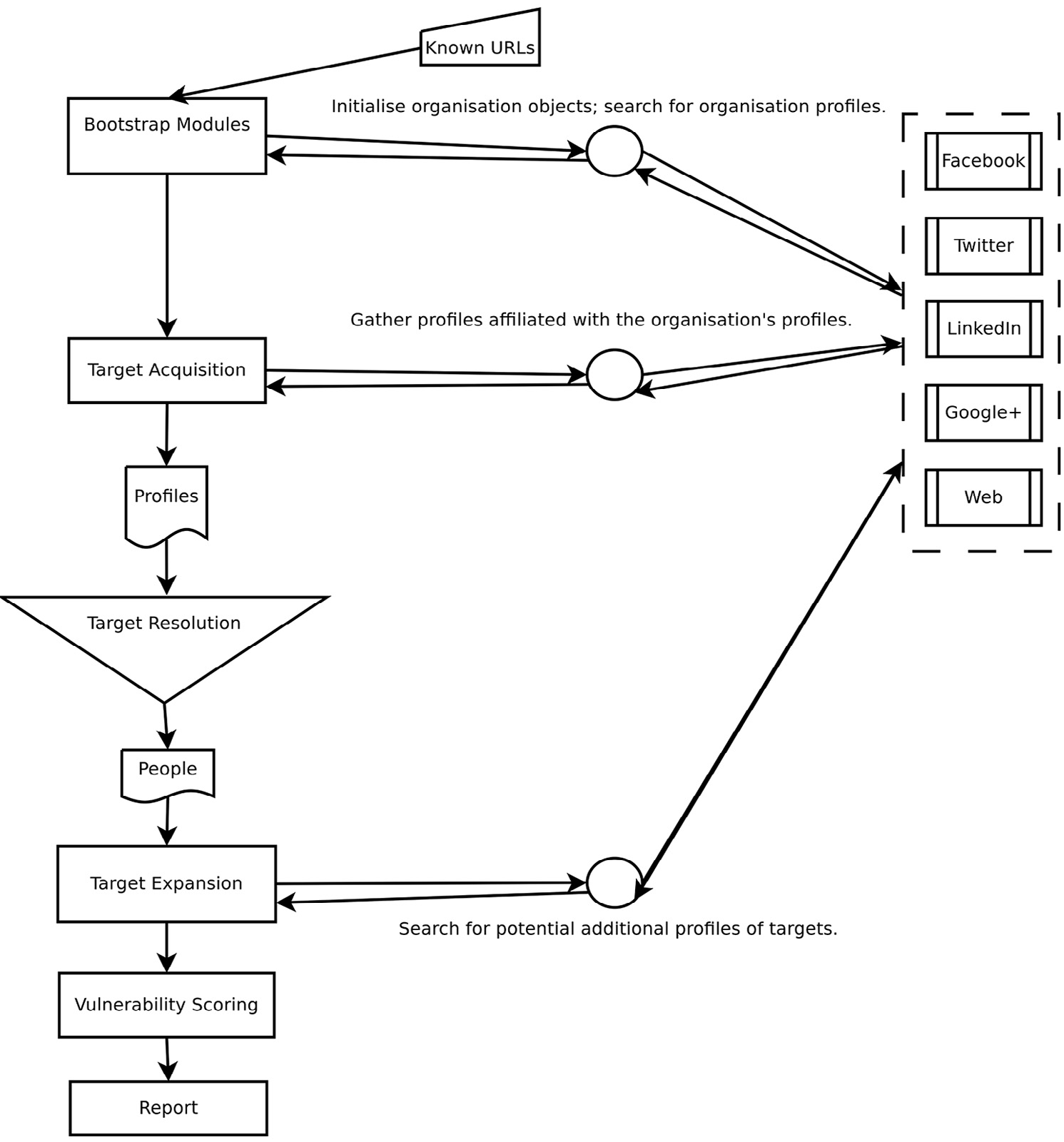
2. Linking Identities (Target Expansion)
Once a target is identified, the system searches for them on other networks using a probabilistic ensemble classifier. Instead of relying on a single attribute, it looks at:
- Visual Evidence: Profile picture similarity via Euclidean distance of image histograms.
- Behavioral Fingerprints: Activity time bins (when do they post?) and link-sharing history.
- Stylometry: Usage of "function words" (it, some, if, there) to create a unique writing fingerprint.
Experimental Results: A Grim Reality for Critical Infrastructure
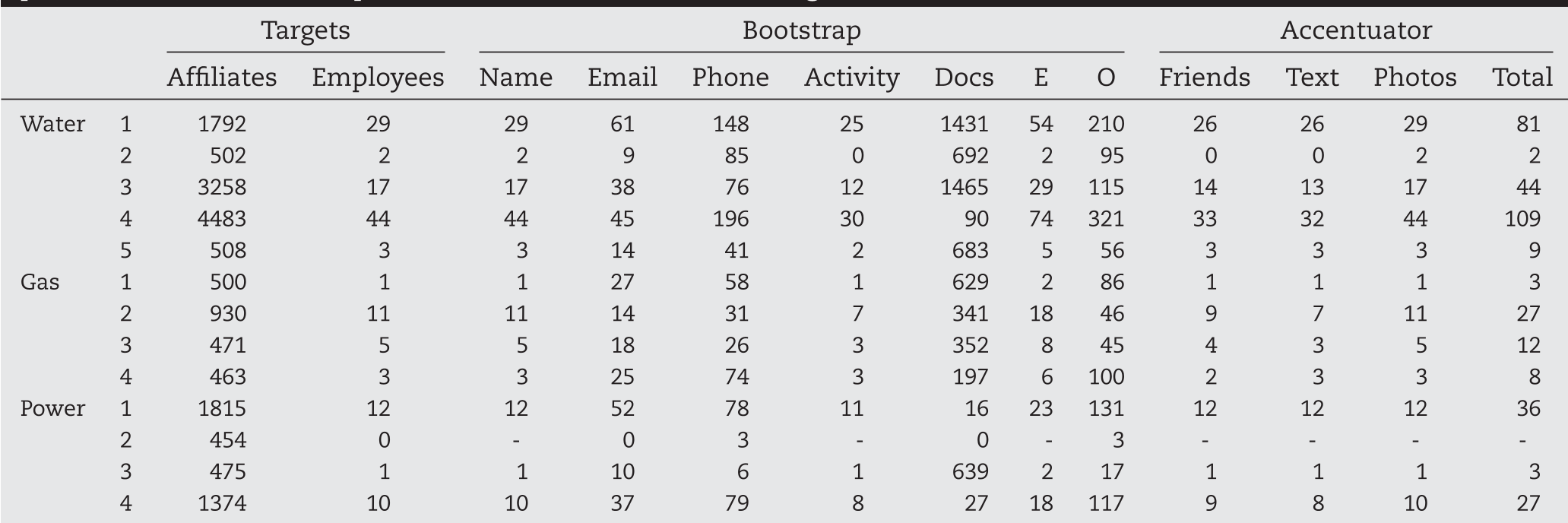
The authors tested their tool on 13 critical infrastructure companies (Water, Gas, Electricity). The results were stark:
- Automation Effectiveness: Over 15,000 profiles were distilled down to 128 confirmed employees automatically.
- Attack Data: For almost every organization, the tool found enough "Bootstrap" data (names, emails) and "Accentuators" (hobbies, photos, friends) to launch a high-success spear-phishing or "vishing" (voice phishing) campaign.
The model achieved an AUROC of 0.96, indicating that its ability to correctly link identities across platforms is nearly perfect compared to random guessing.
Critical Analysis: The Dual-Use Dilemma
The paper concludes by proposing this tool as a Vulnerability Scanner. Just as IT admins use Nessus to find software bugs, HR and Security teams should use tools like "Panning for Gold" to find "human bugs."
Limitations:
- API Restrictions: The tool currently relies on official APIs, which are increasingly restricted (e.g., X/Twitter's API changes).
- Precision vs. Recall: While it finds almost all employees (high recall), it still flags some non-employees (moderate precision), requiring a final human check.
Conclusion: Hardening the Human
The era of manual social engineering is over. Attackers are using OSINT automation to find the path of least resistance into secure networks. This research serves as a wake-up call: visibility is vulnerability. If an algorithm can find your employees' personal habits in seconds, so can a determined adversary. Organizations must move beyond generic "don't click links" training and start using data-driven metrics to measure their true social engineering exposure.