
Beyond Anonymity: The Privacy Paradigm Shift in the Age of Social Networking
The Need for a Paradigm Shift in Addressing Privacy Risks in Social Networking Applications
This paper identifies a critical need for a paradigm shift in protecting informational privacy within Web 2.0 social networking applications. It proposes moving beyond traditional anonymity-based Privacy-Enhancing Technologies (PETs) toward solutions focused on transparency, accountability, and technical data-usage rights.
TL;DR
The traditional "hide-and-disguise" approach to privacy is failing in the Web 2.0 era. As social networks thrive on the open sharing of sensitive data, we need a "Privacy 2.0" paradigm. This paper argues for transitioning from simple access protection to technically enforced accountability, where privacy policies are "stuck" to the data itself, ensuring transparency and purpose limitation throughout the data lifecycle.
The Conflict: Economic Value vs. Informational Integrity
The modern Internet has transformed from a passive information source (Web 1.0) into a participatory ecosystem (Web 2.0). However, the business model of this ecosystem relies on a fundamental tension: the monetization of sensitive personal data.
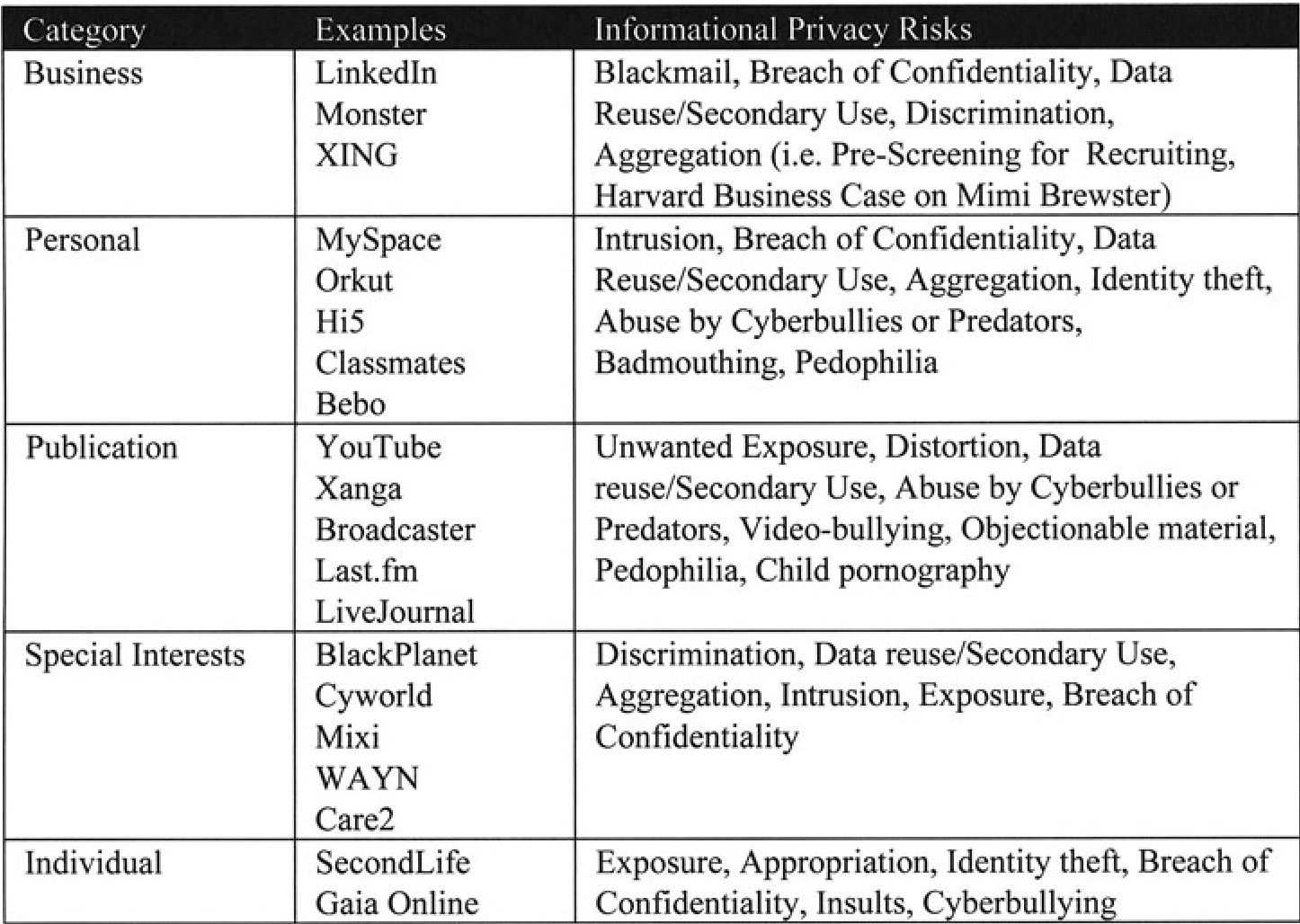
As the paper highlights, social networking users are highly attractive to marketers—not just for their numbers, but for their specific demographics and influence on online retail growth. When "attractive users have attractive personal data," the risk of identity theft, stalking, and price discrimination skyrockets. The core problem is that existing Privacy-Enhancing Technologies (PETs) are often at odds with the user's goal of being "seen" and "connected."
The Problem with Current PETs
Historically, privacy research focused on:
- Anonymity: Making the user indistinguishable.
- Unlinkability: Preventing different data points from being traced to a single person.
While effective for some tasks, these are counter-intuitive for a platform like LinkedIn or Facebook, where the point is to be found and linked. Furthermore, current policy languages like P3P (Platform for Privacy Preferences) only check if a website has a policy; they do not enforce how that website actually uses your data once they have it.
Methodology: The "Wikinomics" of Privacy
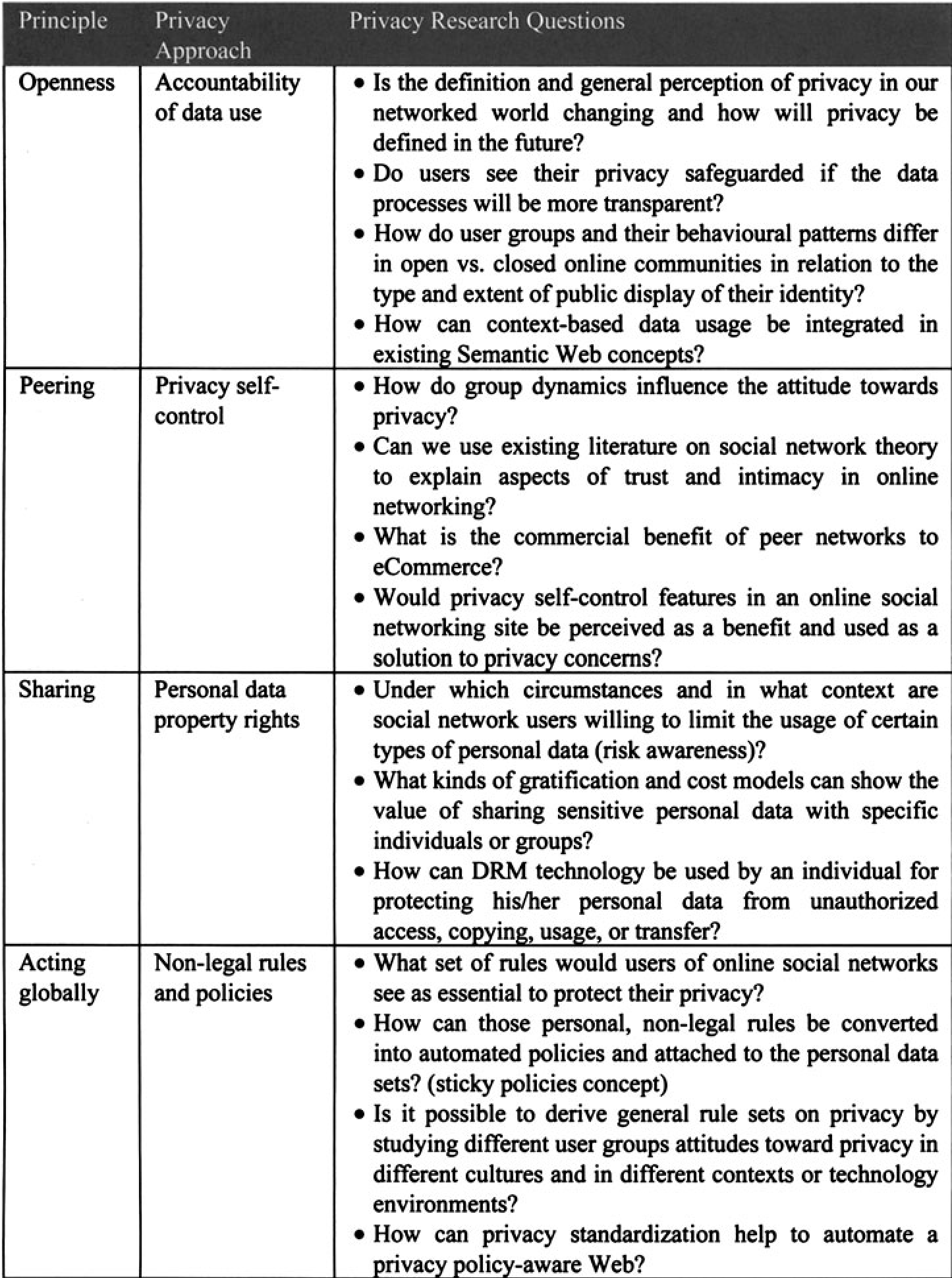
To solve this, the author aligns privacy research with the four pillars of modern mass collaboration:
| Wikinomics Principle | Emerging Privacy Approach | Key Research Objective |
|---|---|---|
| Openness | Accountability | How to make data processes transparent and auditable? |
| Peering | Self-determination | Can users control their data flow within peer groups? |
| Sharing | Usage Rights | How to attach DRM-like rights to personal profiles? |
| Acting Globally | Non-legal Policies | How to automate cross-border policy enforcement? |
Technical Deep Dive: From Access Control to Usage Control
The paper's most provocative insight is the application of Digital Rights Management (DRM) to personal data. Just as a music file can be restricted so it only plays on certain devices or for a certain time, the author suggests personal data should carry "Sticky Policies."
Imagine a personal profile where:
- Context Tags: The data knows it is being shared for "Recruiting" but not for "Marketing."
- Audit Trails: Every time a third-party script accesses the data, a log is generated that the user can review.
- Semantic Awareness: Using Semantic Web technologies to interpret the purpose of a data request and automatically block it if it violates the user's intent.
Critical Insight: The "Google Data Privacy" Dream
The paper echoes a prophetic blog entry describing a "Google Data Privacy" (GDP) tool. This hypothetical tool would allow users to:
- Review all information retained across all services.
- Determine maximum data retention periods.
- Selectively opt-out of cross-service data mining without losing service quality.
This vision moves privacy from a "barrier" to a "feature"—a shift that remains one of the most significant challenges in modern AI and LLM data handling today.
Conclusion & Future Outlook
The growth of social networks requires us to rethink the very definition of privacy. It is no longer about "hiding"; it is about controlled disclosure.
Takeaways for Researchers:
- Focus on Usability: Privacy solutions must be as easy to use as the social networks themselves.
- Focus on Accountability: Develop robust monitoring and watermarking techniques to ensure data provenance.
- Focus on Standardization: Privacy-aware web standards must be established to handle the decentralized nature of Web 2.0 (and now Web 3.0/AI agents).
While this paper was written during the rise of the "social web," its call for a shift toward data accountability is more relevant than ever in the era of Generative AI, where personal data is often swallowed by models without any "sticky policies" or transparency.