
PECM: Revolutionizing Big Data Clustering with Parallel Evolving Logic
Parallel Evolving Clustering Method for Big Data Analytics Using Apache Spark: Applications to Banking and Physics
The paper introduces Parallel ECM (PECM), a parallel and distributed implementation of the Evolving Clustering Method (ECM) using the Apache Spark framework. It achieves real-time, one-pass clustering for big data, significantly outperforming serial ECM on large-scale banking and physics datasets.
TL;DR
Researchers have successfully parallelized the Evolving Clustering Method (ECM) using Apache Spark, creating PECM. Unlike traditional multi-pass algorithms, PECM processes data in a single pass across a distributed cluster, achieving up to 7.7x faster execution on massive datasets while maintaining the ability to handle online, evolving data streams.
Context & Positioning
In the landscape of Big Data, clustering is often the bottleneck. While iterative algorithms like K-Means are the "standard," they fail when data size exceeds memory or when real-time results are required for streaming inputs. PECM positions itself as a high-performance alternative, shifting the paradigm from static, iterative processing to online, incremental evolution in a distributed environment.
The Problem: The High Cost of Iteration
Most classical clustering methods (Density-based, Grid-based, etc.) share a common flaw: they need to look at the data multiple times. For a dataset like the HIGGS (1.4 GB) or ccFraud, reading from disk or even shuffling through memory multiple times creates a massive latency overhead. Furthermore, most parallel versions of these algorithms are not truly "online"—they cannot easily update clusters as new data arrives without recalculating from scratch.
Methodology: The Parallel Evolving Core
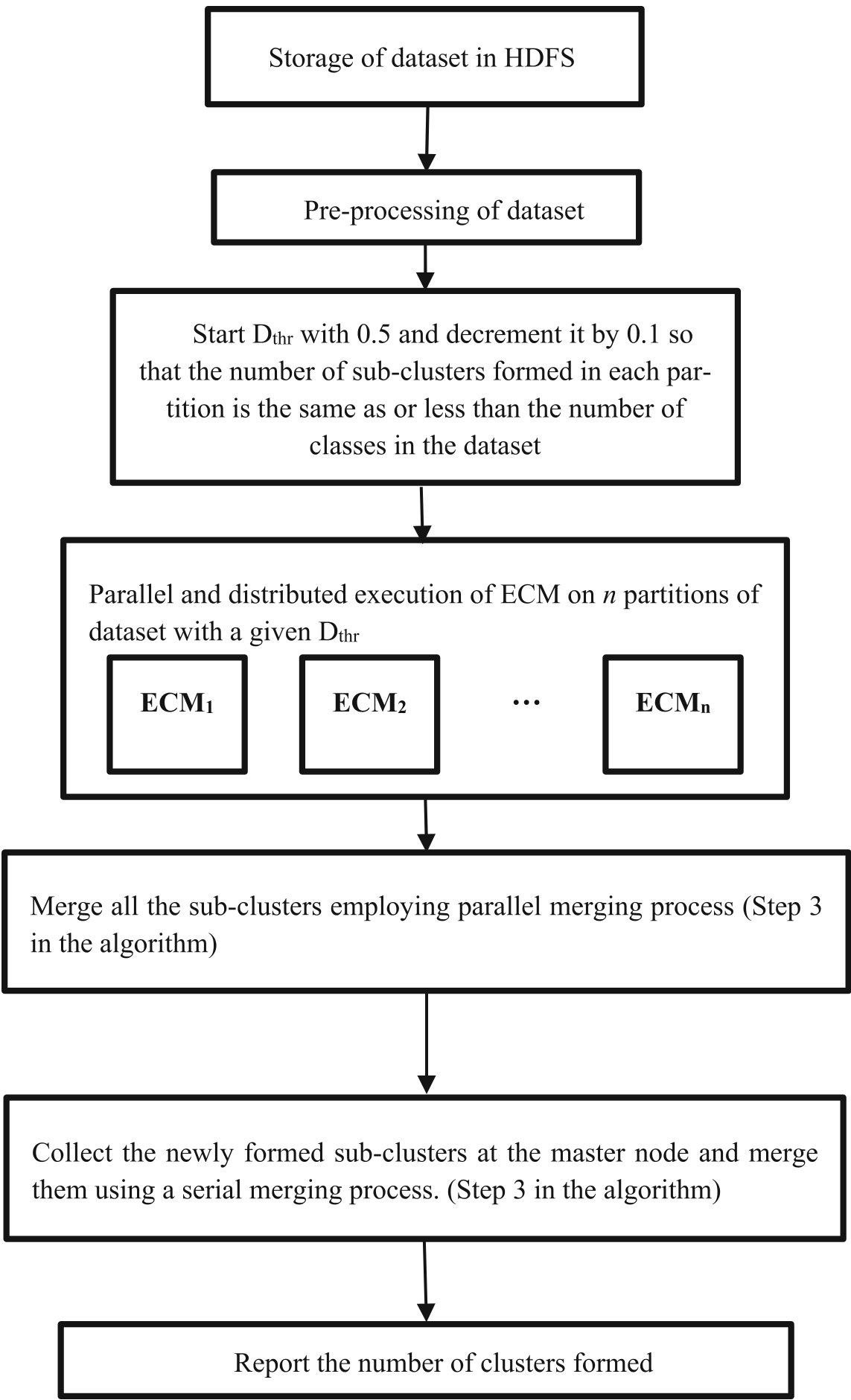
The brilliance of PECM lies in its decentralized architecture. The process is broken down into three distinct stages:
- Parallel Execution: The dataset is partitioned across Spark worker nodes. Each worker runs an independent instance of the ECM algorithm on its local slice of data (Step 2 of the algorithm).
- Parallel Merging: Sub-clusters produced by the workers are not sent directly to the master node (which would create a bottleneck). Instead, they are first partially merged across the worker nodes using a "Parallel Merging Threshold."
- Serial Consolidation: The final set of refined sub-clusters is gathered at the master node for a final serial merge to match the required number of global clusters.
Mathematical Intuition
The core ECM logic relies on the Maximum Cluster Radius (). If a new data point falls within the radius of an existing cluster, the cluster updates its center; if not, and it exceeds , a new cluster is born. PECM scales this by calculating these Euclidean distances in time where is the number of processors, drastically cutting down the serial complexity.
Experimental Results & Performance
The authors tested PECM on a 10-node cluster (Intel Core i7, 32GB RAM each).
- Credit Card Fraud (ccFraud): 10 million samples, 297 MB. Execution time dropped from 74s to 28s (2.6x speedup).
- HIGGS Physics Dataset: 11 million samples, 1.4 GB. Execution time dropped from 77s to 10s (7.7x speedup).
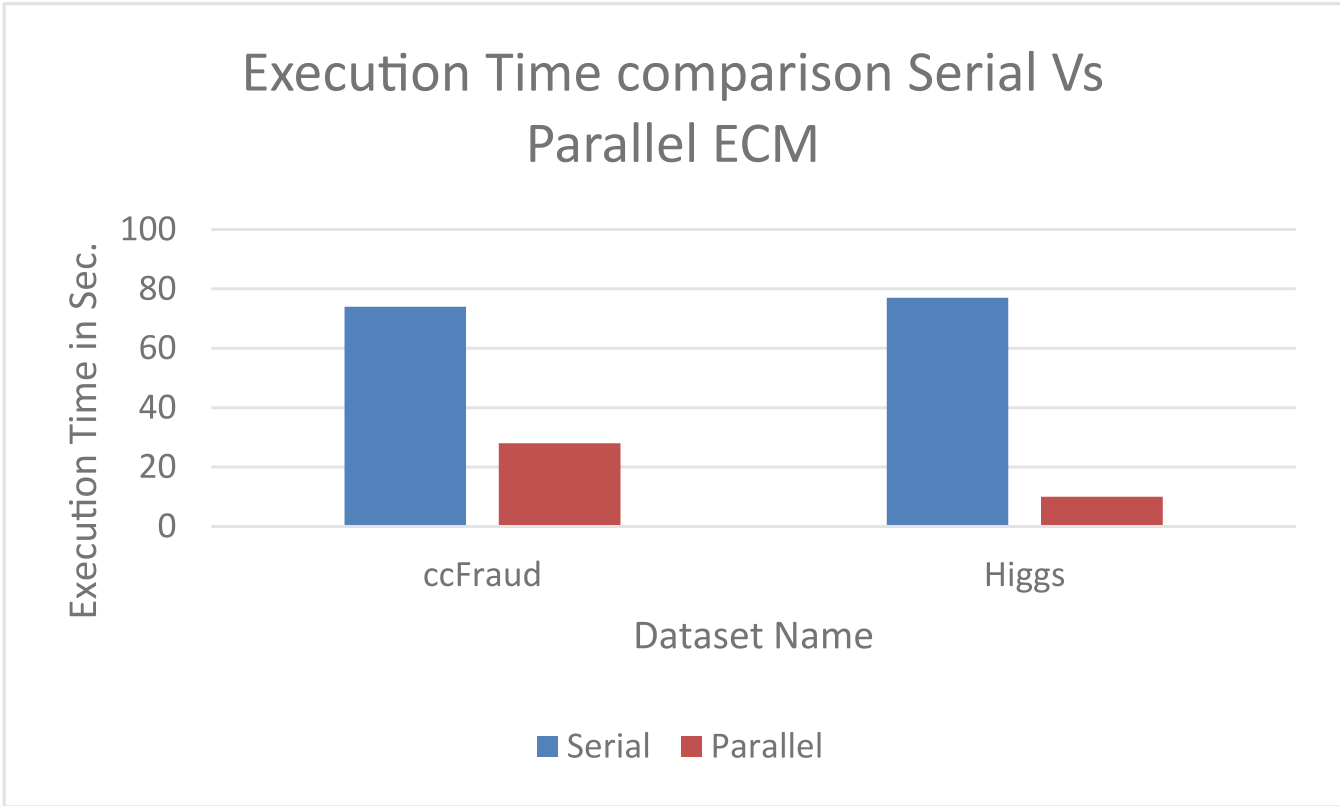
Interestingly, the speedup was more pronounced on the HIGGS dataset. The authors attribute this to data distribution: HIGGS is a balanced dataset (53% positive), whereas ccFraud is highly unbalanced (5.96% fraud), suggesting that data entropy and distribution play a significant role in parallel efficiency.
Critical Insights & Future Directions
The proposed dual-merging strategy effectively mitigates the communication overhead typically found in distributed clustering. However, the reliance on a manually or semi-automated selection of merging thresholds indicates a potential area for improvement using adaptive thresholding.
Takeaways for the Industry:
- One-pass is the future: For real-time fraud detection or high-energy physics analytics, iterative methods are no longer viable.
- Spark Integration: Utilizing Spark’s RDD abstractions and DAG-based lazy evaluation allows PECM to minimize disk I/O, which is the primary killer of performance in Hadoop-based systems.
Future work aims to hybridize PECM with Probabilistic Neural Networks (PNN) and Wavelet Neural Networks (WNN) to bridge the gap between unsupervised clustering and supervised classification tasks in big data.