
PMP Algorithm: Revolutionizing Information Routing to Social Opinion Leaders
Parallel Multicast Information Propagation Based on Social Influence
The paper introduces a Parallel Multicast Information Propagation (PMP) model and algorithm designed to find optimal paths from a single source to a designated set of influential opinion leaders. By maximizing social influence (minimizing propagation cost), the algorithm constructs a merge graph from concurrent subgraphs to establish an efficient information propagation tree.
TL;DR
To maximize information reach, you first need to reach the "multipliers"—the opinion leaders. This paper moves beyond traditional "broadcast" models to propose a Parallel Multicast Information Propagation (PMP) algorithm. By treating social influence as a cost-reduction factor, PMP constructs an optimal tree from a source to multiple influencers, significantly reducing the overhead compared to standard serial methods.
Context: Why Multicast Matters
Most influence maximization research asks: "Which set of nodes should I pick to start a fire?" This paper asks a different, more practical question: "I have a message and I know who the influencers are; how do I get it to them most effectively?"
Existing approaches often rely on Serial Unicast, essentially sending the message to each leader one by one. This is computationally expensive and redundant. The authors argue that information propagation should be viewed as a multicast problem, where shared paths reduce the "cost" of dissemination.
Methodology: The Parallel Subgraph Bridge
The core innovation is the Parallel Multicast information Propagation (PMP) algorithm. It operates on a simple but powerful physical intuition: if terminal nodes (influencers) are close in social space, their propagation paths should be merged.
The 3-Step Architecture
- Parallel Subgraph Construction: Every terminal node (the source and leaders ) concurrently identifies its local neighborhood based on minimum propagation costs ().
- The Merge Graph (): These subgraphs are joined. If two subgraphs are adjacent, the algorithm finds the "Bridge Path"—the shortest link between these local clusters.
- Tree Extraction: From this consolidated merge graph, the final "Information Propagation Tree" is extracted by finding the shortest paths from the source to all leaders.
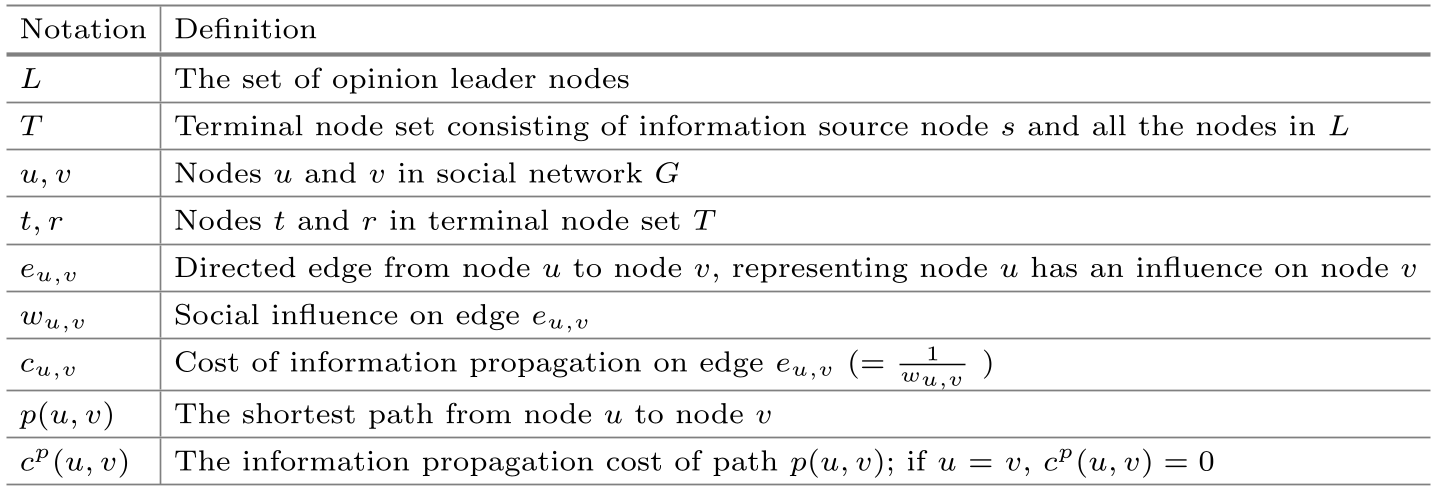 Table 1: Key notations defining the relationship between influence () and cost ().
Experimental Insights
The authors validated PMP using both classic social network datasets (Dolphins and Zachary’s Karate Club) and artificial networks generated via SNAP.
Performance vs. Serial Methods
As the number of terminal nodes increases, the efficiency gap between PMP and Serial Unicast Propagation (SUP) widens. PMP effectively "reuses" edges, ensuring that information is transmitted over a high-influence edge only once, rather than multiple times for different destinations.
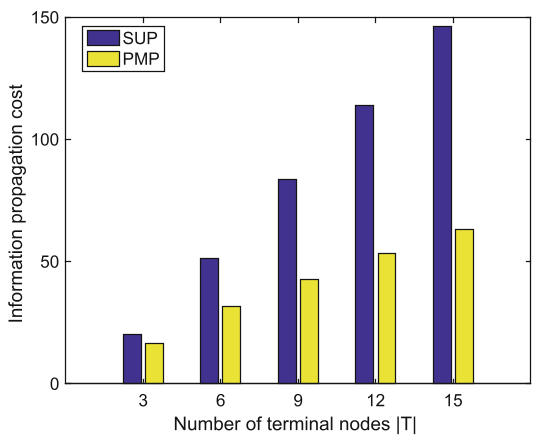 Figure 1: Comparison of tree costs in the Dolphin network. PMP demonstrates superior scalability as the number of influencers grows.
The Impact of Network Topology
The study provides a deep dive into how graph characteristics affect propagation:
- Average Degree: Higher connectivity provides more "shortcuts," drastically reducing the cost of reaching influencers.
- Network Density: Densely connected networks allow the algorithm to pick "high-influence" paths more selectively.
- Path Length: As expected, longer average paths in a network increase the cost, but PMP maintains a competitive edge by optimizing the tree structure.
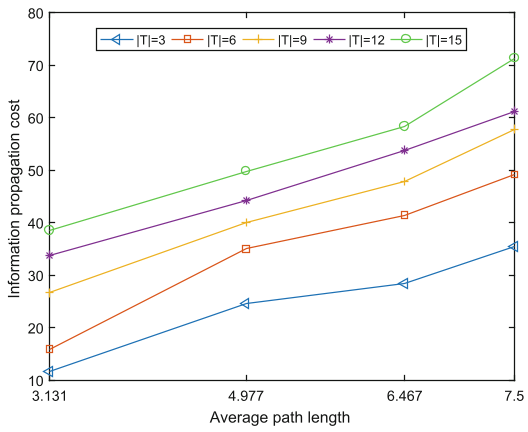 Figure 4: The correlation between network density and information propagation cost.
Critical Analysis & Conclusion
Takeaway
The PMP model shifts the focus from who is influential to how to reach them. By framing the problem as a cost-minimization task on a merge graph, it provides a scalable solution for corporate communications, political campaigning, or public health announcements.
Limitations
- Static Assumption: The paper assumes influence weights () are static. In real-world social networks, influence is "decaying" or "bursty" based on time and topic.
- Node Capacity: The model doesn't account for node "fatigue"—the idea that an influencer might stop forwarding if they receive too many messages.
Future Outlook
The next logical step for this research is to integrate Dynamic Social Influence, where edge weights change in real-time. Additionally, applying this multicast logic to multi-layered networks (e.g., overlapping Twitter and LinkedIn circles) could offer even higher precision for information targeting.