
Scaling the Truth: Parallel and Streaming Discovery in Quantitative Crowdsourcing
Parallel and Streaming Truth Discovery in Large-Scale Quantitative Crowdsourcing
The paper introduces parallel and streaming truth discovery algorithms tailored for quantitative crowdsourcing tasks (e.g., object counting). By leveraging MapReduce and online Expectation-Maximization (EM), the authors achieve SOTA performance in accuracy while ensuring the system scales to massive or real-time data streams.
TL;DR
Quantitative crowdsourcing—asking the crowd to count objects or estimate percentages—is notoriously noisy. This paper presents a breakthrough in making these estimations both accurate and scalable. By redesigning the TBP (Truth, Bias, and Precision) model, the authors developed parallel (MapReduce) and streaming (Online EM) algorithms that outperform traditional baselines by 30% in error reduction while handling datasets that crash standard models.
The Motivation: Why Counting is Harder than Labeling
Most truth discovery research focuses on categorical tasks (e.g., "Is this image a dog or a cat?"). In those cases, if ten people say "dog," the truth is likely "dog."
However, in quantitative tasks like people counting or ballot counting, every participant might give a different number (e.g., 48, 52, 55). Traditional methods that look for exact matches fail here. The authors previously proposed the TBP Model, which uses "Bias" and "Precision" to model each worker. But there was a catch: the original TBP was a "batch" algorithm. It required the entire dataset to be loaded into memory, making it impossible to use for Big Data or real-time streams.
Methodology: Decoupling for Scalability
The core innovation lies in the mathematical restructuring of the TBP model.
1. The New Batch Foundation
The authors moved the latent truth () into the Expectation (E) step instead of treating it as a model parameter in the Maximization (M) step. This shift allows the updating rules for participant biases () and precisions () to have closed-form solutions.
2. Parallelism via MapReduce
Because parameters are now decoupled, the data can be split into "chunks."
- Mappers: Calculate "sufficient statistics" for local chunks of data (local sums of expectations).
- Reducers: Aggregate these statistics globally to update the final model.
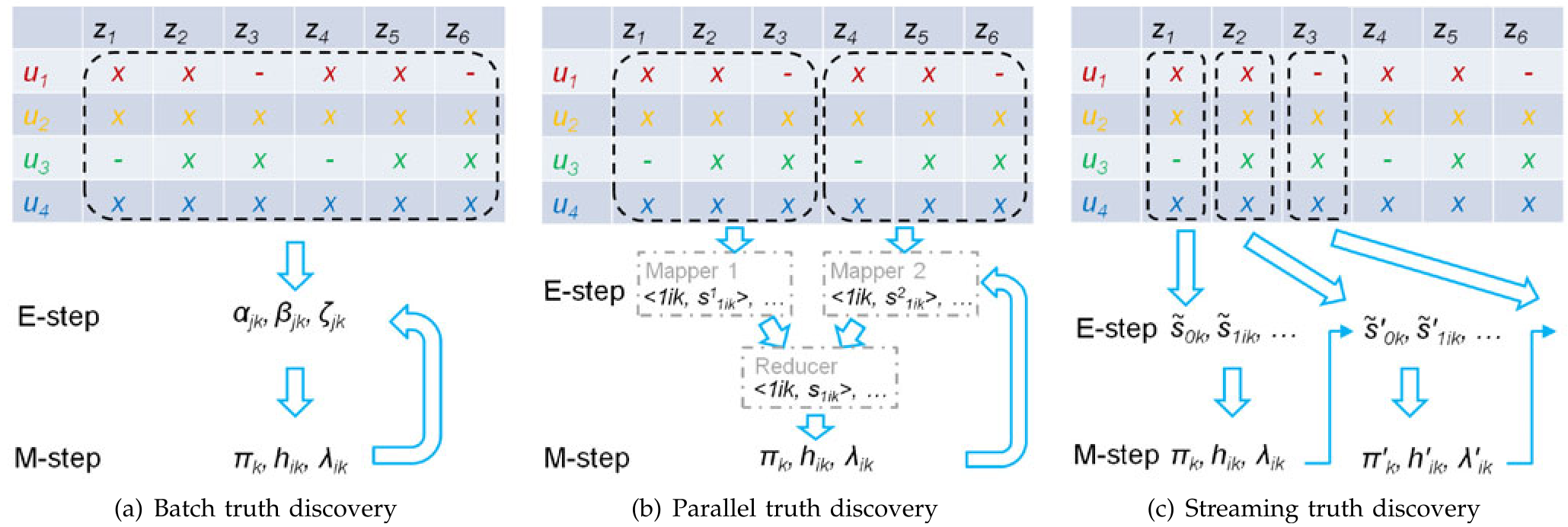 (Figure 3: Contrast between Batch, Parallel, and Streaming architectures)
3. Streaming via Online EM
For real-time data, the authors utilized an Online EM algorithm. Instead of iterating over the whole dataset multiple times, it processes one target at a time, recursively updating the sufficient statistics using a stochastic step size. This allows for "incremental learning"—the model gets smarter as each new claim arrives.
Experimental Results: Performance and Scalability
Effectiveness
In real-world tests for people counting and occupancy estimation, the TBP-based algorithms (Batch, Para, Stream) consistently outperformed "Median" and "Truth Finder."
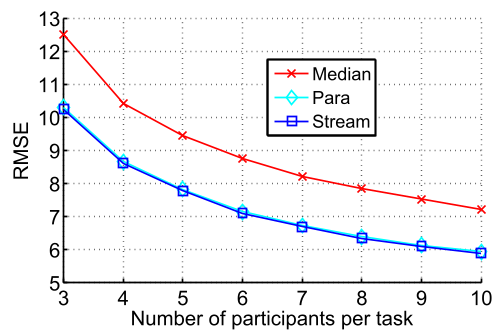 (Figure 6: RMSE vs. Task Count—showing stable, superior accuracy for the proposed methods)
The Scalability Wall
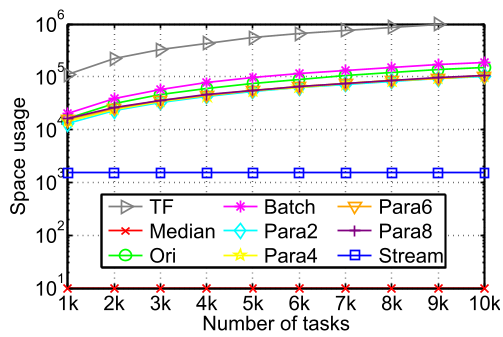
The true value of this work is seen in the synthetic "Syn2" dataset (1 million claims).
- Batch and Original methods: Suffered "Out of Memory" errors at 30,000 tasks.
- Parallel/Streaming methods: Handled all 100,000 tasks with ease.
- Speedup: Using 8 processors (Para8) provided a linear-like speedup as the workload increased, making it the most time-efficient choice for massive datasets.
Critical Analysis & Conclusion
Takeaway: If you are building a crowdsourcing platform for sensor validation, financial estimation, or large-scale counting, the Streaming algorithm is the most practical choice. It balances low memory usage with the ability to handle data in real-time.
Limitations: The "Streaming" algorithm does show a very slight loss in accuracy compared to the "Batch" version because it only sees each data point once. Furthermore, it requires a "warm-up" period (around 20 claims per participant) to stabilize its estimation of worker quality.
Future Outlook: This framework sets a precedent for porting other complex Bayesian crowdsourcing models to the MapReduce/Streaming paradigm, potentially enabling "wisdom of the crowd" applications at the scale of global social media feeds.