
Beyond Defaults: Optimizing Data Mining via Virtual Community Parallel Genetic Algorithms
Parametric Optimization in Data Mining Incorporated with GA-Based Search
This paper introduces a Genetic Algorithm (GA) based heuristic search for optimizing high-dimensional parameters in data mining models. Using a back-propagation Neural Network (NN) as a case study, the authors propose Virtual Community Parallel GA (VC-PGA) to achieve nearly linear scaling and superior accuracy compared to default parameter settings or random search strategies.
Executive Summary
TL;DR: This work addresses the often-overlooked "dark art" of parameter tuning in data mining. By implementing a Genetic Algorithm (GA) and a novel Virtual Community Parallel GA (VC-PGA), the authors demonstrate how to navigate a massive search space to optimize Back-Propagation Neural Networks. The result is a paradigm shift from using "good enough" default values to evidence-based, data-dependent optimization that scales linearly with hardware.
Background Positioning: This paper sits at the intersection of Evolutionary Computation and AutoML. It moves beyond simple heuristic search by proposing a distributed architecture suitable for large-scale data mining tasks where single-machine search is a bottleneck.
The Problem: The Myth of "Good" Default Parameters
In the world of data mining, we are often told that default parameters are "good estimates." However, models are inherently data-dependent. A learning rate or momentum that works for one dataset may lead to vanishing gradients or local optima in another.
The challenge is the Combinatorial Explosion. For a standard Neural Network, tuning learning rate, momentum, hidden layers, nodes, and epochs creates a search space so vast that a brute-force approach is impossible. While random search is a common alternative, it is "blind"—it doesn't learn from the search history.
Methodology: VC-PGA and the Virtual Community
The authors suggest that Genetic Algorithms (GAs) are ideal because they are directional (via selection) and parallel (via schema theory). To tackle the computational cost, they introduce the Virtual Community Parallel GA (VC-PGA).
The Architecture
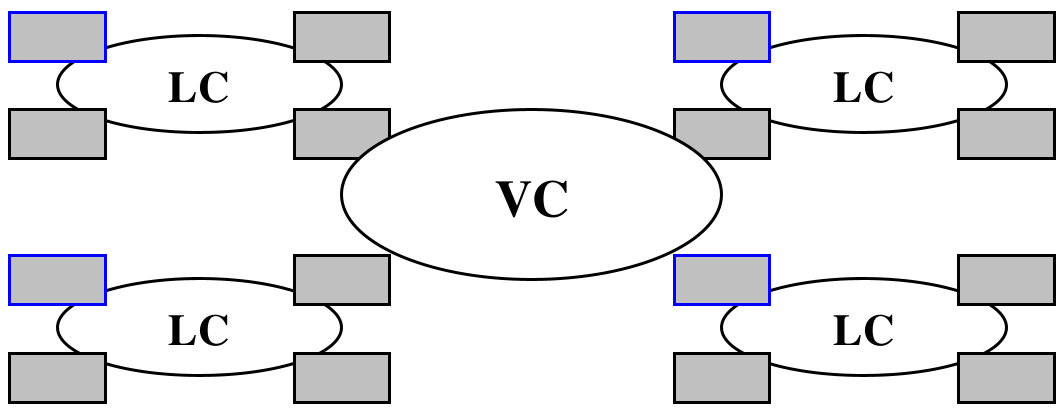
Unlike the traditional "Island Model" where sub-populations might stay isolated or suffer from high communication latency, VC-PGA introduces a hierarchical "Server" structure:
- Local Communities (LC): Neighboring processors share elite individuals through a local server.
- Virtual Communities (VC): Local servers aggregate results and communicate with higher-level virtual servers.
This ensures that the "Globally Fittest" individual is propagated throughout the entire network efficiently, preventing local sub-populations from wasting cycles on inferior search regions.
Experiments: Proving the Heuristic Advantage
The study focused on a Back-Propagation NN with a search space of . The parameters included Learning Rate, Momentum, Hidden Layers, and Epochs.
GA vs. Random Search
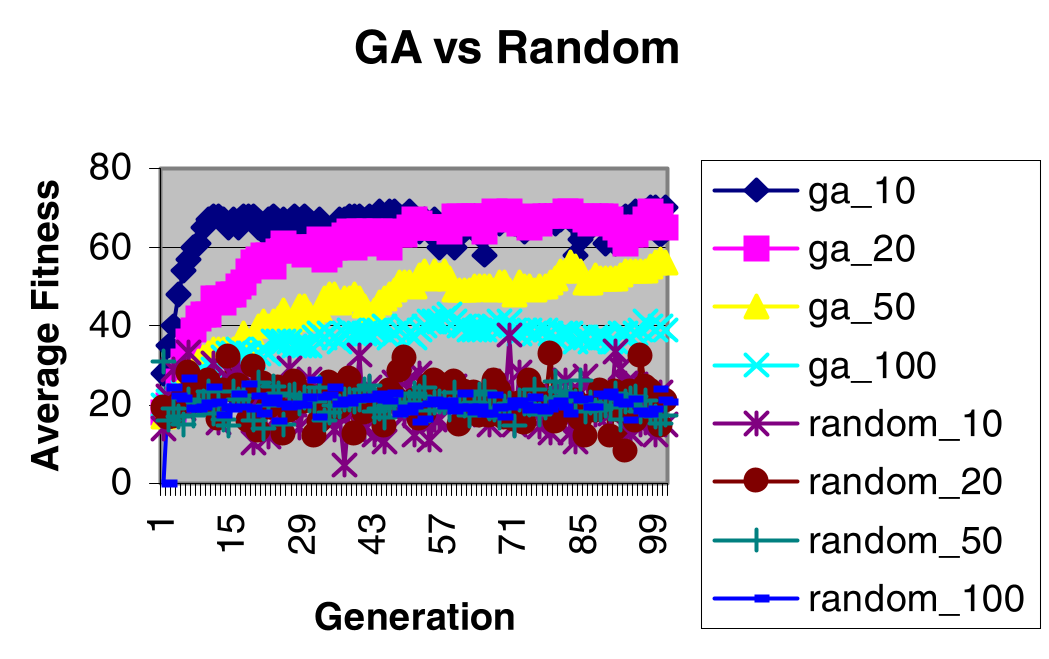
The results were clear: GA-based search consistently outperformed random search. As seen in the performance curves, the GA-based approach converges faster toward high-accuracy models. Even with small populations, the directional nature of GA's crossover and selection operators found better "sweet spots" in the parameter landscape.
Linear Scalability
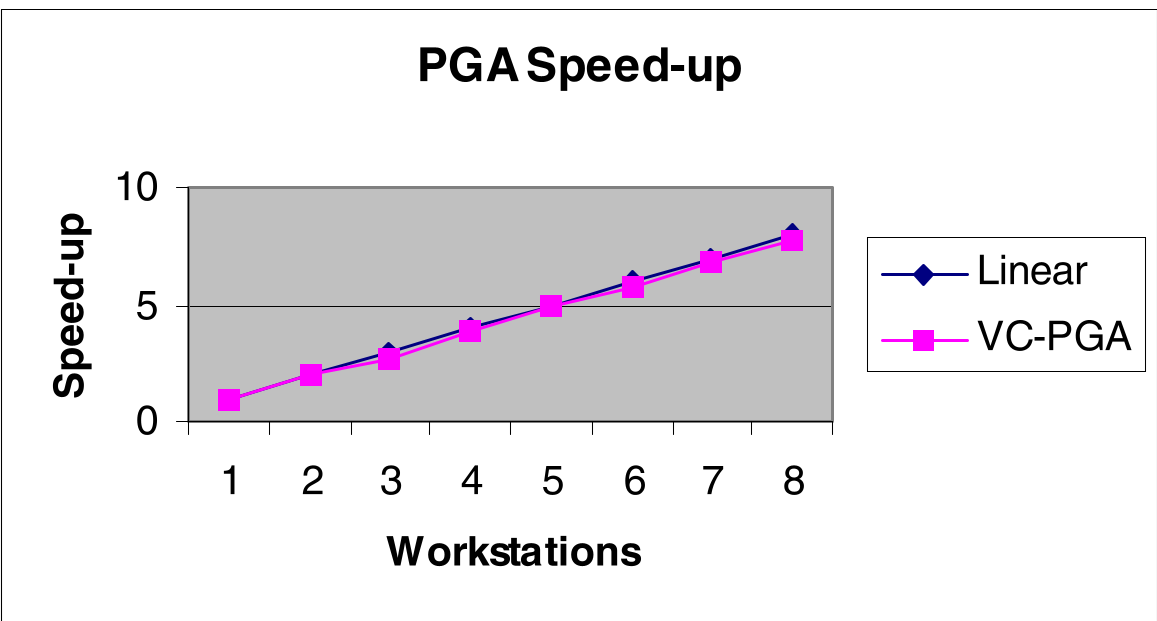
Perhaps the most impressive finding was the scalability of the VC-PGA. By distributing the population across 8 nodes, the authors achieved a near-linear speed-up. This confirms that the Virtual Community model effectively minimizes the communication overhead that usually plagues parallel algorithms.
Critical Analysis & Conclusion
Takeaway
The work proves that parametric optimization is not just a luxury but a necessity for high-performance data mining. The VC-PGA provides a robust framework for performing this optimization at scale.
Limitations
- Complexity of Setup: Implementing a hierarchical community server model is significantly more complex than simple random search.
- Dataset Scale: The study used the Iris dataset for validation; while successful, the overhead of GA might be higher when the objective function (training the NN) takes hours instead of seconds.
Future Outlook
This research pre-dates the current "Hyperparameter Optimization" (HPO) boom in Deep Learning, but its core logic—using hierarchical parallelism to explore non-convex landscapes—remains highly relevant for training modern Transformers and Foundation Models across distributed clusters.