
Breaking Temporal Barriers: Partial Matching for Robust Emotion Recognition
Partial Matching of Facial Expression Sequence Using Over-Complete Transition Dictionary for Emotion Recognition
This paper introduces a partial matching framework for Facial Expression Recognition (FER) that utilizes an over-complete transition dictionary. By decomposing complex video sequences into "partial expression transitions" and using sparse representation, it achieves state-of-the-art results on datasets like CK+, MMI, and NVIE.
TL;DR
Current AI struggles to recognize emotions when a video doesn't perfectly match its training data—for instance, if a smile starts mid-way or lasts too long. This paper introduces a Partial Matching Framework that breaks facial expressions into smaller "atoms" of movement. By matching these atoms against an Over-Complete Transition Dictionary, the system becomes remarkably robust to timing differences and individual facial identities.
The Motivation: Why Temporal Mismatch Ruins FER
Facial expressions are inherently dynamic. However, two people expressing "Surprise" rarely do it the same way: one might have a fast "onset" (the start of the expression), while another might hold the "apex" (peak) longer.
Existing methods (like LBP-TOP) try to analyze the entire video volume at once. If the query video sequence has a different duration or transition type than the training set, the mathematical "alignment" fails. Furthermore, most systems need to see a "neutral face" first to understand the change—a luxury not always available in real-world surveillance or robotics.
Methodology: The Divide-and-Conquer Strategy
1. Identifying Facial "Atoms"
Instead of looking at every frame, the authors use Hierarchical Agglomerative Clustering (HAC) to group face shapes into clusters based on intensity. The "distance" or displacement between these cluster centroids defines a Partial Expression Transition Feature.
2. The Over-Complete Transition Dictionary
The authors stack these transitions from various subjects and emotion classes into a massive matrix. To ensure the model recognizes both the start (onset) and end (offset) of an emotion, they augment the dictionary by mirroring all features (adding a minus sign), creating a comprehensive library of facial movements.
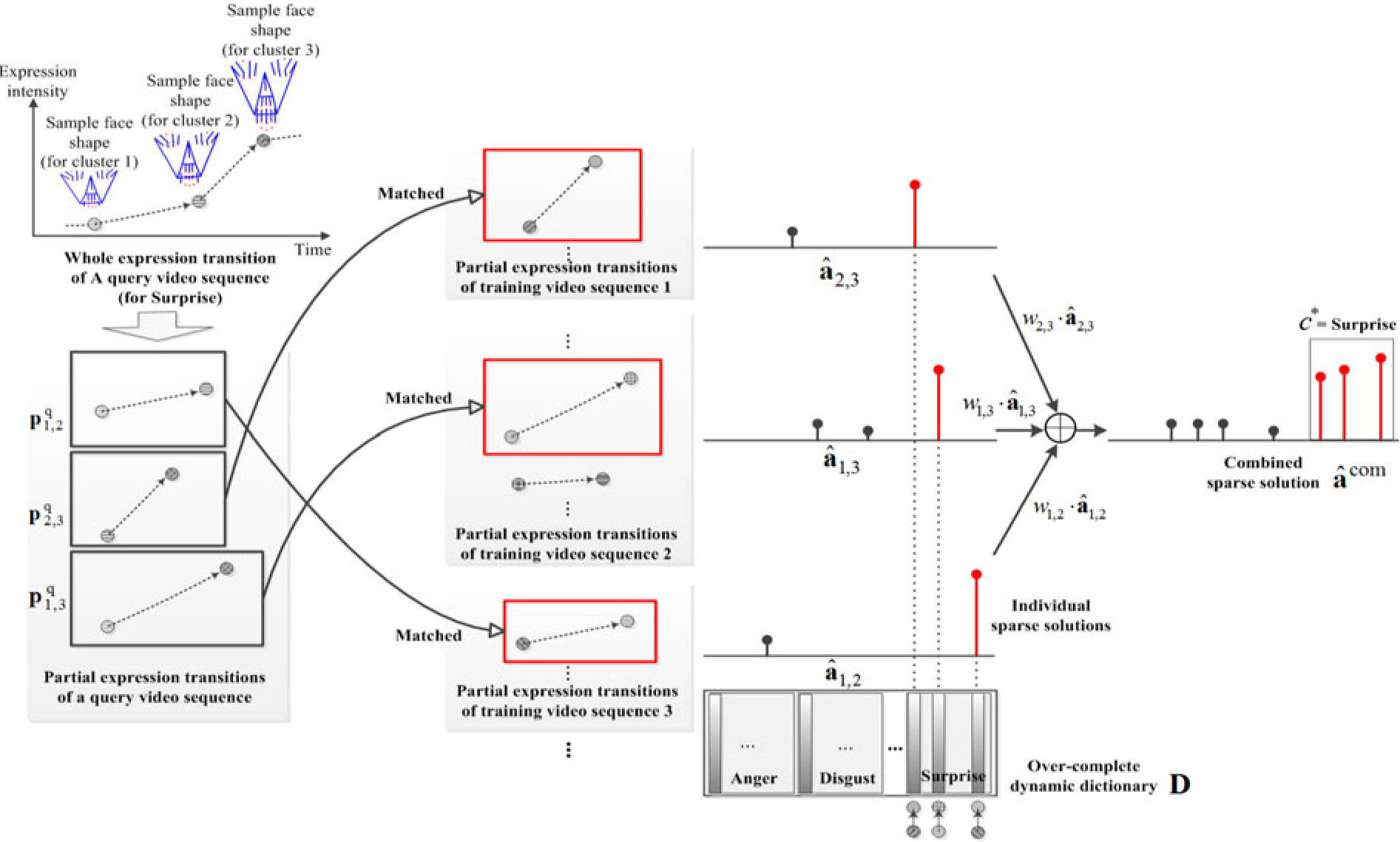 Figure 1: The proposed partial matching framework, illustrating the transition from raw video to a sparse solution via an over-complete dictionary.
3. Geometric Displacement over Appearance
By focusing on the change in length between 29 specific connecting lines (linked to Facial Action Units), the model focuses on how the muscles move rather than what the person looks like. This effectively removes "facial identity" from the equation, allowing for high-accuracy subject-independent recognition.
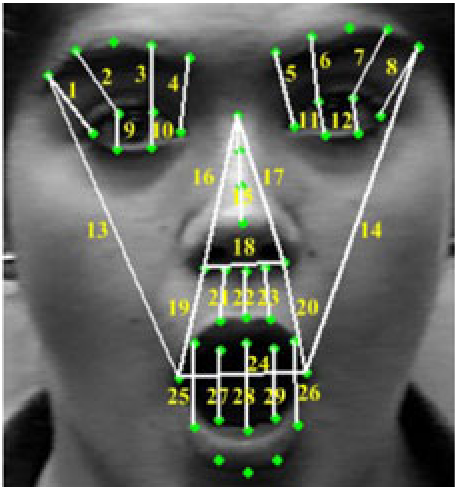 Figure 2: The 29 connecting lines used to encode the geometric movement of the face.
Experiments & SOTA Results
The framework was tested on three major databases: CK+, MMI, and NVIE.
- Robustness to Video Length: Even when video sequences were reduced to half-length, the proposed method saw negligible drops in accuracy, whereas traditional spatio-temporal methods (LPQ-TOP) crashed by over 13%.
- Inter-DB Generalization: The most impressive feat was training on MMI and testing on CK+. While other methods hovered around 20-60%, this method hit 70.03%, proving it isn't just "memorizing" one dataset.
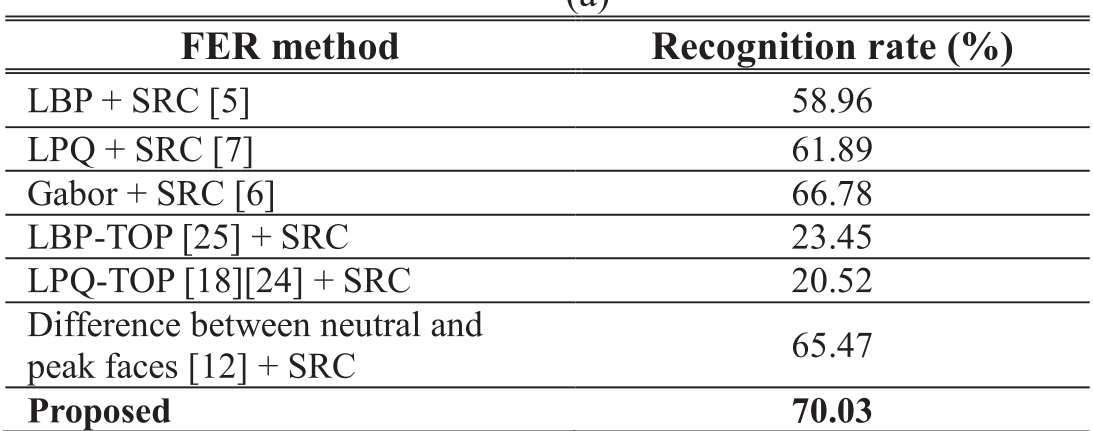 Table: Comparison of inter-database performance, highlighting the proposed method's superiority in generalization.
Critical Analysis & Future Outlook
The beauty of this work lies in its neutral-independence. It doesn't need to know what you look like when you're calm; it only needs to see how your features shift over a few frames.
Limitations: While the geometric approach is robust, it relies heavily on accurate landmark detection. If the landmark tracker fails (e.g., in extreme side profiles), the engine loses its fuel.
The Road Ahead: The authors suggest incorporating Group Sparsity. Instead of analyzing each transition independently, future iterations could enforce a rule that all transitions in a single video must likely belong to the same emotion, further cleaning up the "noise" in spontaneous expressions.
Conclusion
By shifting the focus from "whole sequence matching" to "partial atom matching," this paper provides a blueprint for facial analysis systems that work in the messy, unaligned reality of human interaction.