
Maximizing Marketing ROI: The Science of Participant Selection in Offline Events
18000_Participant Selection for Offline Event Marketing Leveraging Location-Based Social Networks.
This paper introduces a participant selection framework for offline event marketing (e.g., restaurant tasting nights) by leveraging Location-Based Social Networks (LBSNs). The core approach, Team Local Influence (TLI), optimizes invitee selection by modeling distance decay, overlapping social influence, and item coverage constraints to maximize the expected number of venue visits.
TL;DR
Marketing events like "Tasting Nights" are expensive. This paper tackles the "Who to Invite?" problem by leveraging LBSN data (like Foursquare) to build a model called Team Local Influence (TLI). By accounting for how far people live, who their friends are, and what food they actually like, the researchers developed an algorithm that chooses a participant team capable of attracting significantly more customers than traditional "Most Popular" or "Nearest" strategies.
Background: Beyond the "Popularity" Bias
In the era of Social Media, it is tempting to simply invite the people with the most followers to your store opening. However, this paper argues that the Influential First (IF) strategy is fundamentally flawed for offline business for two reasons:
- Redundancy: Influential people often know the same people. Inviting two "superstars" from the same social circle is a waste of a seat.
- Geography: Social influence doesn't teleport. A user might have 1,000 friends, but if those friends live 50 miles from your restaurant, the "influence" won't translate into foot traffic.
The Problem: The Three Pillars of Offline Influence
The authors identify three factors that make participant selection a complex, non-trivial math problem:
- Distance Decay: The probability of a friend visiting a venue drops sharply as distance increases (following a Power Law).
- Overlapping Influence: If user and user are both friends with user , the probability of visiting shouldn't be counted twice. We need "Team Influence," not a sum of individuals.
- Item Coverage: A participant might influence many people, but if your restaurant specializes in "Vegan" and "Soup," and the participant only likes "Steak," the marketing message is misaligned.
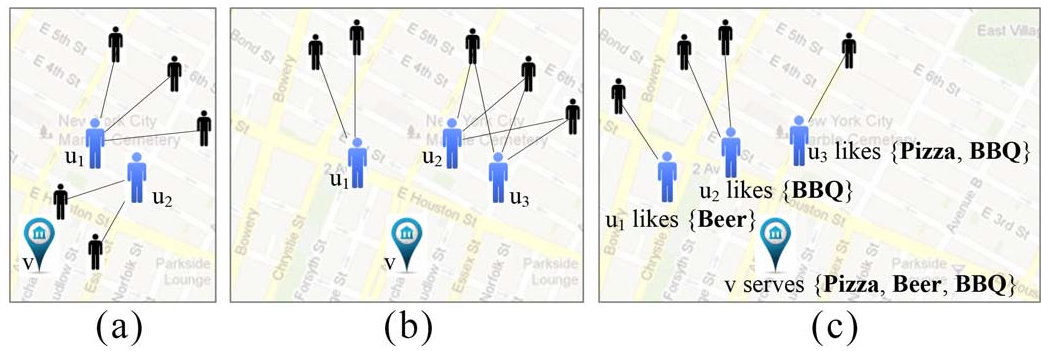 Figure 1: Comparison of influencers—u2 and u3 have overlapping friends, making {u1, u2} a better team than {u2, u3}.
Methodology: Engineering the Optimal Team
The researchers transformed this into a Combinatorial Optimization Problem. Since finding the absolute best team among thousands of users is "NP-hard" (computationally impossible to solve perfectly in a short time), they used Simulated Annealing (SA).
1. The Quantitative Model: ETLI
The "Team Local Influence" (ETLI) model estimates the marketing effect as: This ensures that we only care if a potential customer has at least one friend attending, and we weight that potential visit by how far they have to travel.
2. The Algorithm
To solve the constraints of Scale (exactly seats) and Item Coverage (all menu categories represented), the SA algorithm starts with a "fit" initial group and iteratively swaps users. It allows for "worse" moves early in the process to avoid getting stuck in local optima, eventually converging on a high-performing team.
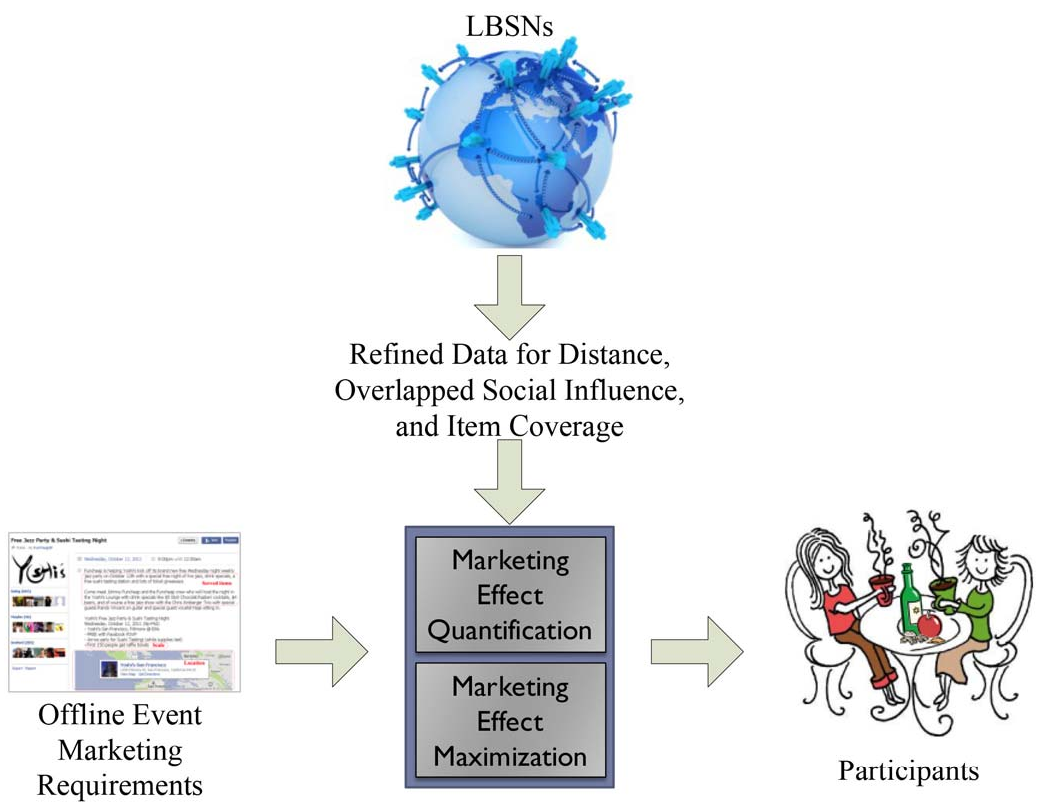 Figure 2: The framework takes LBSN data and marketer requirements to output the near-optimal participant list.
Experimental Results: Why TLI Wins
Using a dataset of ~2,000 users and ~1,800 venues in NYC, the authors compared four models: SI (Simple Influence), SLI (Local), TI (Team), and TLI (Team + Local).
- The "Overlapping" Breakthrough: The results proved that "Team Influence" models (TI/TLI) significantly outperformed individual-sum models. When you account for friendship overlaps, you naturally select a more diverse group of participants who reach different "pockets" of the city.
- Coverage Gap: Without a specific coverage constraint, standard "Influential" strategies failed to cover all food tags (e.g., missing "Soup" lovers), whereas the proposed framework maintained 100% coverage even with small participant scales.
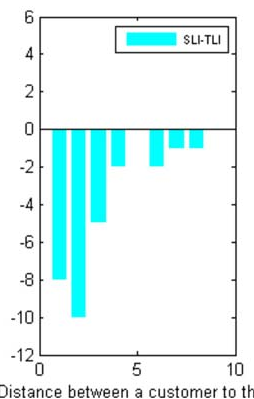 Figure 3: Comparison of how many friends are "pulled" into the venue. TLI (d) successfully minimizes overlap (f-number) while maximizing unique reach.
Conclusion and Takeaways
This paper moves beyond the "bigger is better" mindset of influencer marketing. For physical businesses (restaurants, gyms, shops), the value of a customer is inextricably linked to their geographic location and the uniqueness of their social reach.
Key Insight for Industry: Don't just look for "Socialites." Look for "Connectors" who live near your business and belong to distinct social groups that don't already talk to each other. By using data from LBSNs, businesses can turn a simple giveaway into a mathematically optimized engine for new customer acquisition.