
Participating in the Digital Society: Moving Beyond the Ballot Box
Participating in the Digital Society
This paper explores the evolution of "Digital Democracy" by shifting focus from formal electronic voting to the underlying socio-technical environments necessary for citizen participation. Using the Information System Artefact (ISA) model, it analyzes how digital tools can foster trust and engagement in both full democracies (Sweden) and authoritarian regimes (Uganda), concluding that democracy is a continuous "doing" rather than a static "having."
TL;DR
Is digital democracy dead, or just misunderstood? As trust in social media and formal institutions wanes, researcher Åke Grönlund argues that we must stop obsessing over electronic voting and start focusing on "participatory environments." By examining how digital tools empower teachers in Sweden and anti-corruption monitors in Uganda, this paper reveals that democracy isn't a state of being—it’s a daily practice of information flow and social interaction.
Contextual Positioning
In a world where only 4.5% of the population lives in "full democracies," the academic field of digital democracy has often felt like an ivory-tower exercise. This work serves as a theoretical course correction, moving the needle from "political science formalisms" to "social informatics," positioning digital democracy as an extension of digital government and social accountability.
The Problem: The Facade of Formalism
The author identifies a critical blind spot: most digital democracy research assumes a functioning democratic "soil." However, formal arrangements like voting are often mere facades in countries where civil liberties are restricted or trust is non-existent.
- The Trust Deficit: Without trust that a government won't imprison dissenters, high-tech consultation tools are useless.
- The Artifact Trap: We often treat digital tools as mere hammers (neutral tools), ignoring how their design directs and restricts our behavior.
Methodology: The ISA Model
To bridge the gap between technology and society, the paper utilizes the Information System Artefact (ISA) model. It breaks every digital intervention into three inseparable layers:
- Technical Artefact: The software/hardware (e.g., Zoom, SMS portals).
- Information Artefact: The meaning-making exchange (what data is shared, by whom, and when?).
- Social Artefact: The human interactions and rules (formal procedures or informal social gatherings).
 Note: The model emphasizes that changes in information flows fundamentally alter social systems, and vice versa.
Case Studies: From Digitalized Schools to Anti-Corruption
The paper presents evidence that participation works through "administrative" rather than "political" channels:
1. The Swedish "School Digitalization" Consultation
When Sweden needed to operationalize a vague national strategy, they didn't just issue a top-down decree. They held 30 consultation meetings (physical and online) using a structured digital tool.
- The Result: 3,000 participants reversed the flow of requirements. Instead of the government telling schools what to do, the schools identified 18 national initiatives that the government needed to solve.
- Insight: Participation improved the "functioning of government" (an EIU democracy metric) by leveraging professional expertise.
2. Uganda’s CIPESA & WOUGNET
In an authoritarian context where corruption is rampant, NGOs like CIPESA use a mix of "low-tech" and "high-touch" methods.
- Mechanism: Toll-free call centers, SMS polling, and radio shows allow citizens to report health service failures or bribery.
- The Mediator: NGOs act as a "buffer" social artefact. They verify reports and negotiate with authorities, protecting individual citizens from direct confrontation with the state.
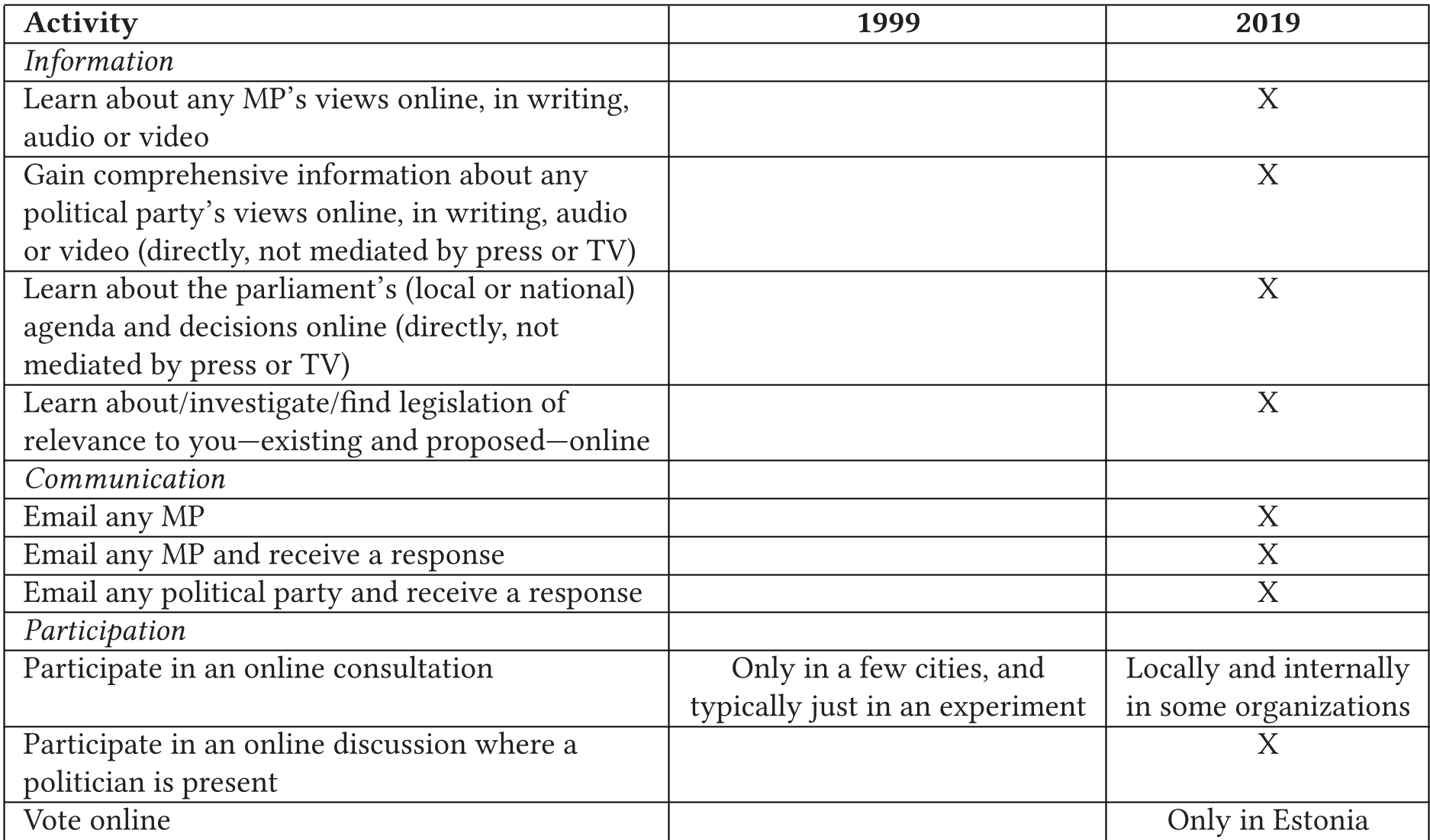 The table highlights that while information access has peaked, structured participation remains rare.
Critical Insight & Conclusion
The paper’s most provocative claim is that "Democracy is not something you have but rather something you do."
It argues that digital democracy researchers should stop looking for a "Silver Bullet" technology (like Blockchain voting) and instead look for ways to nurture participation in mundane contexts: healthcare settings, school administration, and local service delivery.
Takeaway for the Industry: If you are building "GovTech" or social platforms, your design is never neutral. You are either building an "information artefact" that reinforces silos or a "social artefact" that fosters deliberation. Success depends not on the sophistication of the code, but on the alignment of that code with the social trust of the users.
Future Outlook
While the paper is optimistic about small-scale participation, it warns of the "shrinking civic space" in East Africa and the rise of regressive legislation targeting social media. The future of digital democracy may not be found in national parliaments, but in the resilient, "pre-political" networks formed by professionals and NGOs fighting for social accountability.