
Deciphering the "Core" Problem: How Social Capital Shapes Collaboration Networks
Participation and Engagement in Inter-organizational Groups: Synthesizing Social Network Analysis with Ethnography to Evaluate Social Capital
This paper introduces a "Network Ethnography" methodology that synthesizes Social Network Analysis (SNA) with ethnographic content analysis to evaluate an Australian inter-organizational technology cooperation group. By mapping relationships and analyzing meeting transcripts, the study identifies a core cluster of actors who hold the majority of "Social Capital," which paradoxically stabilizes the group while potentially inhibiting broader engagement.
TL;DR
Why do some professional groups thrive while others dwindle despite everyone sharing the same goals? This paper argues that the secret lies in Social Capital. By combining the "hard" data of Social Network Analysis (SNA) with the "soft" insights of ethnography, the researchers discovered that most inter-organizational groups are kept alive by a tiny, tight-knit "core cluster" that inadvertently creates a barrier for outsiders.
The "Why" Behind the "What": Beyond the Graph
Standard organizational research often treats social networks as simple maps of "who talks to whom." However, this fails to explain the motivation behind the talk. The authors identify a critical gap: we can see participation dropping, but we don't know if it’s due to external competition, internal boredom, or a subtle "clique" culture that makes new members feel unwelcome. This paper proposes Network Ethnography as a way to peek under the hood of these social engines.
Methodology: The Two-Stage Deep Dive
The researchers didn't just look at attendance lists; they immersed themselves in the group's "life" for two months.
- Stage One (The Skeleton): They used 45 months of historical data to build an SNA graph. They measured Degree Centrality (how many ties an actor has) and Betweenness Centrality (who acts as a bridge).
- Stage Two (The Soul): They transcribed seven two-hour meetings and performed content analysis to identify sources of Social Capital.
The Structural Reality
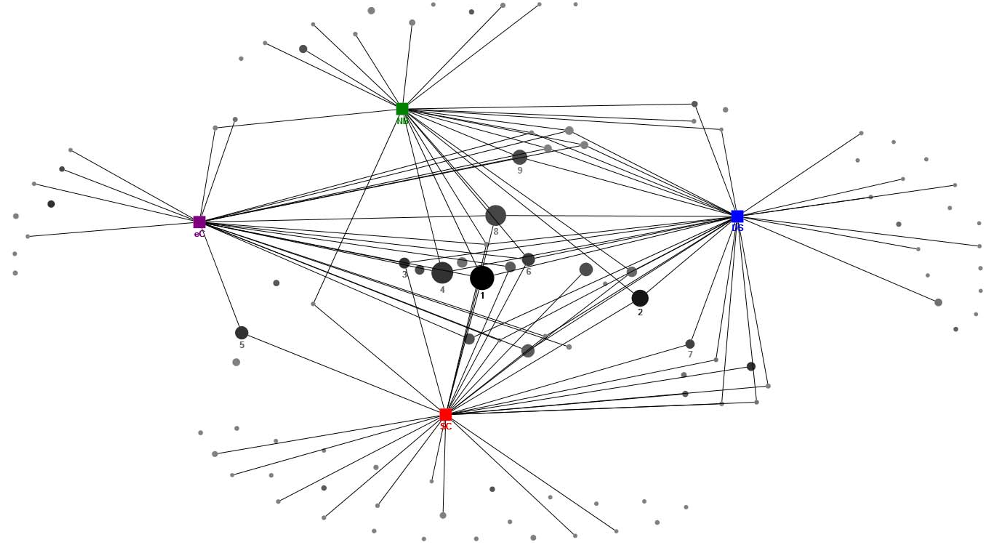 Figure 1: The SNA map reveals a highly fragmented group. The larger, darker nodes represent a small elite that does all the heavy lifting.
Key Insight: The Social Capital Trap
The most fascinating finding wasn't the lack of work, but the type of social interaction occurring. The team categorized social capital into two types:
- Consummatory (36 counts): Values introjection and "Bounded Solidarity." These are the jokes, the "we're all in this together" speeches, and the enforcement of group norms.
- Instrumental (16 counts): Reciprocity exchanges and "Enforceable Trust." This is the actual work—sharing data, collaborating on projects, and technical advice.
The group was "over-socialized" in the wrong way. The core cluster spent more time reinforcing their own bonds (solidarity) than facilitating instrumental work that would invite others to join.
Performance vs. Participation
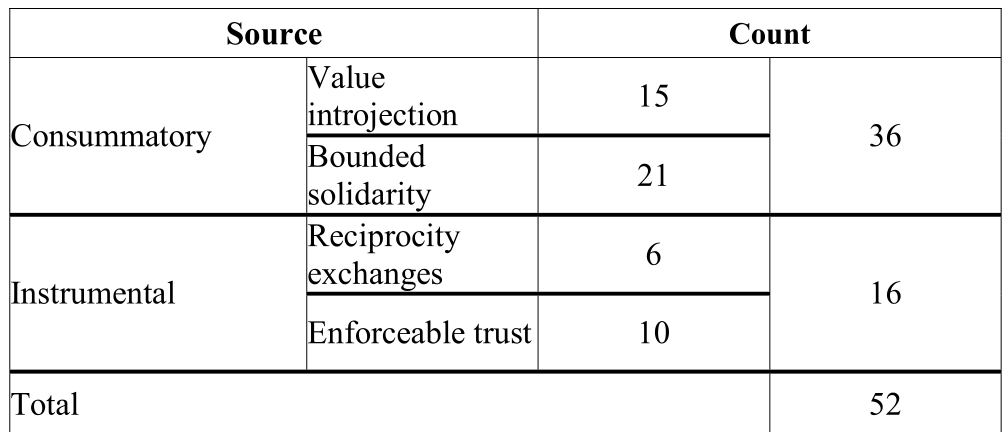 Table 1: Quantitative evidence showing the dominance of consummatory social capital over instrumental exchanges.
Critical Analysis & Conclusion
This study provides a roadmap for "diagnosing" failing collaborations. The takeaway is clear: Density matters less than the nature of the ties. A group can be "connected," but if those connections are purely based on historical friendship (consummatory) rather than shared task-output (instrumental), the group will eventually stagnate into a "clique."
Limitations and Future Work
While robust, the study acknowledges that external factors (like a new market entrant) play a massive role in group behavior that internal SNA cannot capture. The authors suggest that the next evolution is moving these interactions to Social Computing platforms, which can record and analyze these social signals in real-time, allowing for "early intervention" when participation begins to wane.
Final Thought: If you want your professional group to grow, stop just "bonding" and start "bridging."