
VSSE: Bridging Virtual Worlds and Real-World Mobile Social Networks
Participatory Mobile Social Network Simulation Environment
The paper introduces VSSE (Virtual Social Simulated Environment), a novel participatory simulation framework for Mobile Social Networks (MSN) built within Second Life. It replaces traditional random mobility models with a pattern-based approach using "SL bots" and real human avatars to emulate realistic social encounters.
TL;DR
Researchers have developed a Virtual Social Simulated Environment (VSSE) within Second Life to solve a long-standing headache in mobile networking: how to simulate human movement realistically. By combining a "Working Day" Markov model with real human participants (avatars), they achieved a simulation where movement patterns are within 21% accuracy of real-world Australian user traces.
The "Random" Problem in MSN Simulation
For years, protocols for Mobile Social Networks (MSN) were tested using Random Walk or Random Waypoint models. While mathematically convenient, these models are socially "blind"—they assume humans bounce around like gas molecules. In reality, humans have intent; we go to work, meet friends for coffee, and follow predictable temporal patterns.
The authors argue that existing models are too static. To capture the true "social" in social networks, you need two things: Daily Routines and Human Participation.
Methodology: The State-Machine Approach to Life
The core of VSSE is a pattern-based mobility model. Instead of moving randomly, the "Bots" (automated agents) operate on a Markov Model with 9 distinct states, representing a typical daily cycle.
1. The Markov Model of Daily Life
The system defines transitions between states like Home, Train, Office, and Restaurant.
- Probabilistic Logic: Transitions aren't fixed. If a bot went to "Restaurant A" yesterday, the probability of it choosing that same path today is adjusted (Domain Assumption-1), mimicking human habit formation.
- Dynamic vs. Static States: While "Office" is a static coordinate, "Train" or "Bus" are dynamic states where bots move along sub-state grids to simulate transit.
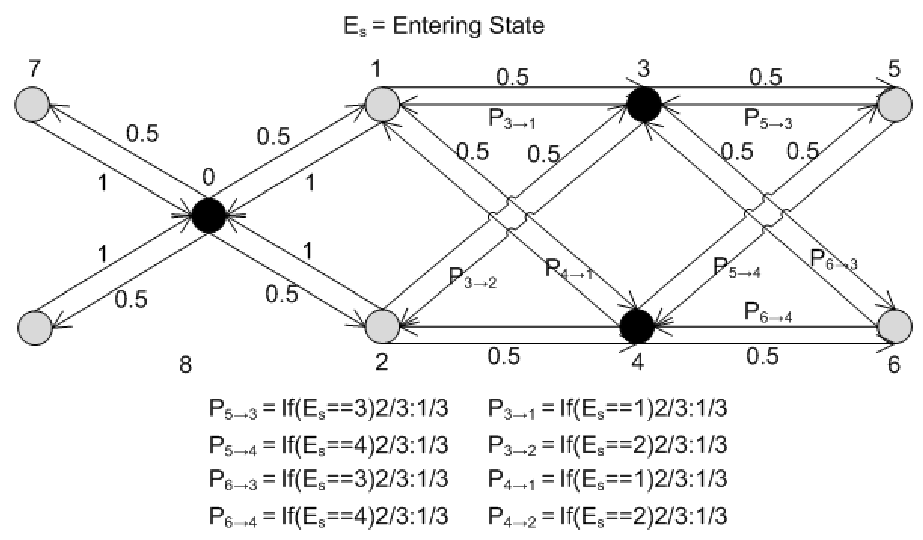 Fig 1: The finite state machine capturing daily transition probabilities for the SL bots.
2. Participatory Dynamics
This is where VSSE stands out. Unlike a closed simulation script, it runs in Second Life.
- Human-in-the-Loop: Real people can log in.
- Communication: Using a custom-built virtual mobile device (programmed in LSL), avatars can exchange messages with bots if they have matching "interests" and are within range. This creates a "dynamic social topology" that is impossible to code manually.
Experimental Validation: Virtual vs. Reality
To prove that Second Life isn't just a game but a valid scientific tool, the authors compared VSSE data against a real-world field experiment involving students and office workers in Sydney.
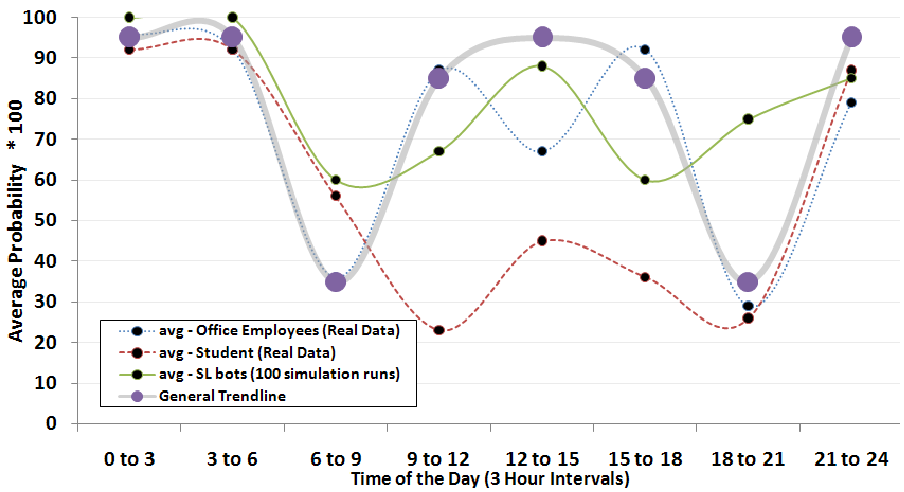 Fig 2: The physical ground truth—mapping movement in Sydney to validate virtual patterns.
The results showed a striking correlation:
- Predictability Peaks: Both real and virtual data showed high predictability during the night (at home) and midday (at the office).
- The 21% Gap: The average difference in pattern prediction probability was only 21%. Considering the virtual model only used 9 states, this is highly encouraging for the use of virtual worlds as "proxy environments."
Critical Insight & Future Work
The beauty of VSSE is its accessibility. By using a virtual world, even non-experts can participate in and observe complex network simulations. However, the study identifies a clear limitation: the current model is a bit too simple (only 9 states).
The Takeaway? As we move toward the "Metaverse," the line between virtual simulation and real-world behavior is blurring. VSSE demonstrates that virtual environments are no longer just for play; they are robust platforms for stress-testing the social technologies of tomorrow.