
Empowering Communities through Models: How Secure Rights Save Teak Forests
Participatory modelling to improve partnership schemes for future Community-Based Forest Management in Sumbawa District, Indonesia
This paper presents a participatory system dynamics modelling framework to optimize Community-Based Forest Management (CBFM) in Sumbawa, Indonesia. By simulating stakeholder-defined scenarios, it demonstrates that granting secure tenure and harvesting rights to local cooperatives significantly reduces illegal logging while increasing revenue for both communities and the state.
TL;DR
In the heart of Sumbawa, Indonesia, a unique experiment in Participatory Modelling has proven a vital point: the best way to save a forest is to give the people living there the right to harvest it. By using system dynamics to simulate future scenarios, researchers showed that granting full management rights to local cooperatives could slash illegal logging by 75% while simultaneously boosting government tax revenue.
The Motivation: A Legacy of Abandonment
The story begins in 1986 with state-owned teak (Tectona grandis) plantations. When the state company departed in 1999, they left behind 18,160 hectares of "abandoned" state forest. The result was a tragedy of the commons: illegal logging and encroachment became the norm because local communities were treated as mere laborers rather than owners.
The core research intuition here was that incentives matter. Without the secure right to harvest mature trees, communities had no reason to protect them from others. Earlier policies failed because they didn't account for the feedback loop between tenure security and ecological resilience.
Methodology: Systems Thinking in Action
The researchers didn't just build a model in isolation; they used System Dynamics Modelling as a mediation tool. By involving the Forestry District Agency and local cooperatives in the modelling process, they transformed abstract policy questions into a visual, quantifiable system.
The Model Architecture
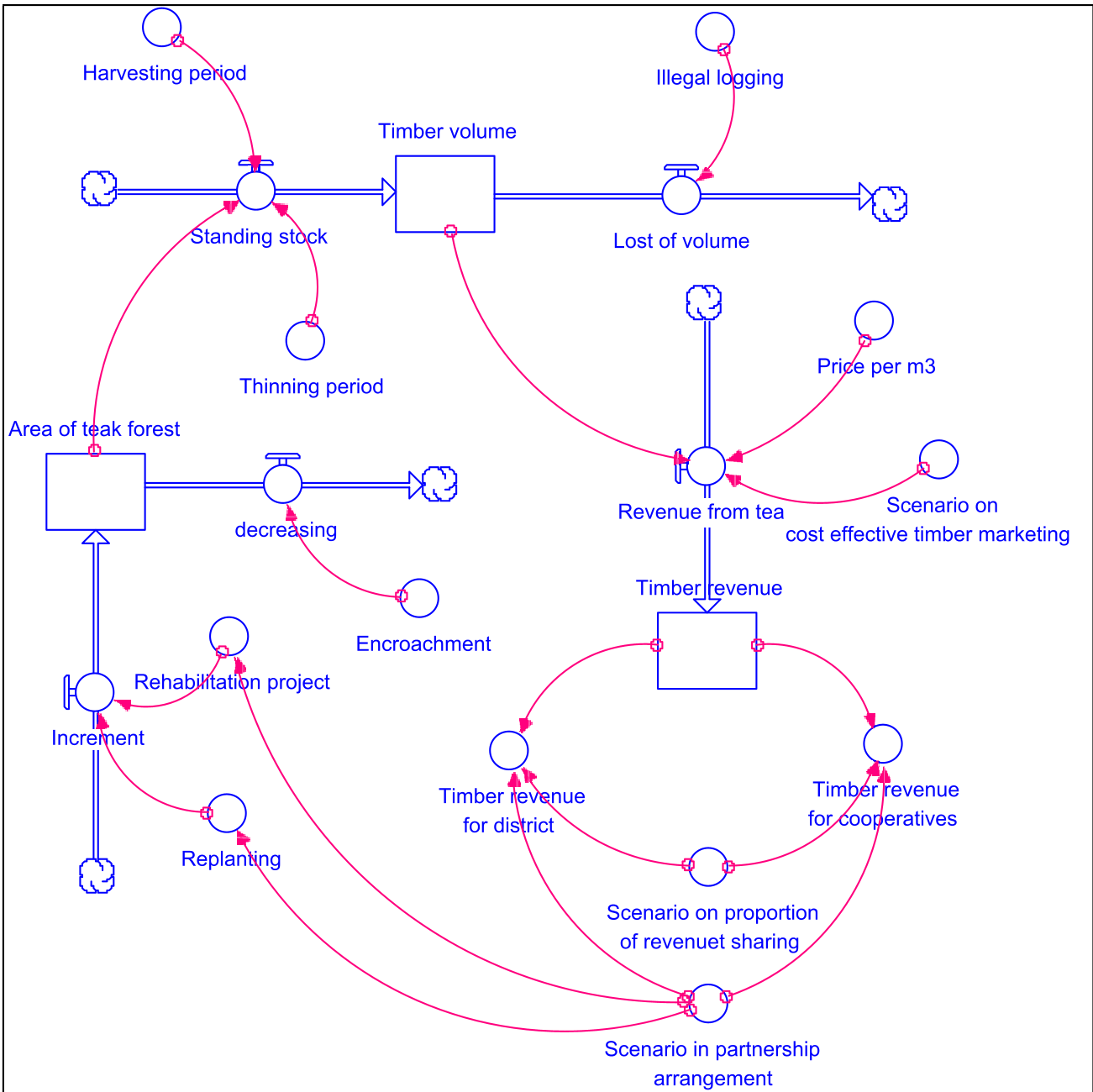
The model was built using the STELLA platform, focusing on the "stocks and flows" of timber.
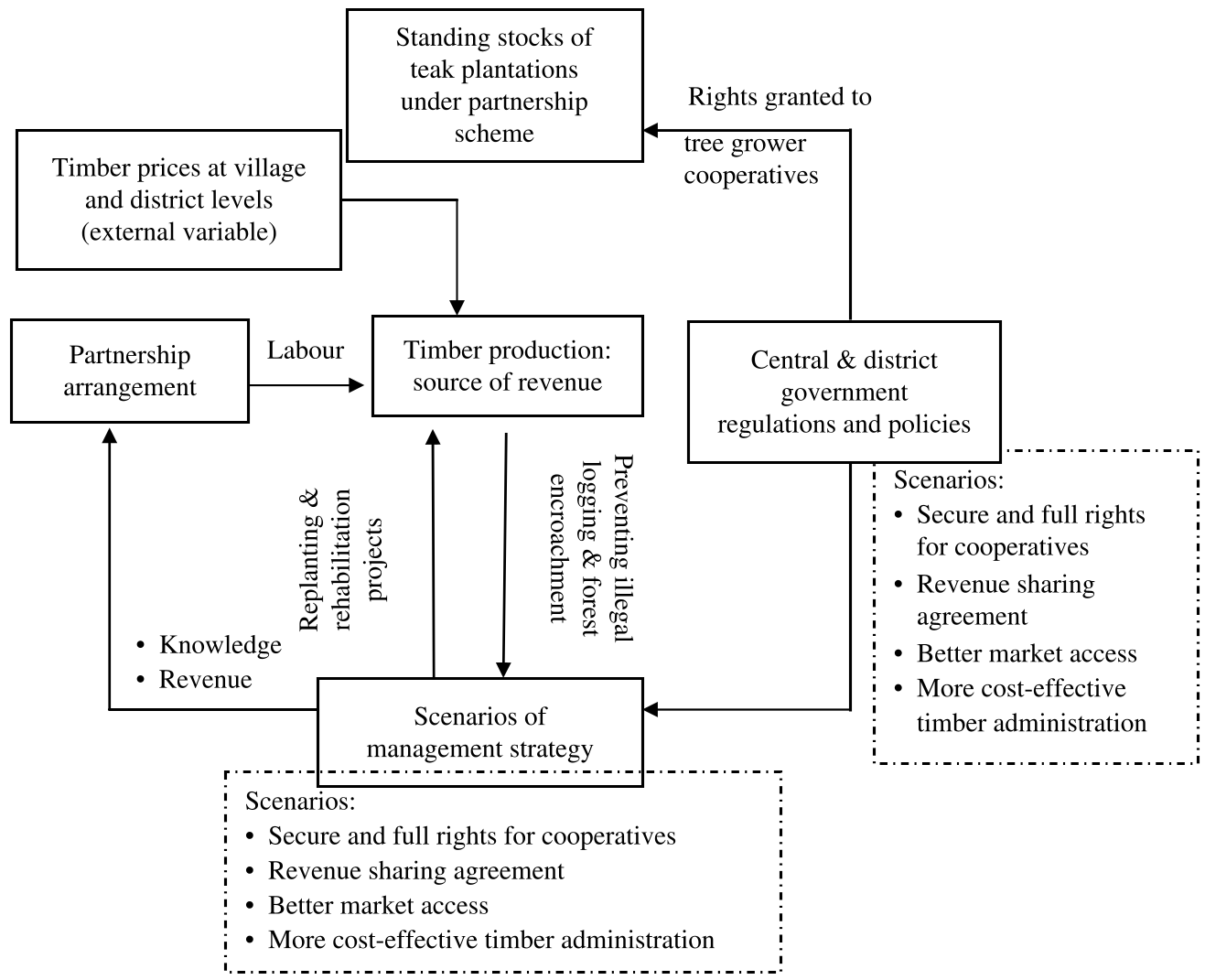
The conceptual model illustrates how timber production serves as a dual revenue source, with internal drivers (replanting) and external inhibitors (illegal logging).
Key variables included:
- Standing Stocks: The "Bank Account" of the forest.
- Bundle of Rights: The policy "Switch" (varying from zero rights to full harvesting rights).
- Revenue Sharing: A 70/30 split between cooperatives and the agency.
Results: The Triple-Win Scenario
The simulation compared three scenarios over a 30-year horizon. The outcomes were stark and provided the evidence needed to challenge the central Ministry of Forestry (MoF).
The graph above demonstrates the "Delta" of standing stocks—showing how much more timber remains in the forest when community rights are secured compared to the base-case.
| Metric | Scenario 1 (No Rights) | Scenario 3 (Full Rights) |
|---|---|---|
| Community Revenue | -$34,228 (Losses) | $14,696,573 |
| State Tax Revenue | -$3,423 (Losses) | $1,741,416 |
| Illegal Logging | High/Increasing | Reduced by 75% |
Why This Works
The "Full Bundle of Rights" scenario creates a virtuous cycle. When the community knows they own the second rotation of trees, their Inductive Bias shifts from short-term extraction to long-term stewardship. Intercropping (planting crops between teak trees) provides immediate cash flow, while the eventual timber harvest secures their future.
Deep Insight: Beyond "Participation"
This study is a landmark in CBFM research because it moves past the "feel-good" rhetoric of participation. It uses hard data to show that economic resilience is a prerequisite for ecological resilience.
The main limitation noted by the authors is the capacity of local district staff to maintain these complex computer models. However, the true value of the work was its role as a "visioning tool." By presenting these results to the Ministry of Forestry, the team provided a scientific basis for the devolution of power—proving that when communities win, the forest wins too.
Conclusion
The Sumbawa case study demonstrates that participatory modelling can bridge the gap between local reality and national policy. To protect the world's remaining tropical forests, we must stop viewing local people as threats and start viewing them as the primary stakeholders in a system that rewards conservation with prosperity.