
Swarm Intelligence: Rethinking Community Formation through the Boids Paradigm
Particle Swarm as a Model for Community Formation in Social Networks
This paper introduces a particle swarm-based model to simulate the formation and evolution of online communities. By adapting the Boids algorithm, the authors model social users as independent particles whose collective behavior, governed by simple rules, emerges into complex group structures centered around leader figures.
TL;DR
Social networks aren't just graphs; they are living, breathing ecosystems. This paper adopts the Boids algorithm—originally designed to simulate bird flocks—to model how online communities form. By treating users as "particles" and administrators as "leaders," the researchers demonstrate how simple rules of local interaction (Influence, Reputation, and Recommendation) determine the stability and scale of digital social groups.
Context: Why "Particles" for People?
Most social network models treat communities as static clusters or rely on heavy probabilistic distributions. However, online communities (like Reddit or Stack Overflow) are subject-centered and volatile. They require more than just "nodes" and "edges"—they require agency.
The authors argue that global group behavior emerges from local individual actions. Instead of complex psychological modeling, they use the Artificial Life approach: if we can simulate the "physics" of social attraction and repulsion, we can understand why some communities thrive while others dissipate.
Methodology: The Social Physics of Swarms
The core of the model is an adaptation of Reynolds' Boids algorithm. Every "user" (agent) follows three mechanical constraints that the authors translate into social dimensions:
- Coherence (Social Attraction): Moving toward the average position of the group (joining the crowd around a topic).
- Adjustment (Norm Conformity): Aligning velocity and heading (adopting the community's tempo and behavior).
- Separation (Individual Privacy): Maintaining a safe distance to avoid collisions (preventing social friction).
The Leader-Follower Extension
Unlike a standard flock, social communities have Leaders (administrators).
- Leaders (5% of agents): Act as anchors, attracting unassociated agents.
- Reputation: A temporal variable. The longer an agent stays in a group, the higher the leader's reputation, which in turn strengthens the group's Coherence.
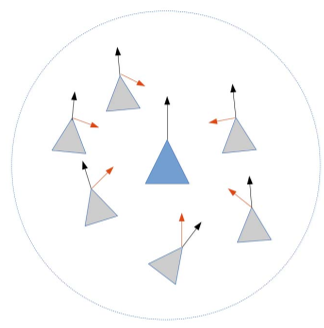 Caption: Visual representation of the core swarm behaviors: (a) Coherence, (b) Adjustment, and (c) Separation.
Experiments and Key Findings
The researchers conducted several simulations (400 agents, 20,000 steps) using the MASON library. Their findings offer a "manual" for community designers:
1. The Influence Threshold
When mutual influence between agents is strong, groups are stable, and users rarely switch (average groups per agent ≈ 1). However, as influence weakens, the time spent "outside" a group skyrockets. Takeaway: Communities must provide real-time interaction tools (chat, presence indicators) to stay "sticky."
2. The Recommendation Paradox
The study compared "Leader-only" vs. "All-member" recommendations.
- Result: Recommendations by leaders alone are largely ineffective.
- Insight: To trigger migration and group growth, the recommendation tools must be decentralized. However, aggressive all-member broadcasting actually decreases average group lifespan, leading to more "volatile" social dynamics.
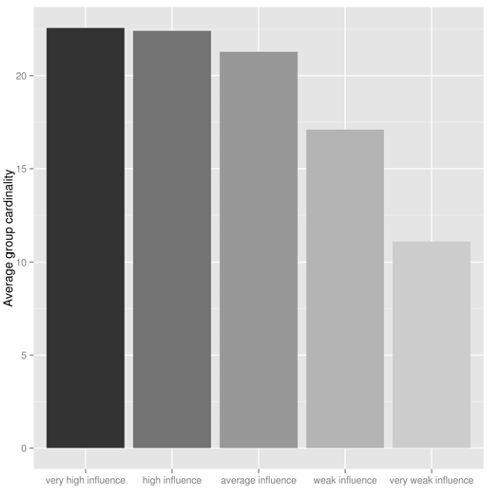 Caption: Sensitivity analysis showing how varying influence levels impact group cardinality, reputation, and time spent in clusters.
Deep Insight: From Biology to Information Systems
What makes this work stand out is the transition from topological analysis to emergent behavior. By observing the Likeness parameter—which grows with shared time—the authors find that "social bonds" are essentially a form of low-pass filter on group noise. High reputation and high likeness act as a stabilizing force that allows a swarm to ignore external "recommendation" noise.
Limitations & Future Work
The model assumes a "flat" Euclidean space for social distance, which might not capture the multi-dimensional nature of user interests. Furthermore, while the model accounts for reputation, it doesn't yet simulate malicious agents or "anti-social" swarms that seek to disrupt communities.
Conclusion
This paper proves that the "simple rules" of Artificial Life are sufficient to model the macro-properties of online social structures. For architects of digital spaces, the message is clear: focus on the local influence and reputation feedback loops, and the community will effectively "organize itself."