
The Maturity Gap: Why Your Particle Swarm Isn't as "Intelligent" as You Think
Maturity of the Particle Swarm as a Metric for Measuring the Collective Intelligence of the Swarm
This paper introduces a Maturity Model for Particle Swarm Optimization (PSO) to quantify collective intelligence. By synthesizing the C2 (Command and Control) Maturity Model and Collaborating Software attributes, it evaluates various PSO strategies as complex systems, concluding that current swarms lack the necessary maturity for robust multimodal optimization.
TL;DR
Particle Swarm Optimization (PSO) is often lauded as a prime example of Collective Intelligence. However, this paper argues that most PSO variants are "immature" systems. By applying a military-grade Maturity Model (C2), the research demonstrates that because we still "babysit" particles with external parameters (inertia weights and acceleration coefficients), the swarm lacks the true autonomy and awareness required to solve the most difficult optimization landscapes.
Background: Beyond the Velocity Equation
In the world of optimization, PSO has been a staple since 1995. The brilliance of PSO lies in its simplicity: particles fly through a search space, influenced by their own best experience (cognitive) and the swarm’s best experience (social). Yet, despite dozens of variants like TVIW (Time-Varying Inertia Weight) or CLPSO (Comprehensive Learning PSO), we still see swarms getting trapped in local optima.
The author, Zdenka Winklerová, suggests we stop asking "How do we tweak the formula?" and start asking "How mature is this system's intelligence?"
The Problem: The Illusion of Decentralization
Current PSO models suffer from a "Command and Control" problem. While the particles move independently, their rules of motion are dictated by external observers.
- Prior Work Limitation: Most SOTA (State-of-The-Art) methods rely on empirical tuning.
- The Stagnation Trap: If the global best particle stops moving, the whole swarm often collapses toward it because there is no "awareness" shared that the leader is stuck.
Methodology: The C2 Maturity Framework
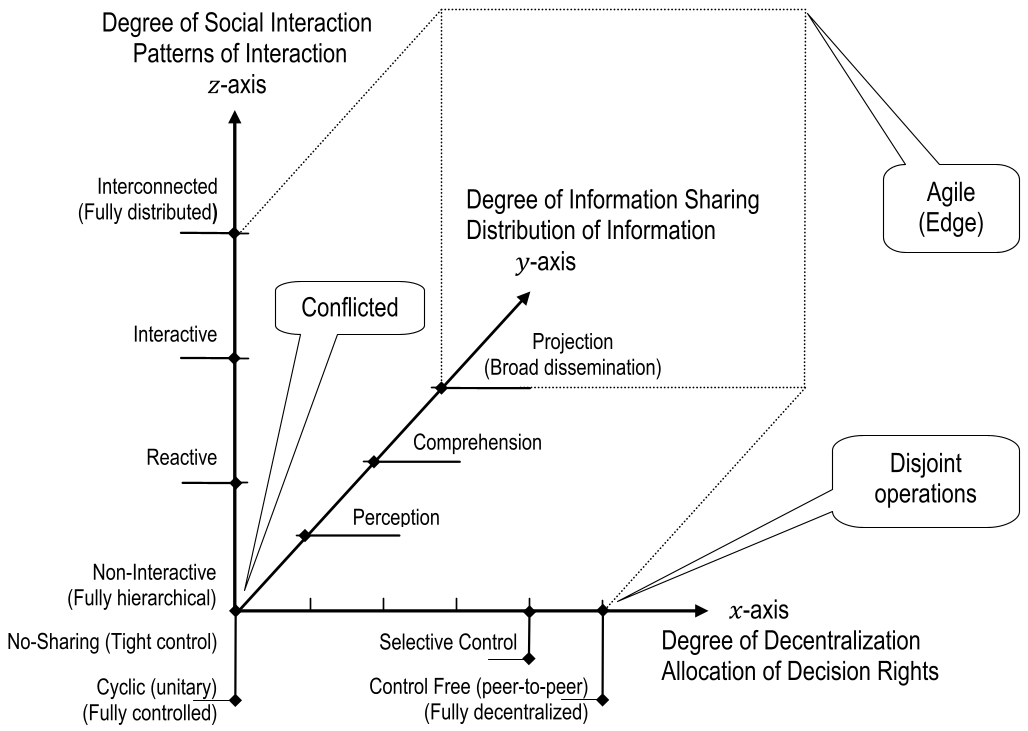
The paper adopts the NATO Network Enabled Capability C2 Maturity Model. It evaluates the "Operational Space" of the swarm across three axes:
- Allocation of Decision Rights (X-axis): From unitary control to peer-to-peer autonomy.
- Information Distribution (Y-axis): From basic perception to shared projection.
- Patterns of Interaction (Z-axis): From non-interactive to fully integrated/agile.
Deconstructing Collective Intelligence
The author further breaks down the swarm's "Maturity" using six collaborative attributes:
- Awareness: Does the swarm know when a particle leaves the search space or when the leader stagnates? (Current Answer: Mostly No).
- Investigation: How do particles find information? (Lbest vs. Gbest topologies).
- Integration: Can particles combine intermediate results? (Achieved via velocity updates, but lacking "differentiation of parts").
Critical Findings: The "Selective Control" Reality
The research concludes that the particle swarm is currently in a state of Selective Control, not full Decentralization.
- Why it's effective: Higher-level integration (like CPSO) allows swarms to solve sub-dimensions of a problem simultaneously.
- Where it fails: The lack of System Awareness. Particles don't adjust their "confidence" or "velocity" based on the environment; they adjust it based on a clock or a random number generator provided by the programmer.
The Velocity Consensus
The core movement is still governed by:

The author points out that (inertia) and (acceleration) are essentially "external crutches." A truly mature swarm would derive these values from within the search experience.
Deep Insight & Conclusion
The takeaway is a call for a paradigm shift: Adaptive Self-Organization.
Instead of pre-setting a linear decay for inertia weight, the particle should have a "level of confidence" in its current direction. If the objective function values are improving, the particle gains confidence (and speed); if it’s wandering aimlessly, it slows down or changes its learning exemplar.
Future Outlook
The author proposes using an "Enhanced Observer" that monitors the "Uniformity" of the search space using Chi-squared tests. Only once the hyperspace is explored "maturely" should the global social components be allowed to pull the swarm toward a potential global optimum.
Final Thought: We have spent decades optimizing the math of PSO. It is time we start optimizing the social logic of the swarm.