
DPSO: Redefining Grid Job Scheduling with Discrete Particle Swarm Optimization
A Novel Particle Swarm Optimization Approach for Grid Job Scheduling
This paper presents a Discrete Particle Swarm Optimization (DPSO) approach specifically designed for job scheduling in heterogeneous and dynamic computational grids. The algorithm optimizes for both makespan and flowtime simultaneously, outperforming existing Fuzzy PSO methods by using a matrix-based position representation to map jobs to grid nodes.
TL;DR
In the world of high-performance computing, efficiently mapping tasks to distributed resources (Grid Scheduling) is a notorious NP-complete puzzle. This paper introduces a Discrete Particle Swarm Optimization (DPSO) approach that utilizes a structured matrix representation to minimize both makespan (total time) and flowtime (average latency). By rethinking how "particles" move through a discrete search space, the authors significantly outperform existing fuzzy-logic-based PSO methods in both speed and solution quality.
The Challenge: Heterogeneity and Dynamism
Modern Computational Grids are not static. They are composed of diverse Virtual Organizations (VOs) where resources are added or removed at any moment. Traditional scheduling fails because:
- Heterogeneity: Nodes have different capabilities and "previous workloads."
- Complexity: Finding the global optimum for jobs on nodes is computationally exhaustive.
- Multiple Objectives: Minimizing the finish time of the last job (Makespan) often conflicts with minimizing the average completion time (Flowtime).
Methodology: The Matrix-Based Insight
The core innovation lies in the Position Matrix. Instead of representing a solution as a simple vector, the authors use an matrix where each column corresponds to a job and each row to a grid node.
1. Position and Velocity Redefined
- Position (): A binary matrix where means job is assigned to node . The constraint is strict: only one '1' per column.
- Velocity (): A real-valued matrix that represents the "tendency" or "probability" of a job being assigned to a specific node.
2. The Move Update Rule
Instead of the standard continuous update, the authors use a "Winner-Takes-All" approach for the position update: This ensures that each job is always assigned to the node with the highest "velocity" or preference in that iteration.
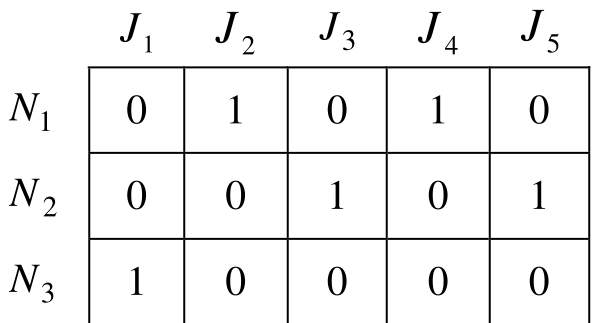 Figure 1: Example of a Position Matrix mapping 5 jobs to 3 nodes.
Experiments: Superior Efficiency
The researchers tested their DPSO against a strong baseline: Fuzzy PSO (FPSO). They used the ETC (Expected Time to Compute) model to simulate realistic grid environments.
Key Findings:
- Better Quality: Across all scenarios (from 50 to 300 jobs), the proposed DPSO found schedules with lower makespans and flowtimes.
- Faster Convergence: Despite the complexity of the matrix, the DPSO required less CPU time to reach an optimal solution than the fuzzy alternative.
- Weighted Fitness: The use of a parameter allowed the scheduler to balance between being "throughput-oriented" or "latency-oriented."
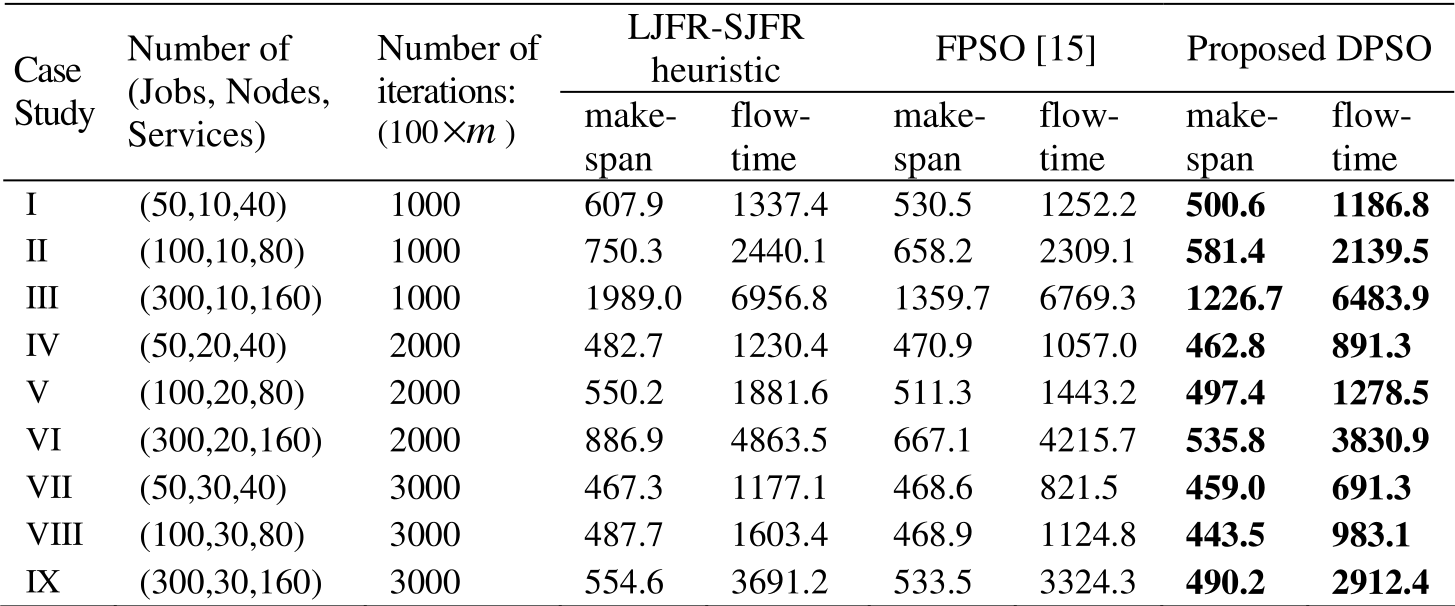 Table 2: Performance comparison showing DPSO consistently beating FPSO and LJFR-SJFR heuristics.
Critical Analysis & Conclusion
The strength of this work is its Inductive Bias. By forcing the PSO's internal structure to mirror the physical constraints of the grid (the matrix representation), the algorithm avoids "illegal" search spaces that fuzzy methods might waste time exploring.
Limitations & Future Work
- Static vs. Dynamic: The paper assumes jobs are independent and available at the start. In modern cloud-native environments, job dependencies (DAGs) and streaming arrivals are more common.
- Scalability: While 300 jobs is a solid test, modern data centers handle millions. Future iterations could explore hierarchical PSO for extreme scales.
Final Takeaway: This research proves that when applying nature-inspired meta-heuristics to engineering problems, the way you encode the solution is often more important than the specific flavor of the algorithm itself.