
Beyond Polarization: Relaxed Structural Balance in Signed Social Networks
Partitioning signed social networks ଝ
The paper introduces the "Relaxed Structural Balance Blockmodel," a generalized approach for partitioning signed social networks. It extends classical structural balance theory by allowing positive and negative tie blocks to appear anywhere in a network's structure, rather than being restricted to specific diagonal positions.
TL;DR
Social life is rarely as simple as "friends with friends, enemies with enemies." While classical Structural Balance Theory suggests that networks naturally polarize into hostile camps, empirical data often tells a messier story. This paper introduces a Relaxed Structural Balance Blockmodel, which allows for complex social roles like mediators (friends to both sides) and "popular" targets. By relaxing the strict architectural constraints of traditional blockmodels, the authors achieve significantly higher accuracy in modeling real-world social groups.
The Problem with Perfection: Why Balance Often Fails
For decades, social network analysis relied on the First and Second Structure Theorems. These stipulated that in a "balanced" network:
- Positive ties only happen within clusters.
- Negative ties only happen between clusters.
However, the authors point out that this "polarized" view makes no room for mediation. Imagine an actor who maintains positive ties with two mutually hostile groups. Under traditional balance theory, this actor is an "inconsistency" to be moved or ignored. In reality, such actors are crucial bridges. Furthermore, some individuals might be universally disliked (hostility within a group) or universally liked (differential popularity), both of which violate the strict diagonal structures of classical balance.
Methodology: Relaxing the Rules
The core innovation is the Relaxed Structural Balance Blockmodel. Instead of forcing positive blocks onto the diagonal and negative blocks off-diagonal, the authors treat the block types as flexible units.
The Formal Intuition
The authors use a criterion function , where represents negative ties where they shouldn't be and represents positive ties where they shouldn't be.
By relaxing the model, they allow:
- Negative blocks on the diagonal: Representing internal friction or rivalry within a group.
- Positive blocks off the diagonal: Representing mediation or broad popularity across group boundaries.
- Null blocks: Essential for sparse networks where no systematic interaction occurs.
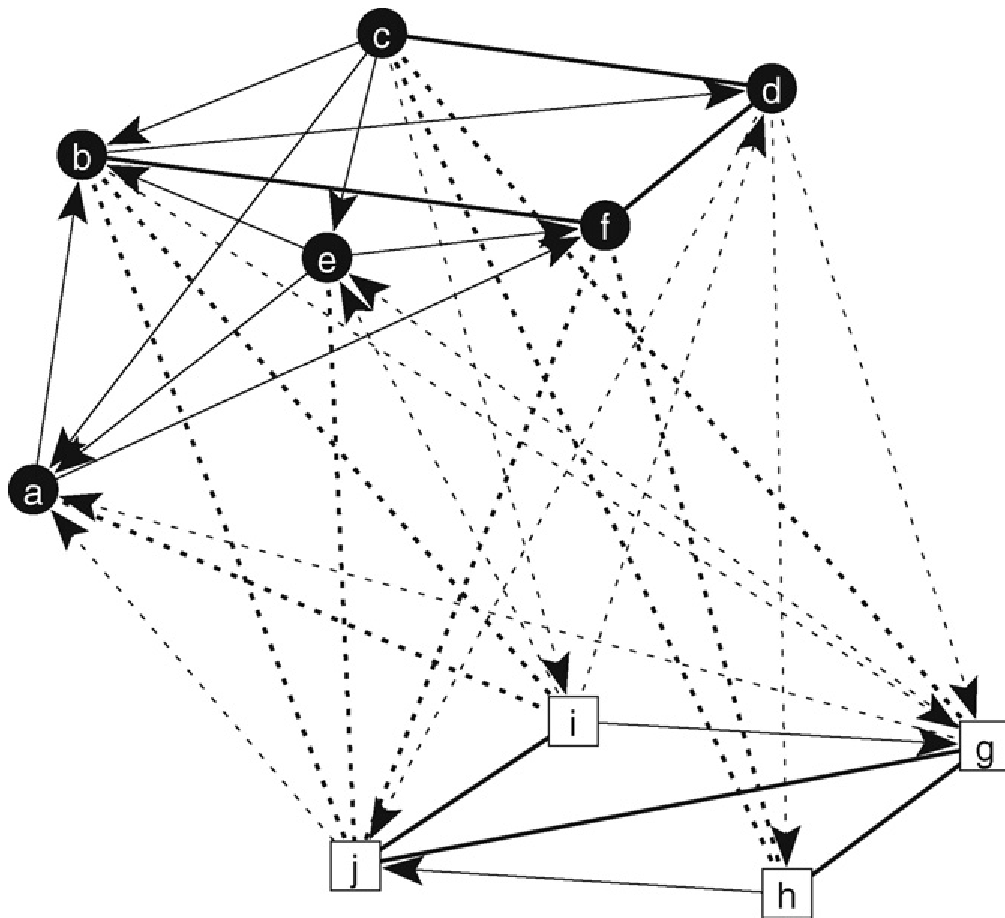 Fig 1: A traditional balanced network showing two polarized, mutually hostile groups.
Experiments: Real-World Evidence
The authors apply this to several "hallmark" social datasets.
1. The Sampson Monastery Data
The Sampson data tracks a group of monks who eventually split into the "Young Turks," "Loyal Opposition," and "Outcasts." While traditional balance identifies these three clusters, it misses the internal dynamics. The relaxed model finds that some members of the Loyal Opposition actually sent positive ties to the Young Turks—a mediation signal that traditional models would label as an error.
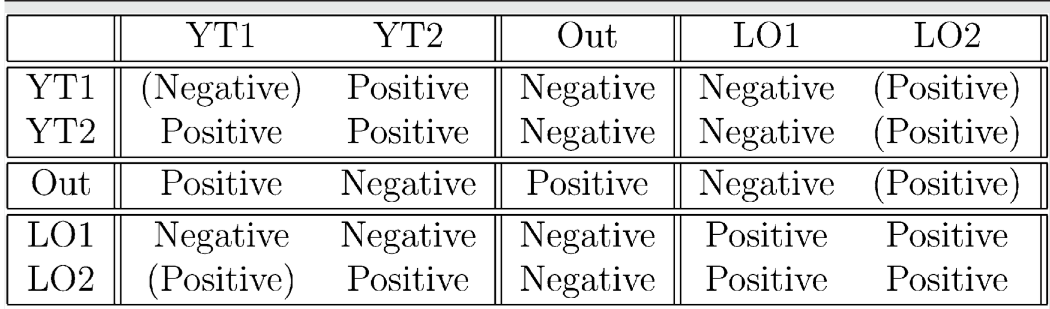 Table 1: The relaxed block structure for the Sampson data, highlighting nested sub-clusters and mediation.
2. The US Supreme Court (2006-2007)
In analyzing non-unanimous decisions, the authors compared the classic liberal/conservative split. The relaxed model proved superior because it accurately positioned Justice Kennedy as a bridge. While a structural balance model would try to force him into one camp, the relaxed model identifies his positive associations with members of both wings.
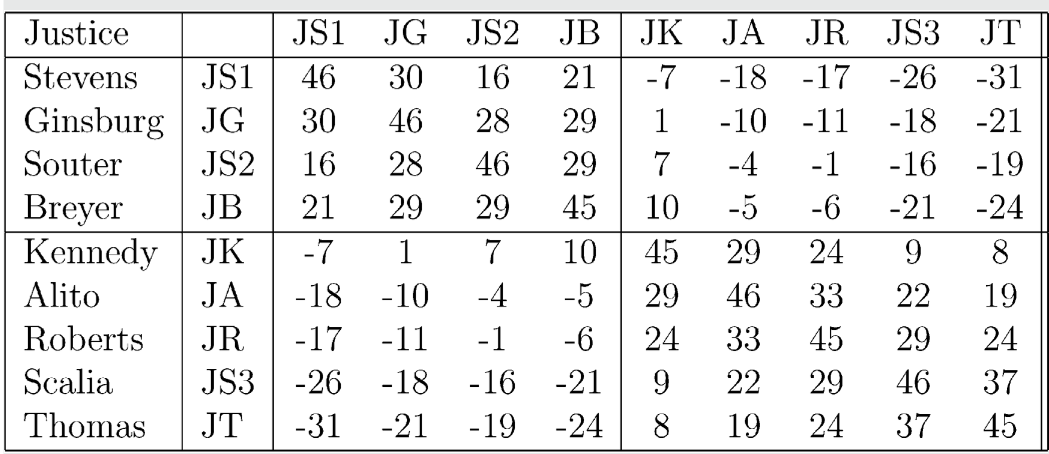 Table 2: Voting patterns among Supreme Court Justices showing the "swing" role of Justice Kennedy.
Critical Insights & Takeaways
The paper’s fundamental contribution is the shift from a single-process view (everything tends toward balance) to a multi-process view (balance competes with mediation, popularity, and hostility).
- Value: It provides a more nuanced tool for sociologists to interpret why groups don't fit the "us vs. them" mold.
- Limitation: As the authors prove in Theorem 4, the criterion function for the relaxed model declines monotonically as the number of clusters () increases. This means there is no longer a "mathematically unique" best , requiring researchers to use more substantive judgment or secondary criteria to determine the optimal number of groups.
- Future Work: The integration of null blocks (lean fit) remains a frontier. As social networks grow larger and sparser, the ability to recognize "no relationship" as a structural feature becomes even more critical.
In conclusion, by relaxing the "perfection" required by early social theorists, Doreian and Mrvar have provided a practical framework that finally acknowledges the structural utility of the mediator and the complexity of internal group strife.