
Beyond Keywords: Implementing Patient-Centered Search in Healthcare Forums
Patient-Centered Information Extraction for Effective Search on Healthcare Forum
The paper introduces a "Patient-Centered Information Extraction" framework designed for healthcare forums. It transitions from syntactic search units (posts/threads) to semantic units (individual patients) to improve the relevance of medical information retrieval.
TL;DR
Search in online healthcare forums is often a frustrating experience. You search for "Vitamin B6" and "Aggression," but you get posts that mention them separately for different people. This paper introduces a Patient-Centered Information Extraction system that shifts the search focus from words in a post to the actual experiences of a single patient across an entire conversation. By building a database centered on the person rather than the post, the system improves search relevance (F1-score) by over 25% compared to traditional methods.
The "Alignment" Problem in Medical Social Media
When a user searches a health forum, they aren't looking for a document; they are looking for a relationship (e.g., “Does this drug cause this side effect for someone like me?”).
The authors identify a fundamental "mis-alignment" in current technology:
- Post-based Search: Too narrow. If the symptom is mentioned in Post 1 and the treatment in Post 4, the match is missed (Low Recall).
- Thread-based Search: Too broad. It might match a symptom for "Participant A's son" and a treatment for "Participant B's mother" in the same thread (Low Precision).
The missing link is the Patient. To find meaningful correlations, all keywords in a query must refer to the same individual.
Methodology: Building the Semantic Patient Profile
The researchers developed a sophisticated pipeline to transform messy forum threads into a structured, patient-centric database.
1. The Extraction Pipeline
The system doesn't just look for keywords; it attempts to understand the "cast of characters" in a thread:
- Person Identification: Uses Stanford NLP and MetaMap (UMLS) to find names, pronouns, and familial terms like "son" or "mother."
- Person Resolution: This is the "secret sauce." It uses coreference resolution to link "Katie," "she," and "her" across multiple posts, even accounting for the "Reply-To" structure of forums.
- Patient Identification: It filters general people from actual patients using Semantic Role Labeling (SRL). A person is tagged as a patient if they are associated with actions like "taking pharmacologic substance" or "having a disease."
Figure: The system maps syntactic units (posts) to semantic units (patients) by aggregating scattered mentions into a single profile.
Experimental Results: Precision meets Recall
The team evaluated their system using real queries from an epilepsy forum (e.g., "Vitamins to help with aggression?").
Key Performance Metrics:
| Method | Precision | Recall | F1-Score |
|---|---|---|---|
| Post-based | 0.995 | 0.326 | 0.491 |
| Thread-based | 0.417 | 1.000 | 0.589 |
| Patient-based (This Work) | 0.851 | 0.674 | 0.752 |
The results (Table 5 in the paper) prove that by identifying the patient, the system avoids the "noisy" matches of thread-based search while capturing the "scattered" information that post-based search misses.
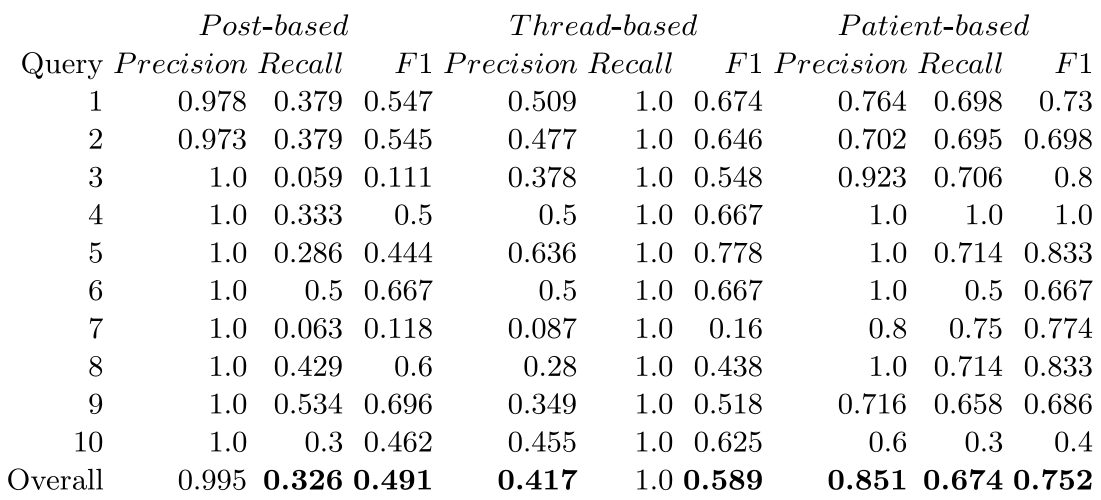 Figure: Comparative analysis showing the superior F1-measure of the patient-centered approach across 10 diverse medical queries.
Critical Insight & Future Outlook
The brilliance of this work lies in its Inductive Bias: the assumption that medical forum searchers are interested in individual case studies rather than just topic presence.
Limitations:
- Slang and Acronyms: The system struggled with forum shorthand like "DD" (Dear Daughter).
- NLP Fragility: It is highly dependent on the accuracy of the underlying coreference resolution tools, which can fail in informal, conversational text.
The Future: Imagine this system integrated with an LLM (like GPT-4). Instead of a keyword database, the patient-centered extraction provides the Grounding Content for Retrieval-Augmented Generation (RAG), allowing users to ask, "Show me summaries of patients who tried Keppra but switched to B6." This paper laid the semantic groundwork for that exact future.
Conclusion
By treating the "Patient" as the primary unit of data, Liu and Chen have demonstrated that understanding the subject of a sentence is just as important as understanding the keywords. This is a significant step toward making the vast, disorganized knowledge of health communities accessible to those who need it most.