
Engineering the Crowd: A Pattern-Based Approach to Complex Workflows
Pattern-Based Specification of Crowdsourcing Applications
The paper proposes a pattern-based framework for designing and deploying complex crowdsourcing workflows using the CrowdSearcher system. It formalizes crowd activities into elementary tasks (e.g., classifying, sorting) and orchestrates them through composition patterns, achieving SOTA-level control in human-computation pipelines.
TL;DR
This paper addresses the challenge of scaling human computation by rethinking crowdsourcing as a structured workflow of interacting tasks rather than isolated micro-jobs. By introducing a formal library of Intra-Task and Workflow Patterns, and implementing them via the CrowdSearcher system, the authors demonstrate how reactive rules and data-driven flow control can significantly boost the quality and speed of human-in-the-loop applications.
Problem & Motivation: The Complexity Wall
Crowdsourcing has evolved beyond simple labeling. Modern applications require complex reasoning—yet, human performers are most effective at simple, atomic units of work. The gap lies in orchestration.
Current systems suffer from:
- Control Flow Rigidity: Most platforms use imperative scripts that are hard to adapt mid-execution.
- Data Isolation: Difficulty in passing context or refined results from one set of workers to another.
- Quality Bottlenecks: Over-reliance on simple majority voting instead of procedural validation.
The authors argue for a "Data-Driven Workflow" perspective, where data objects are transformed through a graph of tasks, managed by a centralized Control Mart.
Methodology: Patterns and Reactive Control
The paper categorizes crowdsourcing into a hierarchy of patterns that can be composed like building blocks.
1. Task Taxonomy
- Intra-Task Patterns: These manage how a single objective (e.g., sorting a dataset) is split into micro-tasks. Examples include SortByTournament and StaticAgreement.
- Workflow Patterns: These define the "social business logic" between different task types, such as the Create/Decide (iterative generation and voting) or Find/Fix/Verify patterns.
2. The Reactive Engine
The technical backbone is the Control Mart, which stores task state and performer metrics. It uses ECA (Event-Condition-Action) rules to trigger actions:
- Event: A performer submits a classification.
- Condition: Has the "Agreement Threshold" of 3 been reached?
- Action: Close the object and stream it to the next task in the workflow.
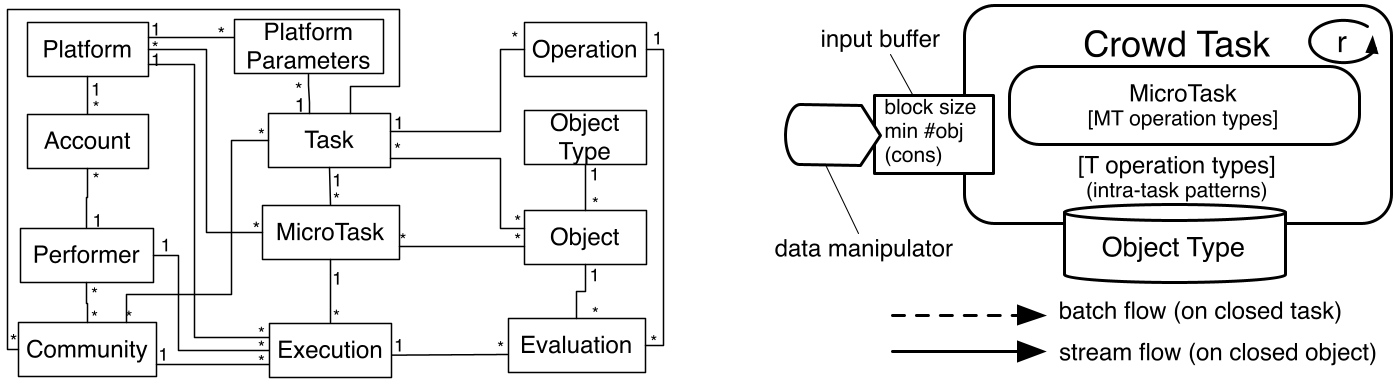 The Task Model: Mapping abstract operations to platform-specific micro-tasks via a controller.
Experiments: The Value of Workflow Design
The authors validated their framework using movie scene annotation tasks on Amazon Mechanical Turk.
Streaming vs. Batch Flows
Does "streaming" (passing objects one by one as they are finished) beat "batching" (waiting for all objects to finish)?
- Result: Streaming allows for synchronous activation, making the workflow feel more "live," but surprisingly didn't significantly change the total project duration because batch tasks attract more workers at once on platforms like AMT.
Validation Strategies
The paper compared simple internal agreement (majority vote) against workflow-level validation (a second task to check the first).
- Top Performance: The A5 Configuration (Majority Voting @ 2 for validation) achieved a 0.97 F-Score, proving that a separate "Decide" stage is superior to just adding more replicas to a "Create" stage.
 Table 2: Comparison of different actor identification configurations. Note that over-complicating workflows with feedback loops (A6) can actually decrease performance due to overhead.
Critical Insight & Conclusion
The most striking takeaway is that Workflow Design > Intra-task Optimization. Instead of spending more on "Gold Standards" or complex consensus algorithms for a single task, researchers should focus on how tasks interact.
However, there is a "Complexity Ceiling." The authors found that Configuration A6, which included a feedback loop (notifying creators of errors), was actually less efficient and more expensive. This suggests that while human workflows should be "smart," they must remain "lean" to avoid the overhead of constant re-planning.
Future Outlook: As we move into the era of LLMs, these patterns are highly relevant for RLHF (Reinforcement Learning from Human Feedback), where the interaction between human "rankers" and AI "generators" is essentially a high-stakes version of the Create/Decide pattern discussed here.