
PCAPLib: Navigating the Privacy-Utility Trade-off in Real-World Network Tracing
15829_PCAPLib A System of Extracting, Classifying, and Anonymizing Real Packet Traces.
PCAPLib is an automated system for extracting, classifying, and anonymizing real-world network packet traces. It leverages Active Trace Collection (ATC) and deep packet anonymization (PCAPAnon) to provide high-quality, privacy-preserving datasets for network research, achieving up to 96% anonymization efficiency.
TL;DR
PCAPLib is a robust framework designed to solve the "data drought" in network security research. By combining Active Trace Collection (ATC) with Deep Packet Anonymization (PCAPAnon), it extracts real traffic from live networks, classifies it automatically using security appliances, and sanitizes sensitive data across hundreds of protocols. It maintains a staggering 96% efficiency in balancing privacy protection with the utility needed for scientific analysis.
Problem & Motivation: The Empty Repository
For network researchers, high-quality packet traces are gold. However, current repositories like CAIDA or DARPA face a "trilemma":
- Scale vs. Organization: Manual categorization cannot keep up with backbone traffic volumes.
- Privacy vs. Utility: Standard anonymization (like
tcpdpriv) often strips payloads entirely, making the data useless for Intrusion Detection System (IDS) evaluation. - Realism vs. Control: Synthetic/emulated traces (like ISCX) lack the messy, diverse nature of real-user behavior.
The authors observed that existing tools like tcpanon were limited to a handful of protocols (HTTP/FTP), leaving specialized or binary protocols completely exposed or truncated.
Methodology: The Core Engine
PCAPLib operates through a two-pillar architecture that ensures both the "meaning" and the "privacy" of the data are preserved.
1. Active Trace Collection (ATC)
Instead of relying on human labels, ATC uses "Domain Knowledge" by replaying raw traffic through various Devices Under Test (DUTs) like Cisco or McAfee appliances. When a device triggers an alert, the system identifies the "anchor packet" and extracts the entire associated session. This ensures the repository is always populated with accurately labeled, relevant traffic (e.g., distinguishing between a benign Web session and a SQL injection attack).
2. PCAPAnon: Semantics-Preserving Anonymization
The real breakthrough lies in how PCAPLib handles payloads. It leverages Wireshark’s 800+ protocol dissectors to parse traffic.
- Length-Semantics-Preserving (LSP): If the system finds an email address, it replaces it with another valid-format email address of the exact same length.
- Length-Prefix-Preserving (LPP): It ensures IP addresses in ASCII (text) format maintain their original length and prefix characteristics.
Why keep the length? Because many IDS signatures and statistical traffic classifiers rely on packet size and offset. By preserving length, PCAPLib ensures that anonymized traffic remains "identifiable" as an attack by security systems, maintaining its utility.
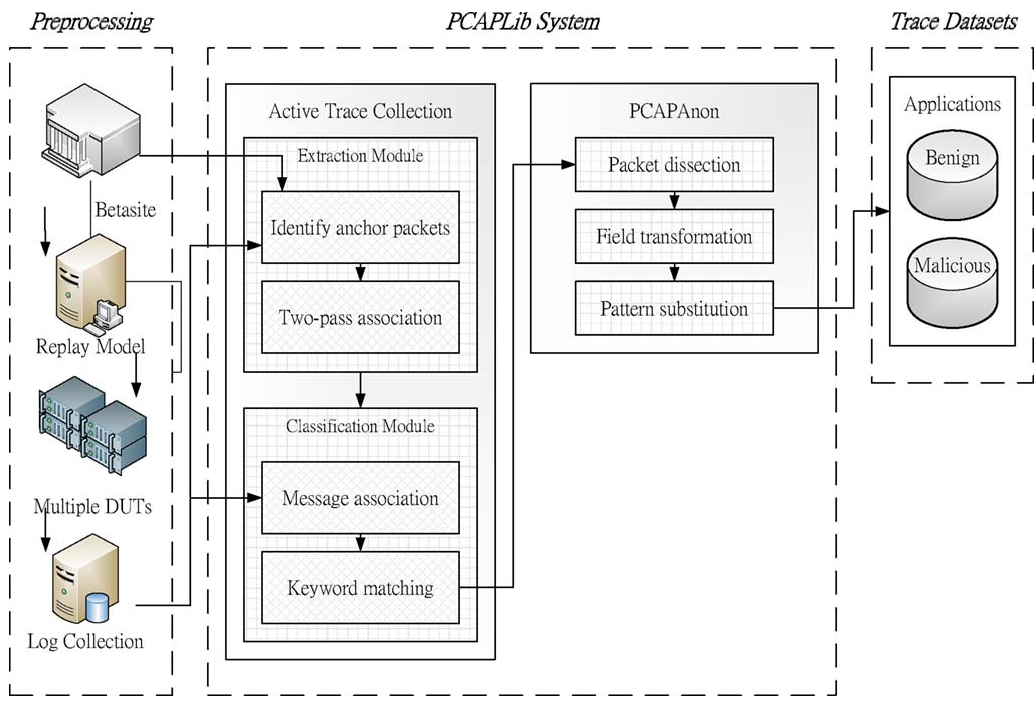 Figure 1: The PCAPLib System Overview, showing the flow from raw traffic to the classified, anonymized repository.
Experiments & Results: Proving Efficiency
The authors evaluated PCAPLib against anontool and tcpanon using 318 traces. They defined a unique Efficiency Metric—the harmonic mean of Privacy (percentage of sensitive fields hidden) and Utility (percentage of attacks still detectable).
- PCAPLib Efficiency: 96%
- tcpanon Efficiency: 52%
- anontool Efficiency: 43%
While other tools failed due to poor protocol support or simple pattern matching, PCAPLib's use of real protocol trees allowed it to find sensitive fields deep within complex binary and text protocols.
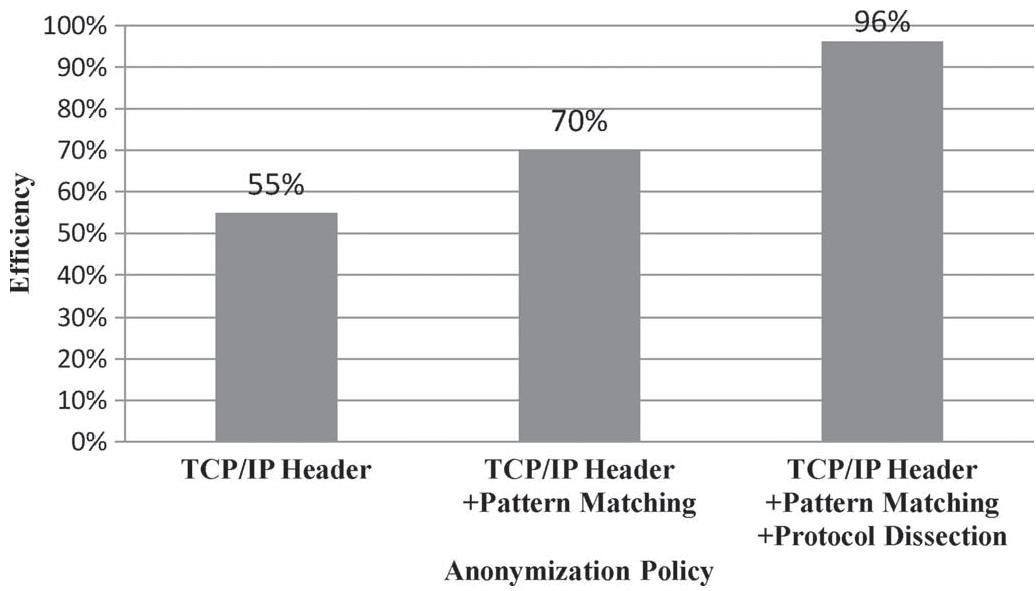 Figure 2: Performance metrics highlighting the superior balance between Privacy and Utility achieved by PCAPLib.
Critical Analysis & Conclusion
Takeaway: The "Golden Mean" of network tracing is reached not by hiding everything, but by hiding identities while preserving structures. PCAPLib successfully demonstrates that modular protocol parsing is the only way to handle the "Long Tail" of Internet protocols.
Limitations:
- Encrypted Traffic: PCAPLib cannot currently anonymize encrypted payloads (e.g., HTTPS/SSL) beyond truncating them or hiding metadata, which is a growing segment of modern traffic.
- Source Diversity: Since the data source is a single university campus (BetaSite), the traces might lack the geographical diversity found in global backbone datasets.
Future Outlook: As Internet traffic becomes increasingly encrypted, the next frontier for PCAPLib will likely involve integration with SSL-intercept proxies or the use of Selective Encryption strategies to maintain utility in an HTTPS-only world.