
Peak-Aware Online Dispatching: High-Stakes Decision Making in Microgrids
Peak-Aware Online Economic Dispatching for Microgrids
This paper introduces peak-aware online economic dispatching algorithms (BED and RED) for microgrids to minimize operating costs under hybrid time-of-use and peak-based pricing. By employing a "rent-or-buy" layering approach, the researchers achieve theoretical best-possible competitive ratios of 2-β (deterministic) and e/(e-1+β) (randomized).
TL;DR
Microgrid operators face a daily gamble: use expensive local generators now, or risk a massive one-time "peak charge" from the central grid later. This paper introduces BED and RED, two online algorithms that solve this "rent-or-buy" dilemma with mathematical precision. By ignoring unreliable forecasts and focusing on "break-even" thresholds, these methods reduce annual operating costs by over 17%, achieving the theoretical limits of online efficiency.
The "Peak" Problem: A 100x Multiplier
In a conventional grid, you pay for what you use (volume). In a microgrid (like a university or data center), you also pay for your peak usage. Utilities like PG&E charge peak prices that are often 118 to 227 times higher than the standard spot price.
The challenge? You only find out what your peak was at the end of the month. If you lean on the grid once during a demand spike, you pay that massive fee for the entire billing cycle. Existing "peak-oblivious" algorithms fail because they only try to save pennies on the spot price while ignoring the hundreds of dollars in peak charges.
Methodology: The Layering Logic
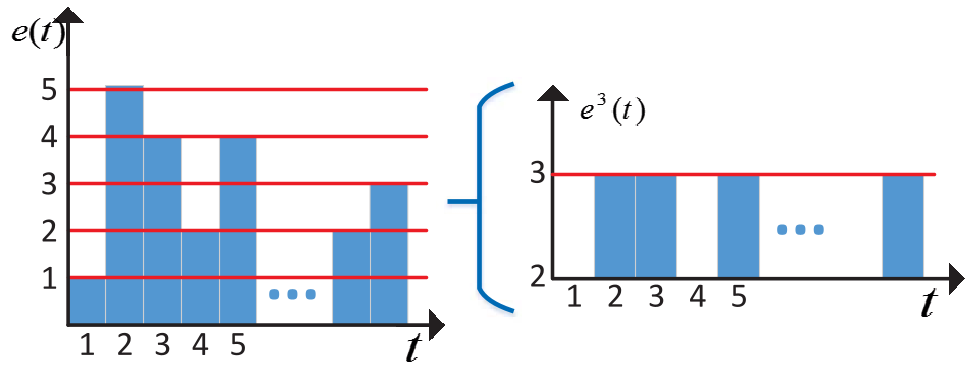
The authors treat the electricity demand not as a single wave, but as a stack of 1-unit layers. This allows them to apply a Divide-and-Conquer strategy.
- Net Demand Layering: Each unit of demand is treated as a sub-problem.
- The "Rent-or-Buy" Analogy: Think of it like a ski rental. Do you rent skis every day (pay local generation cost ) or buy them (pay the one-time peak charge and then use the cheaper grid spot price )?
- Break-Even Point (BED): The deterministic algorithm (BED) switches to grid power only when the accumulated cost of local generation for that layer exactly matches the cost of the peak charge.
Experimental Performance: Near-Offline Optimality
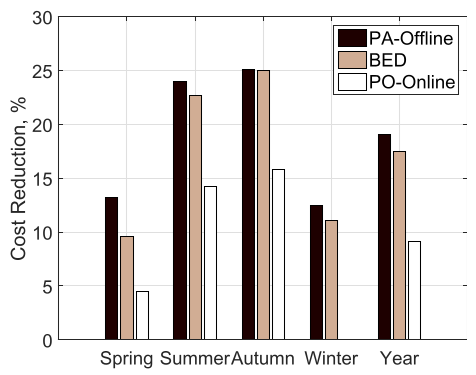
The researchers tested their algorithms against real San Francisco demand traces. The results were striking:
- Cost Reduction: BED reduced annual costs by 17.49%, whereas peak-oblivious models only managed 9.08%.
- Prediction Insensitivity: Surprisingly, giving the algorithm a 24-hour "look-ahead" window only improved performance by <1%. This proves the "Break-Even" logic is robust enough to handle uncertainty without complex forecasting models.
Deep Insight: The Capacity Trap
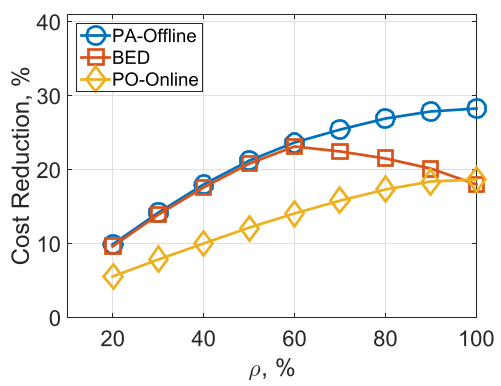
One of the paper's most counter-intuitive findings is the Critical Capacity issue. In an offline world, more generator capacity is always better. In an online world, if your local generation capacity is too high, the algorithm might spend too much money over-utilizing those generators to avoid a peak that was never going to be that high anyway.
As shown in the figure below, cost reduction actually decreases once capacity exceeds a certain threshold. Offline optimality stays flat, but online efficiency drops because the algorithm "tries too hard" with the extra resources.
Conclusion & Key Takeaways
This work shifts the focus of microgrid management from "How do we predict the future?" to "How do we manage the price of uncertainty?".
- Peak-awareness is non-negotiable: If your strategy doesn't account for , you are leaving nearly 10% of your budget on the table.
- Algorithm over Hardware: Simply building a bigger generator generator isn't a silver bullet; without the right dispatch logic, it can actually increase your costs.
- Robustness: The 2-β competitive ratio provides a mathematical safety net, ensuring the microgrid never pays more than roughly double the absolute minimum cost, no matter how chaotic the weather or demand.